
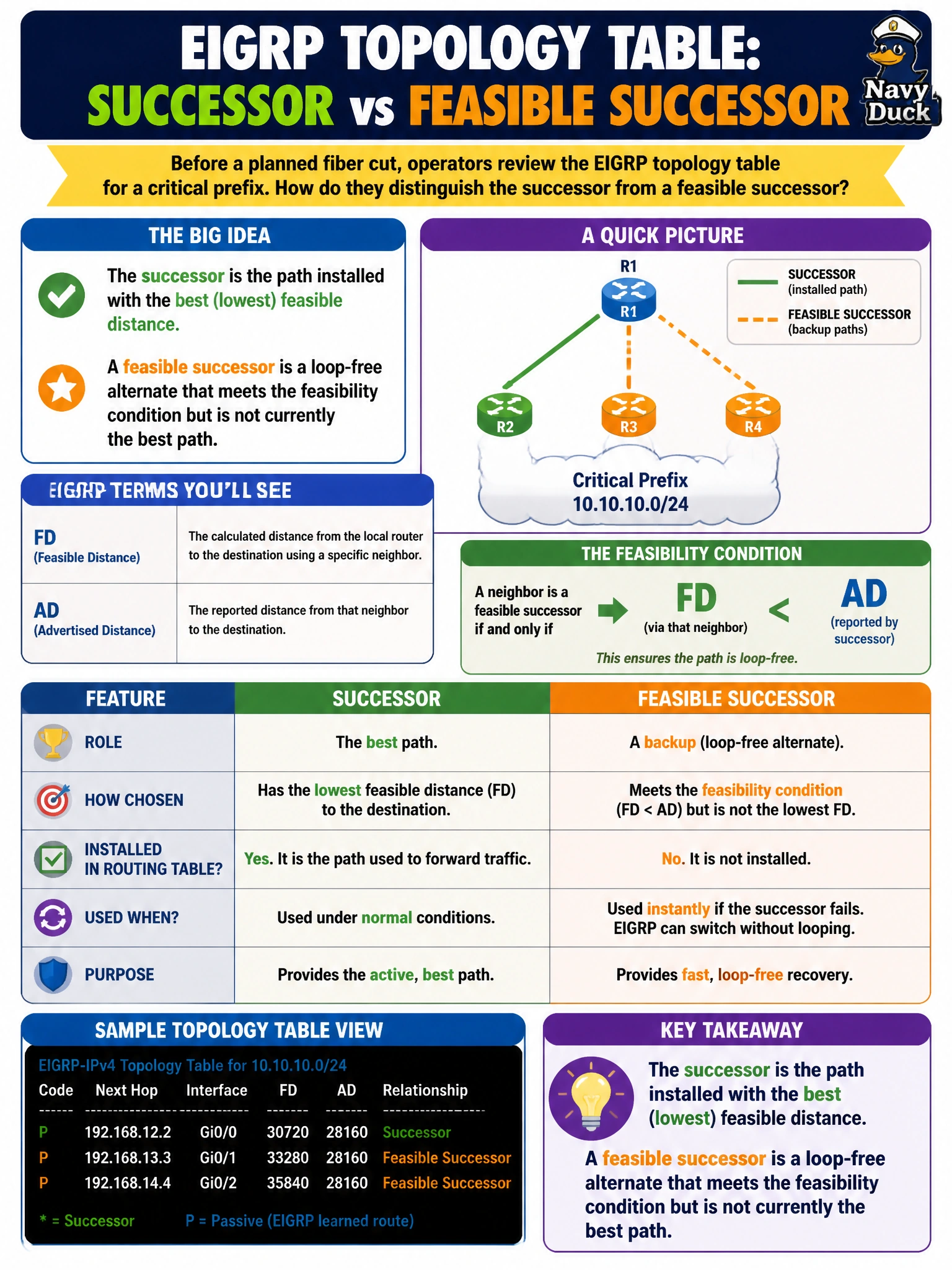
Before a planned fiber cut, a parks department reviews the EIGRP topology table for a critical prefix. How should operators distinguish the successor from a feasible successor?
Select an answer to reveal the explanation.
Short Explanation
Successor is the star player in the lineup—the best FD path actually forwarding. Feasible successor is the warmed-up backup that already passed the loop-free tryout. Parks staff check both in the topology table before cutting fiber.
Full Explanation
In the EIGRP topology table, the successor is the path with the best (lowest) feasible distance and is the route installed for forwarding (subject to maximum-paths for ties). A feasible successor is a loop-free alternate that meets the feasibility condition (neighbor RD < successor FD) but is not currently the best path; it remains ready for fast convergence if the successor fails. Parks department operators reviewing topology before a fiber cut should identify both: who forwards now (successor) and who can take over without an active query in many cases (FS).
Claiming the successor is always the path with the highest reported distance fails by concept: lower FD wins, and RD is evaluated against FD for FS eligibility, not as “highest RD wins.” Claiming feasible successors appear only in the BGP table fails—FS is an EIGRP topology concept visible in show ip eigrp topology. Claiming any topology-table path is already in the RIB as an equal-cost successor fails because non-successor and non-FS entries can appear in the topology table without being forwarding entries.
Exam caveat: absence of an FS means successor loss may go active and query; do not assume every listed next hop is an FS. Operational check before the parks fiber cut: for each critical prefix, record successor, FD, FS entries and their RDs, confirm RD < FD for each FS, and note which remote hub becomes primary after the cut.