
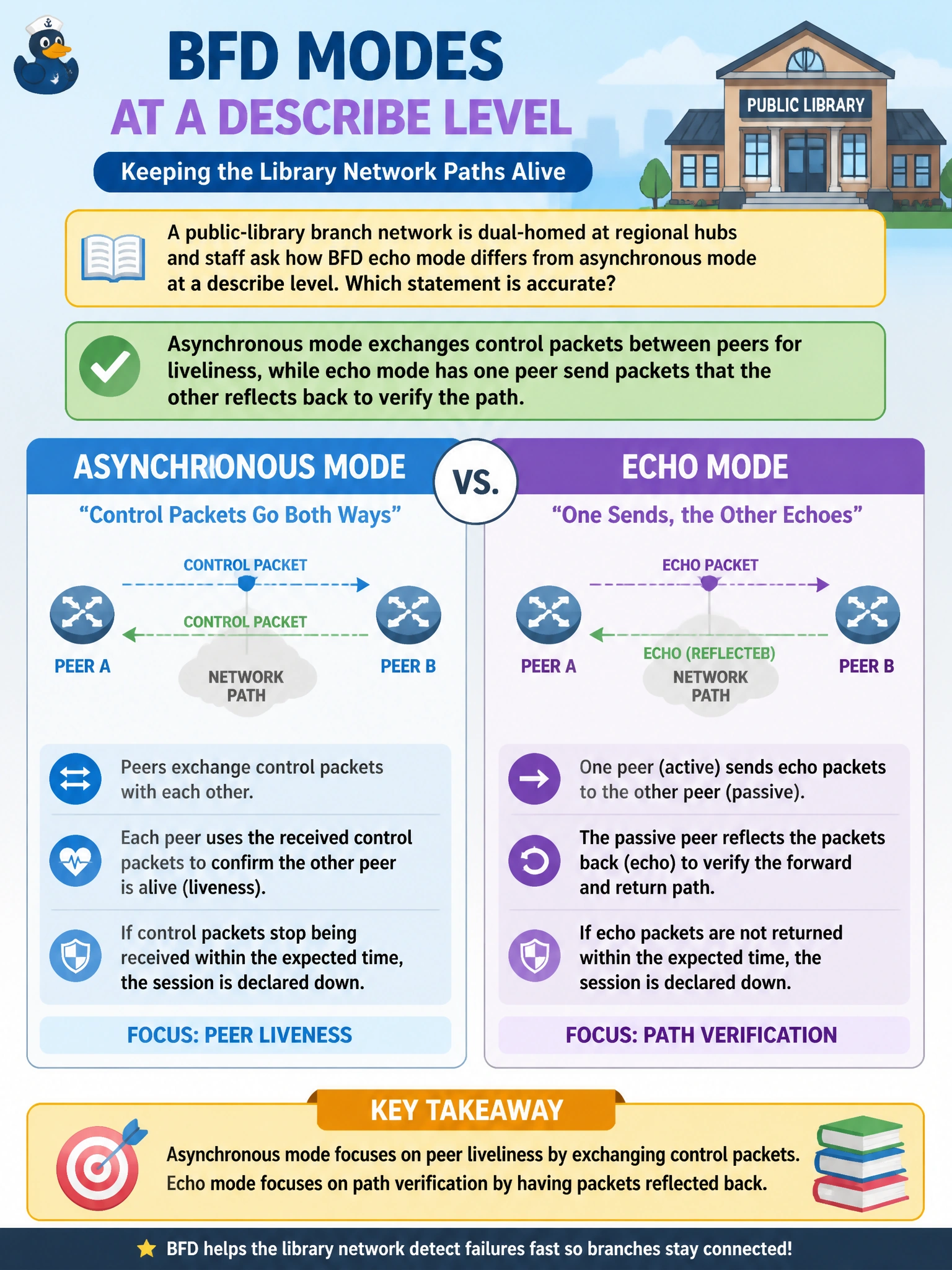
A public-library branch network is dual-homed at regional hubs and staff ask how BFD echo mode differs from asynchronous mode at a describe level. Which statement is accurate?
Select an answer to reveal the explanation.
Short Explanation
Think of a library courier: asynchronous is two branches mailing each other "still open?" notes, while echo is one branch tossing a stamped postcard that the other just sends right back. Same idea—prove the path—different who writes the mail.
Full Explanation
At describe depth for a dual-homed public-library regional hub design, asynchronous BFD has each peer periodically send BFD control packets and expect control packets from its neighbor to declare liveliness. Echo mode instead has one device transmit packets that the peer reflects (loops back) so the sender validates the bidirectional forwarding path from its own transmissions and the echo returns. Both modes exist to detect path failure faster than IGP timers alone; they differ in who originates the continuous validation traffic and how the path is proven. Civic WAN edges between library hubs commonly use asynchronous mode; echo is an optional refinement when the platform and path support reflection.
Claiming echo mode runs only on Layer 2 switches and cannot protect router WAN adjacencies fails by concept: BFD echo is a router forwarding-path feature, not a switch-only LAN curiosity. Claiming asynchronous mode requires IPsec while echo works only inside MPLS L3VPN clouds invents transport dependencies ENARSI does not attach to these mode definitions. Claiming both modes disable the IGP and replace OSPF or EIGRP state machines fails because BFD is a client service to the routing protocols—it signals them; it does not replace neighbor state machines.
Exam caveat: mode names and high-level behavior are what the exam expects here—not exact default timers, echo source addressing minutiae, or every platform restriction. Operational check at the library hubs: confirm which BFD mode is configured on the dual-homed WAN interfaces, verify sessions are Up to each regional peer, and document whether echo is supported end-to-end before relying on it for adjacency protection.