
A county jail facilities IT team wants faster failure detection on a latency-sensitive 911 backhaul than default EIGRP hellos provide. Why prefer enabling BFD for the EIGRP neighbors over simply lowering EIGRP hello and hold timers aggressively?
Select an answer to reveal the explanation.
Short Explanation
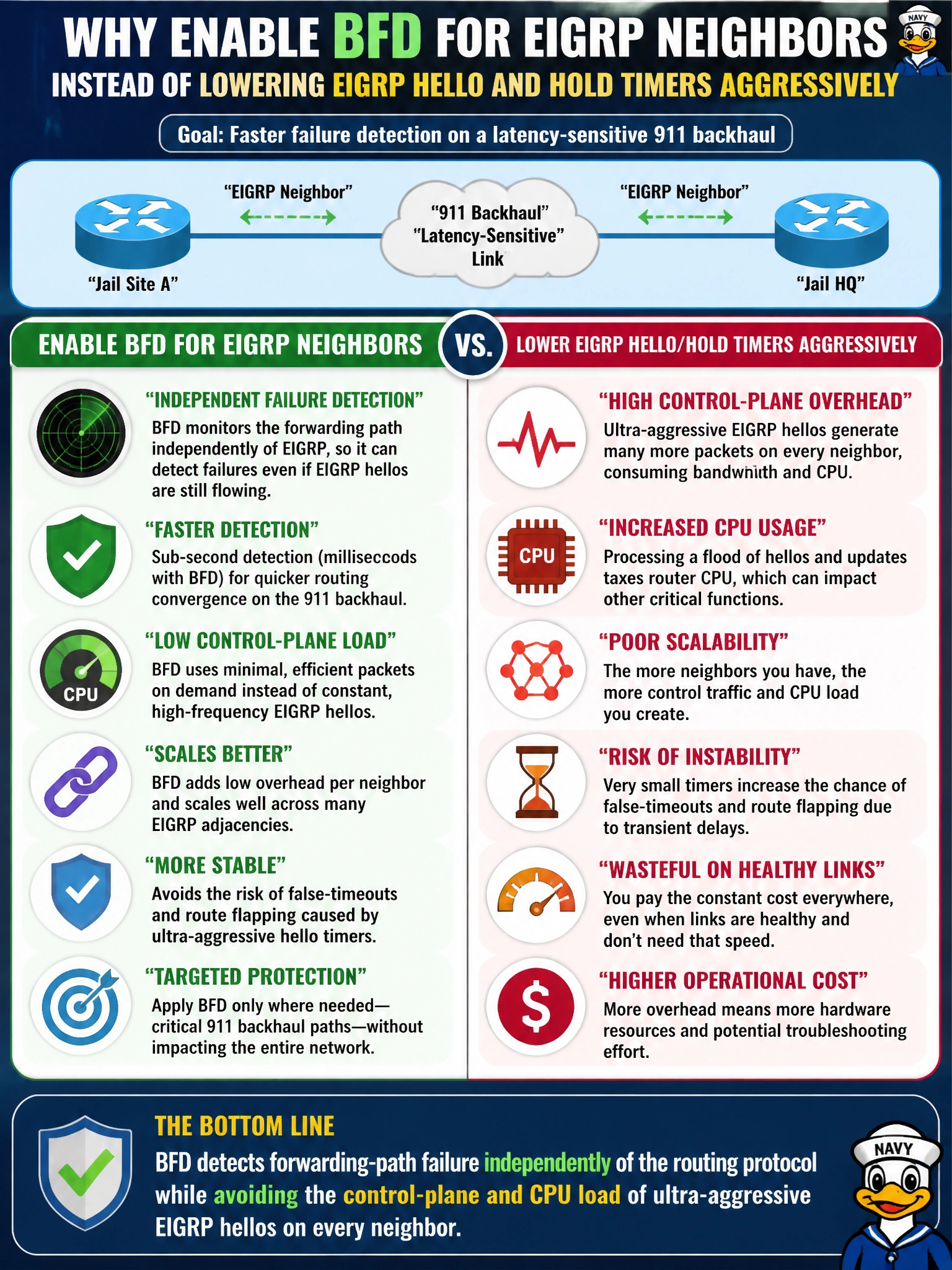
Picture a fire truck that still uses the radio for status, but also watches a dedicated heartbeat light on the road itself. BFD is that light—it notices the pavement break without forcing every EIGRP hello to scream every few milliseconds. You keep sane IGP timers and still get fast detection.
Full Explanation
BFD for EIGRP on a latency-sensitive county 911 backhaul supplies a lightweight, protocol-independent forwarding-path liveliness check that EIGRP can register as a client. When the BFD session drops, EIGRP tears down the neighbor quickly without relying solely on hello/hold expiry. That separation keeps IGP timers at sane values while still delivering fast failure detection on jail-facility and emergency WAN links where silent fiber or MetroE failures would otherwise leave the control plane believing the peer is healthy until hold timers expire. Aggressive EIGRP hello and hold timers can approximate faster detection, but they multiply control-plane packets and CPU work on every adjacency—costly on hubs with many civic neighbors.
Claiming BFD replaces EIGRP and removes any need for IGP hellos fails by concept: BFD is a detection client mechanism, not a replacement routing protocol; EIGRP still forms neighbors and runs DUAL. Claiming aggressive EIGRP timers automatically negotiate BFD without configuration fails because BFD must be enabled and bound to the EIGRP neighbors—timer tuning alone does not create BFD sessions. Claiming BFD works only with OSPF so EIGRP must rely on timer tuning fails because BFD is protocol-independent and is a standard ENARSI tool with EIGRP as well as OSPF.
Exam caveat: BFD improves detection of forwarding-path loss; it does not fix asymmetric routing, MTU black holes, or authentication mismatches that still prevent adjacency. Operational check on the county jail WAN: verify BFD sessions are Up for the EIGRP neighbors (show bfd neighbors / show eigrp neighbors detail as platform supports), confirm EIGRP hold timers remain reasonable, induce a controlled link failure in a change window, and measure neighbor teardown time against the pre-BFD baseline.