
A city traffic-operations center wants OSPF adjacency to drop quickly when a link fails silently between signal-ops routers. How does BFD integrate with OSPF for that outcome?
Select an answer to reveal the explanation.
Short Explanation
OSPF signs up as a BFD customer: when BFD yells that the path is dead, OSPF drops the neighbor without leisurely waiting out the dead interval.
Full Explanation
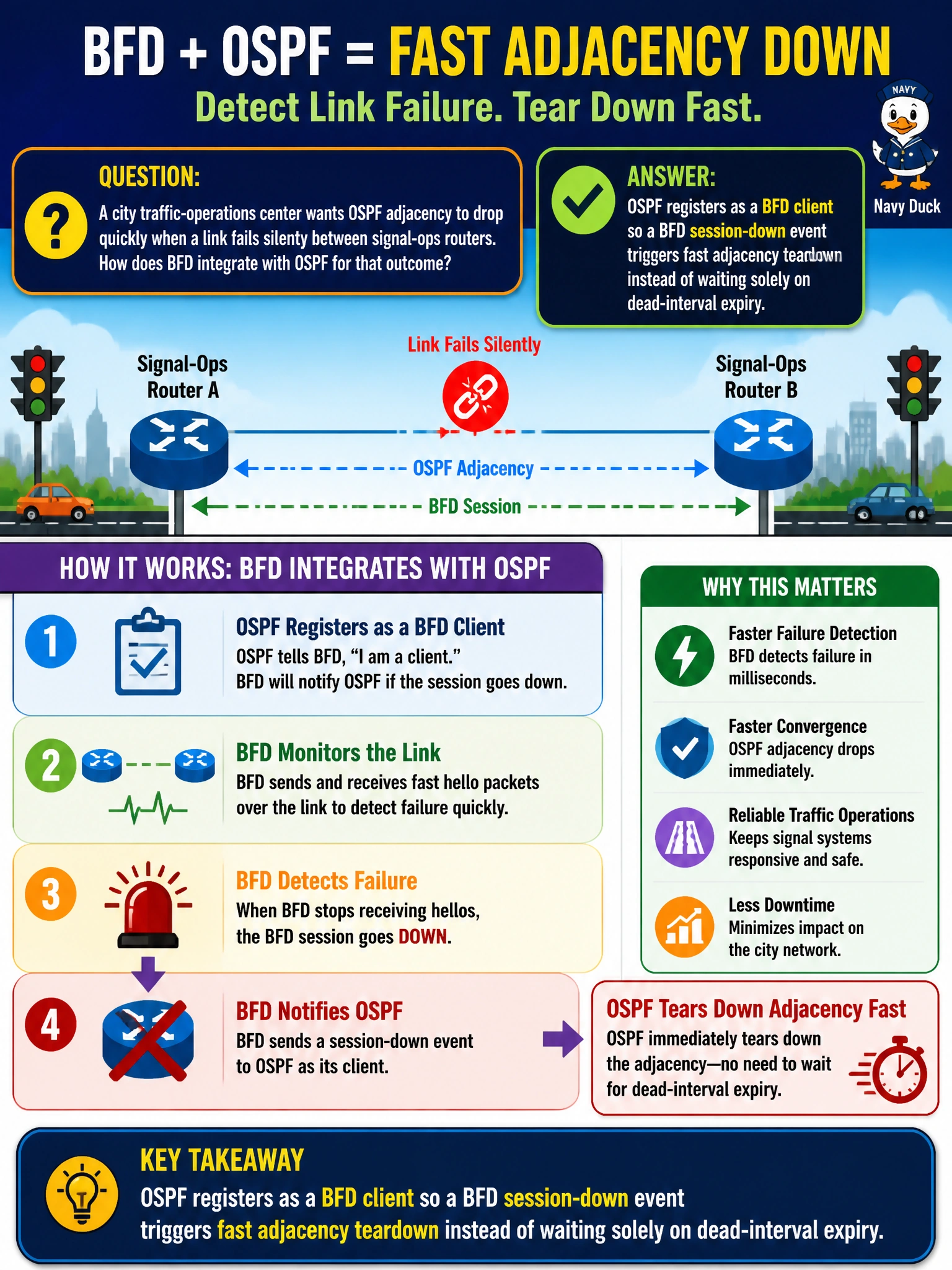
At the city traffic-operations center, OSPF integrates with BFD by registering as a BFD client. When the BFD session goes down because the signal-ops link fails silently, OSPF tears down the adjacency immediately instead of waiting solely for dead-interval expiry. That client/session-down signaling is how BFD delivers fast adjacency loss for OSPF on quiet failures that still leave the interface up at Layer-1/2 from the router’s perspective.
BFD does not rewrite OSPF network types from broadcast to non-broadcast based on loss exceeding one percent; network type is a configuration choice, not a BFD loss-percent side effect. OSPF does not ignore BFD and only shorten hellos when auto-cost reference-bandwidth changes—reference bandwidth affects cost calculation, not BFD client behavior. BFD does not convert OSPF Type-1 LSAs into Type-5 externals during fiber cuts; LSA types are unrelated to BFD failure detection.
Exam caveat: both sides need BFD configured and OSPF BFD enablement (ip ospf bfd / bfd all-interfaces patterns per platform). If BFD is down but OSPF hellos still flow on a partially broken path, understand which plane failed—BFD may use different hardware paths than hellos on some platforms.
Operational check: show ip ospf neighbor and show bfd neighbors before failure; pull the link or simulate silent loss; confirm adjacency drops in line with BFD detection rather than full dead-interval. Restore and verify both BFD and OSPF return without manual clear unless required by local procedure.