
A sanitation department runs EIGRP named mode across township hubs with non-uniform addressing and must choose a summarization approach. When is manual summarization safer than EIGRP auto-summary?
Select an answer to reveal the explanation.
Short Explanation
Manual summary is the tailored city map you draw on purpose; auto-summary is the old fold-along-the-classful-lines trick. Messy township addressing needs the tailored map.
Full Explanation
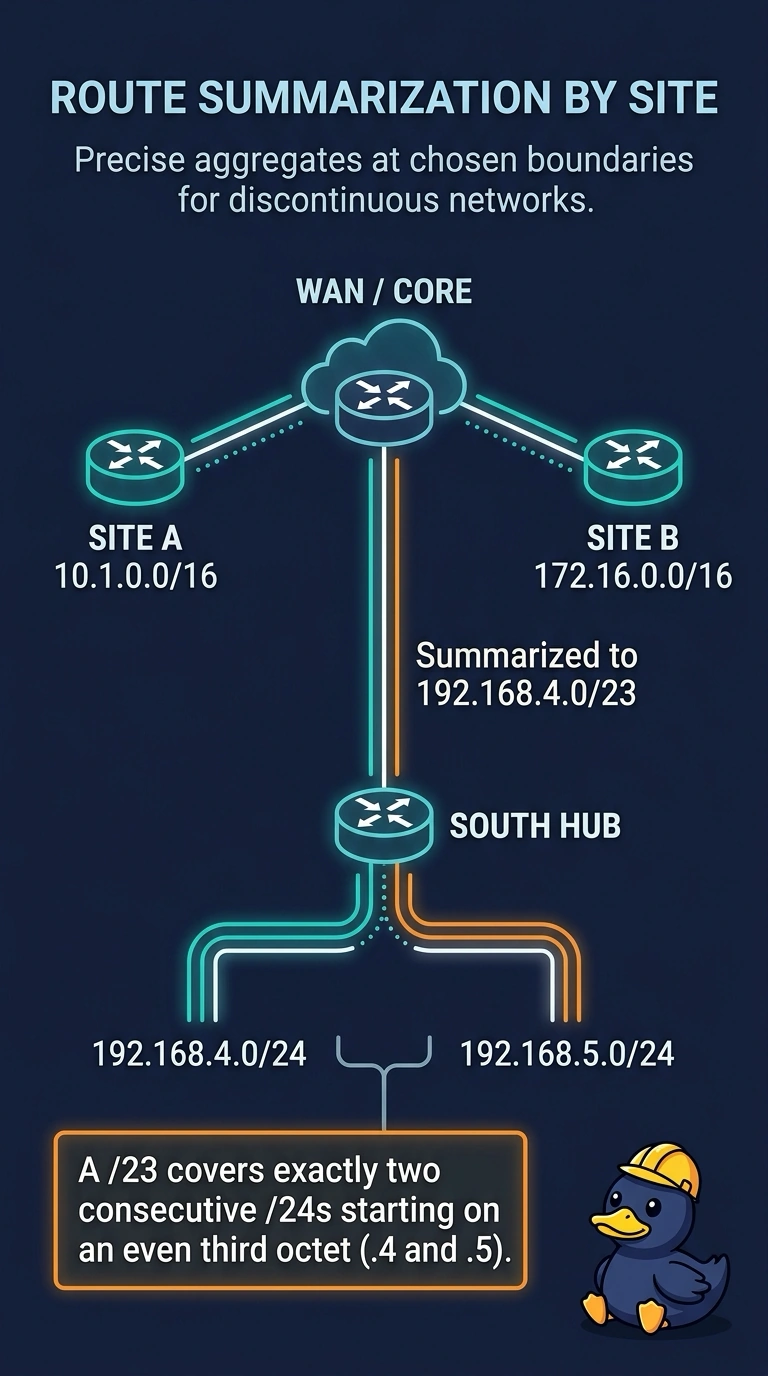
Manual EIGRP summarization is safer than auto-summary for the sanitation department when addressing is discontinuous or when operators need precise aggregates at chosen hub boundaries instead of classful major-network folds. Interface summary-address (or named-mode AF summary) lets the township place exactly the aggregates topology supports, avoiding false major-net claims across non-uniform civic blocks.
Manual summarization is not limited to “only when BGP route reflectors are disabled”; RR state is orthogonal to EIGRP summary design. CoPP for SNMP does not make auto-summary mandatory—CoPP protects the control plane and has no such coupling. Restricting manual summary to broadcast segments where BFD echo is disabled is an invented constraint; summary placement follows addressing and hierarchy, not BFD echo mode.
Exam caveat: even manual summaries install discard routes and can blackhole holes—manual is safer than auto-summary for discontinuous space, but still requires contiguous coverage under each advertised aggregate. Prefer summarization at hub/distribution boundaries the sanitation design controls.
Operational check: disable auto-summary, configure explicit summaries only where show ip route proves components are contiguous, verify null0 for the summary, and confirm spokes learn the aggregate without learning misleading major nets. Test a discontinuous subnet scenario in lab to demonstrate why auto-summary would have failed.