
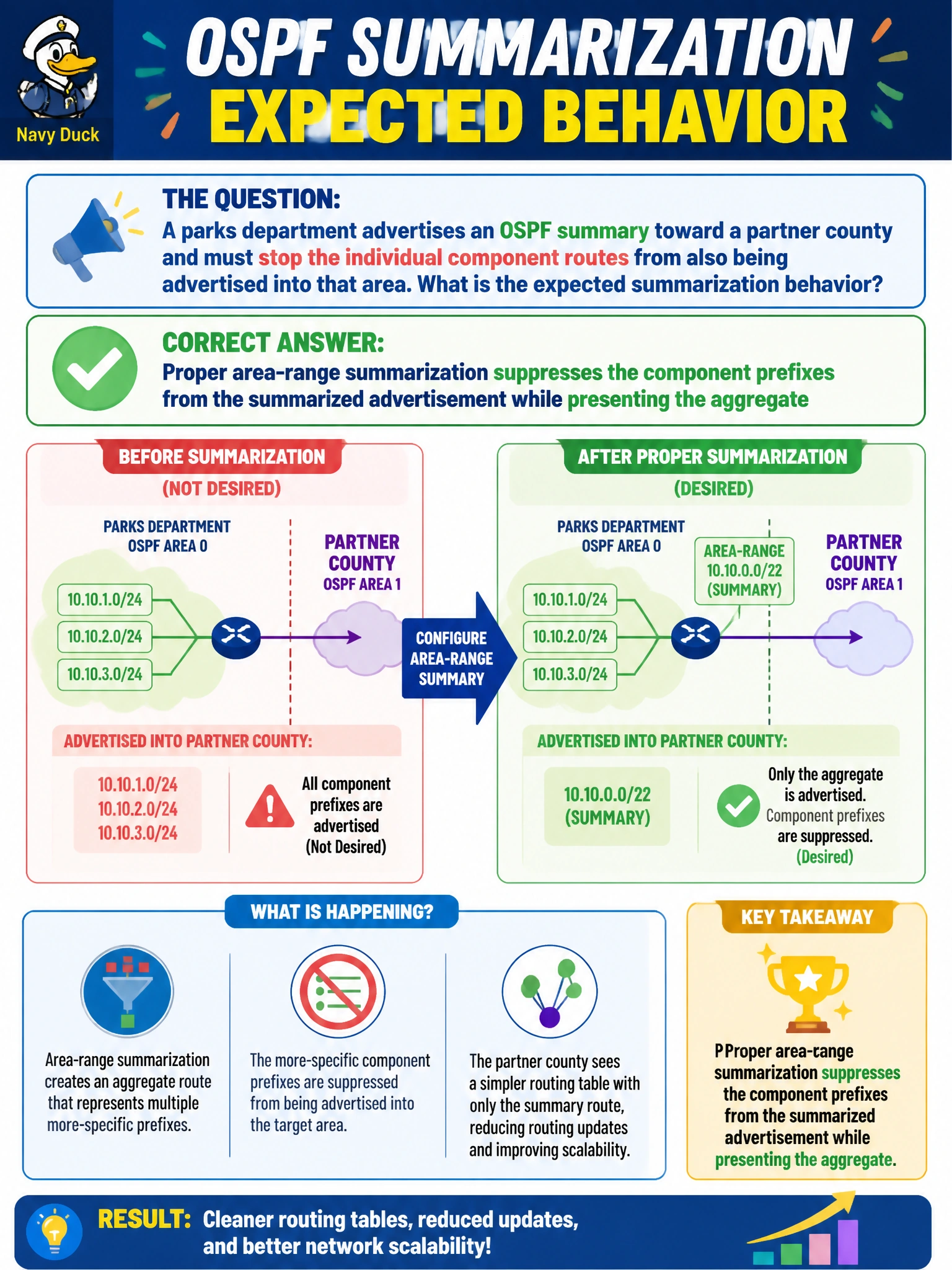
A parks department advertises an OSPF summary toward a partner county and must stop the individual component routes from also being advertised into that area. What is the expected summarization behavior?
Select an answer to reveal the explanation.
Short Explanation
Once the big parks sign goes up, the individual trail markers should not also spam the partner’s map. Good summarization suppresses those components on that advertisement.
Full Explanation
For the parks department advertising an OSPF summary toward a partner county, proper area-range summarization suppresses the component prefixes from that summarized advertisement while presenting the aggregate. Partners should see the concise summary, not every trail /24, which shrinks the LSDB and hides internal topology detail as intended.
Component routes are not rewritten as BGP communities and flooded unchanged by OSPF area-range logic—that confuses BGP community policy with OSPF summarization. Components do not receive AD 255 so neighbors install them as duplicates of the summary; AD is a local RIB preference concept, not how OSPF suppresses Type-3 components into the far area. The ABR should not freely flood both every /24 and the summary so partners can choose either equally—that defeats summarization; suppression of components on the summarized advertisement is the expected behavior.
Exam caveat: components remain known inside the source area; suppression applies to what is advertised into the far area via the summary. If both specifics and summary appear externally, check for additional ASBRs/ABRs, missing area-range, or redistribution paths leaking components another way.
Operational check: in the source parks area, confirm component LSAs/routes still exist as needed. On a partner-county ABR/backbone router, verify the aggregate is present and the individual /24s are absent from the inter-area advertisements. show ip ospf database and show ip route on both sides of the boundary provide the before/after proof.