
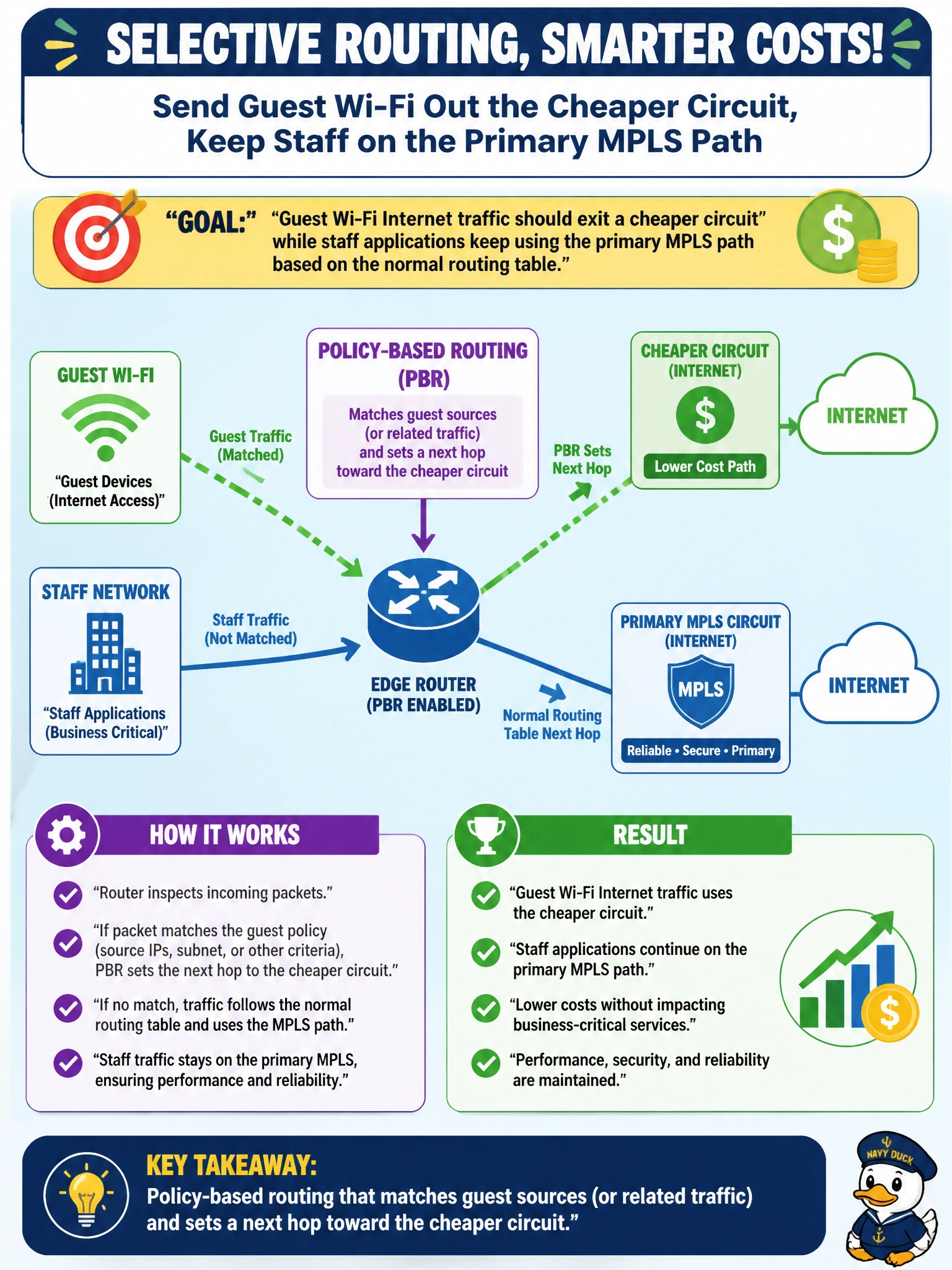
An emergency-management office wants guest Wi-Fi Internet traffic to exit a cheaper circuit while staff applications keep using the primary MPLS path based on the normal routing table. Which feature implements that selective override?
Select an answer to reveal the explanation.
Short Explanation
Destination routing is the highway everyone shares; PBR is the special lane for guest Wi-Fi that peels off to the bargain exit without rebuilding the whole map for staff apps.
Full Explanation
Policy-based routing is the feature that lets the emergency-management office send guest Wi-Fi Internet traffic out a cheaper circuit while staff applications continue to follow the normal destination-based RIB toward primary MPLS. PBR matches guest sources (or related classifiers) on the ingress path and sets a next hop or interface toward the cheap exit without rewriting the global routing table for everyone else.
Raising the AD of the MPLS default so guest users “randomly hash” to the cheap link is not selective—AD changes affect route preference broadly and do not classify guest versus staff flows. OSPF stub areas on the guest SSID do not make the MPLS path disappear in a controlled per-flow way and misuse area types for traffic steering. EIGRP variance might install multiple unequal-cost paths into the RIB for eligible successors, but it does not classify guest Wi-Fi versus staff applications or guarantee the cheap circuit only for guests.
Exam caveat: PBR is evaluated before normal routing for matched traffic on the interface where the policy is applied; unmatched packets still use the RIB. CEF and set ip next-hop verify reachability nuances matter on IOS XE—know set ip next-hop versus set ip default next-hop.
Operational check: apply the route-map on the correct guest ingress interface, match an ACL of guest subnets, set the cheap-circuit next hop, then verify with show route-map, show ip policy, and packet captures or NetFlow that guest flows egress the cheap link while staff flows still take MPLS per show ip route.