
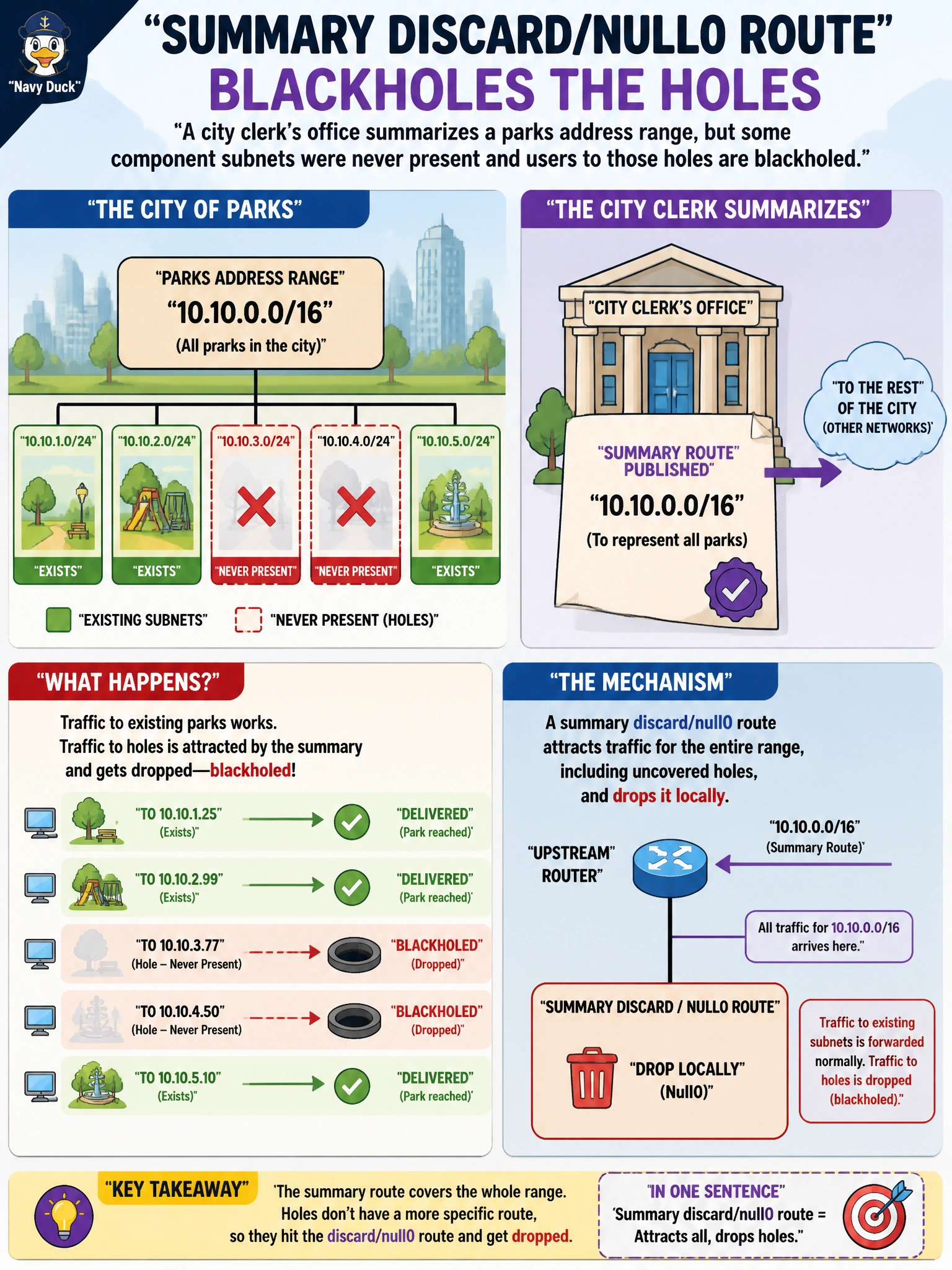
A city clerk’s office summarizes a parks address range, but some component subnets were never present and users to those holes are blackholed. What mechanism most directly explains that symptom?
Select an answer to reveal the explanation.
Short Explanation
When you advertise a summary with gaps, traffic to those missing subnets still matches the summary and reaches its discard route. Null0 drops it locally, creating the blackhole.
Full Explanation
When the clerk’s office advertises a parks summary that includes subnets never present, traffic to those holes still matches the summary rather than less-specific routes. The summarizing router installs a discard/null0 route for the summarized range, so packets for uncovered addresses are dropped locally. This directly explains the blackhole: the summary claims the range, null0 sinks the missing addresses, and users cannot reach those nonexistent parks subnets even when routing appears correctly summarized. BFD echoing on a summary next hop is liveliness detection; it does not force ICMP redirects into a loop or cause summary-hole drops. Raising OSPF reference bandwidth is a separate cost-calculation change and does not make all costs equal or create this symptom. Split horizon does not reflect an aggregate toward the parks LAN so that failed ARP resolution drops packets; that is not the direct summary-hole mechanism. Exam caveat: a summary blackhole for uncovered addresses is often working as designed. Use tighter summary masks, ensure component subnets exist before advertising, or avoid summarizing ranges with known holes. Distinguish a null0 discard on the summarizer from remote routers simply forwarding traffic toward a sink. Practical check: on the summarizing clerk-office router, inspect the route for the summary and confirm null0/discard; traceroute toward a missing component should end there. Compare with a present component subnet that forwards correctly to verify that only the holes are dropped.