
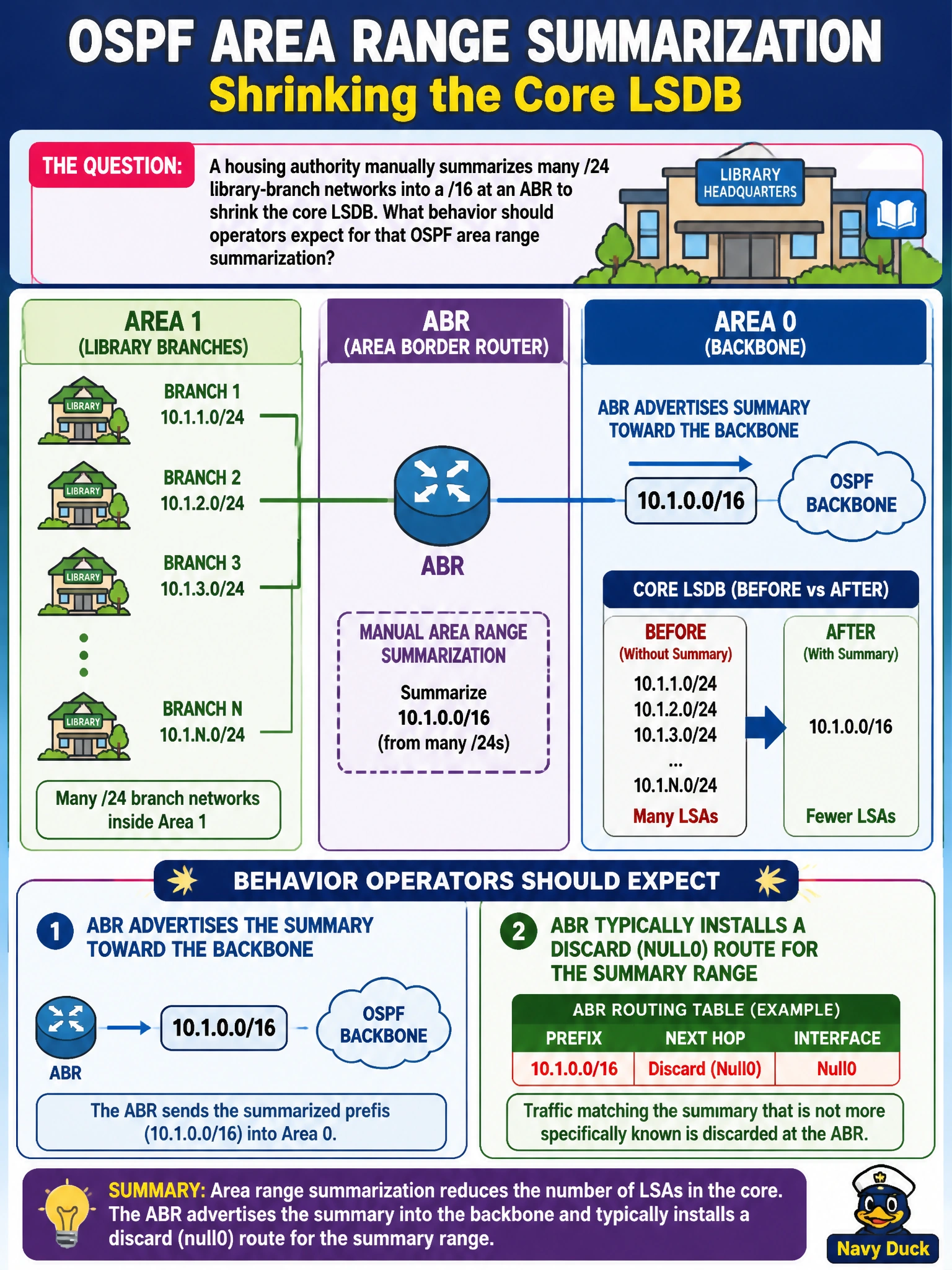
A housing authority manually summarizes many /24 library-branch networks into a /16 at an ABR to shrink the core LSDB. What behavior should operators expect for that OSPF area range summarization?
Select an answer to reveal the explanation.
Short Explanation
Summarizing at the ABR is like putting one big zip-code sign on the highway instead of listing every street. The router also plants a null0 ‘catch-all’ so leftovers do not wander the wrong way.
Full Explanation
When the housing authority configures OSPF area-range summarization for many /24 library-branch networks into a /16 at an ABR, the ABR advertises the summary into the backbone (or other far area) instead of flooding every component. IOS commonly installs a discard (null0) route for the summary range on the summarizing ABR so traffic destined to holes inside the advertised aggregate is dropped locally rather than following a default or longer path incorrectly. That combination—summary advertisement plus discard—is the behavior operators should expect for manual OSPF summarization at the ABR.
It is incorrect that every component /24 continues unchanged into the backbone while the /16 is ignored; successful area-range summarization suppresses those components from the summarized advertisement. The ABR does not convert each /24 into a Type-5 external merely because summarization was configured—Type-5s relate to ASBR redistribution, not ABR area ranges. OSPF does not auto-enable EIGRP-style auto-summary at the ABR; OSPF summarization is explicit (area range / summary-address as applicable), not a classful fold.
Exam caveat: the discard route appears when the summary is active and covering; if no component in the range is present, some platforms suppress the summary entirely depending on configuration. Holes inside an advertised summary are exactly where null0 blackholing shows up—plan addressing coverage carefully for library branches.
Operational check: on the ABR, verify the summary in the backbone LSDB, confirm a null0/discard entry for the /16 in show ip route, and ensure component /24s remain visible inside the source area as appropriate. From a backbone router, confirm only the aggregate is learned, not the individual library /24s.