
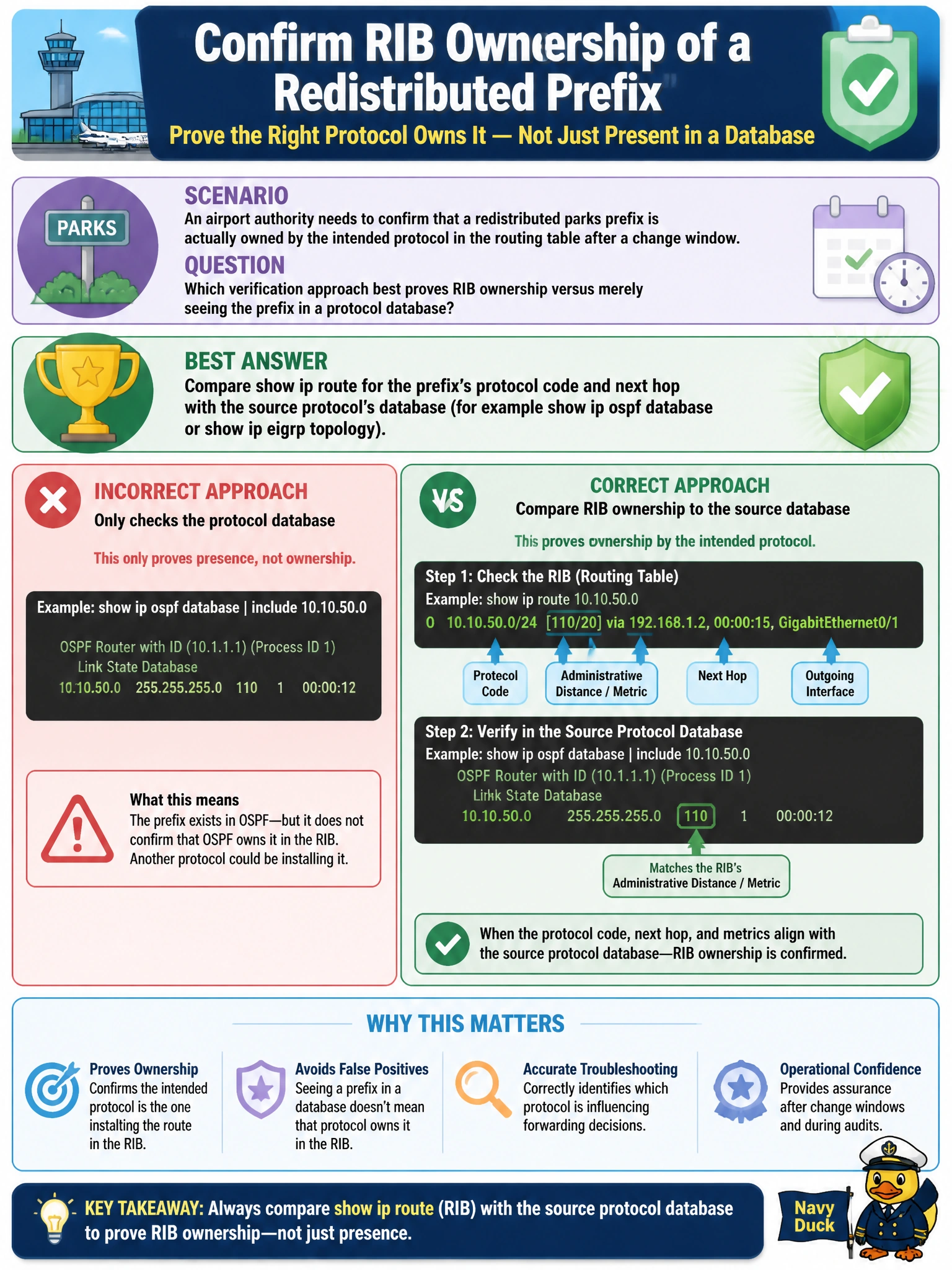
An airport authority needs to confirm that a redistributed parks prefix is actually owned by the intended protocol in the routing table after a change window. Which verification approach best proves RIB ownership versus merely seeing the prefix in a protocol database?
Select an answer to reveal the explanation.
Short Explanation
The RIB is the scoreboard and the protocol database is the dugout. You need both: the route installed with the right code, and proof the protocol actually knows that prefix.
Full Explanation
The airport authority’s goal after a change window is proving RIB ownership: the redistributed parks prefix must be installed under the intended protocol code with a correct next hop, not merely present in some protocol database. The strongest verification correlates show ip route (protocol code, AD/metric, next hop, outgoing interface) with the source protocol’s database—for example show ip ospf database or show ip eigrp topology—so operators see both that the protocol knows the prefix and that the RIB chose that protocol’s path.
Relying only on show ip protocols lists redistribute configuration knobs; it does not prove the parks prefix installed or which protocol owns it in the RIB. Clearing the ARP cache and re-pinging may restore Layer-2 adjacency symptoms but says nothing about which routing source owns the prefix after redistribution. Enabling debug ip packet detail widely is noisy, disruptive on production airport routers, and still fails to systematically prove controlled RIB ownership versus transient forwarding success.
Exam caveat: a prefix can exist in an OSPF LSDB or EIGRP topology yet lose the RIB to a better AD source; conversely, a RIB entry without a matching database entry after redistribution suggests misconfiguration or timing. Always check both planes.
Operational check: document the expected code (O E2, D EX, B, etc.), confirm next hop toward the intended redistribution boundary, and spot-check the originating database entry. If the RIB shows a different code than planned, inspect competing statics, AD tweaks, or a second redistribution point before declaring the change successful.