
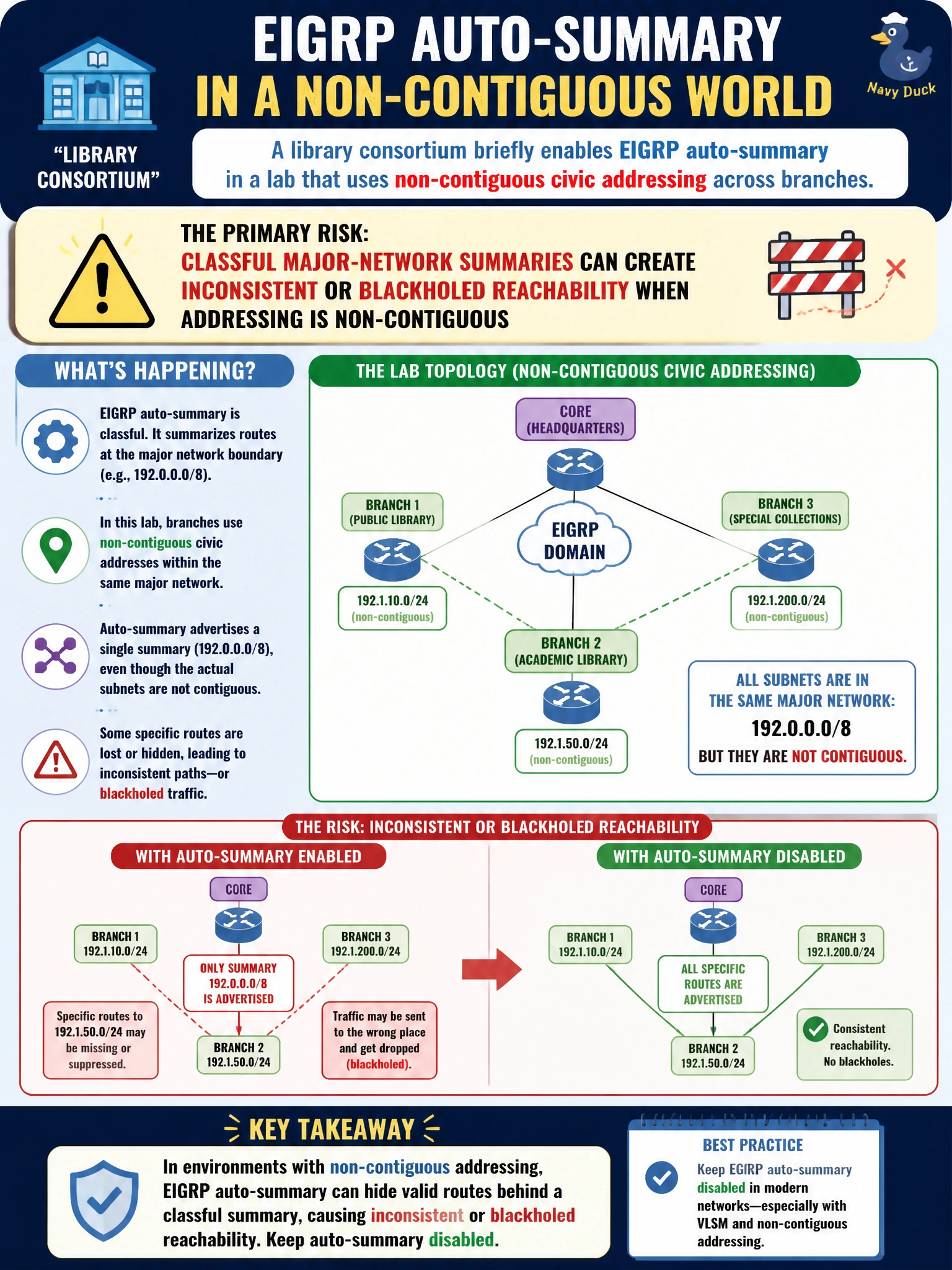
A library consortium briefly enables EIGRP auto-summary in a lab that uses non-contiguous civic addressing across branches. What is the primary risk of that auto-summary behavior?
Select an answer to reveal the explanation.
Short Explanation
Auto-summary is the old fold-the-map-into-classful-blobs habit. With non-contiguous city blocks, those blobs lie about what is really behind them—and traffic falls in the gaps.
Full Explanation
EIGRP auto-summary causes the library consortium’s routers to advertise classful major-network summaries at classful boundaries. With non-contiguous civic addressing across branches, those major-net advertisements can claim reachability that is not actually behind a given boundary, producing inconsistent routing or blackholes where traffic enters a summary that does not cover the real subnet placement. That is the primary risk: classful folds lie about topology when addressing is discontinuous.
Auto-summary does not force every branch into an OSPF NSSA or drop EIGRP neighbors by converting the domain to OSPF; the protocols remain separate unless redistribution is configured. It does not raise BGP local preference to 300 for internal EIGRP routes—local preference is a BGP attribute, not an EIGRP auto-summary side effect. It also does not disable split horizon or guarantee permanent loops on every LAN; split horizon remains an independent interface behavior, and while bad summarization can contribute to loops or blackholes, “guarantees permanent loops everywhere” is not the accurate primary risk statement.
Exam caveat: modern designs leave auto-summary disabled and use manual summary-address (or named-mode summary) only where addressing is contiguous and intentional. The exam loves discontinuous subnet scenarios as the classic reason auto-summary is dangerous.
Operational check: in the lab, enable auto-summary briefly, inspect advertised major nets with show ip eigrp topology / show ip route on peers, then place a discontinuous civic subnet and observe misdirected or dropped traffic. Disable auto-summary and replace with precise manual aggregates at known-safe boundaries, rechecking that branch prefixes remain reachable without false major-net claims.