
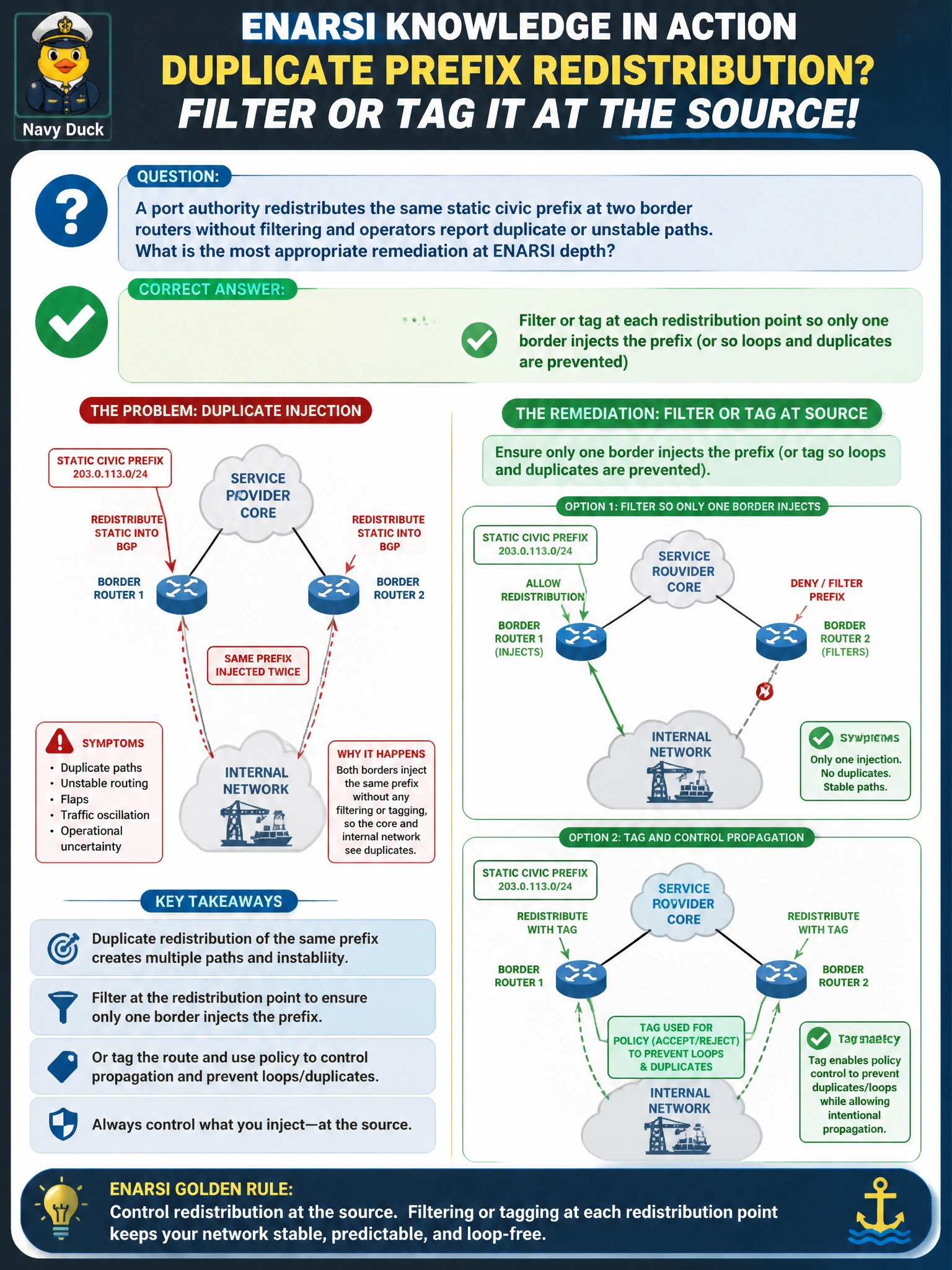
A port authority redistributes the same static civic prefix at two border routers without filtering and operators report duplicate or unstable paths. What is the most appropriate remediation at ENARSI depth?
Select an answer to reveal the explanation.
Short Explanation
Two docks pouring the same crate into the harbor is how you get duplicate paths. Tag or filter so only one border—or a controlled pair—does the injection.
Full Explanation
When a port authority redistributes the same static civic prefix at two border routers with no filtering, both injectors can feed the same prefix into the domain. That often yields duplicate paths, suboptimal selection, mutual redistribution feedback, or flapping as metrics and preferences fight. The ENARSI-appropriate remediation is to filter or tag at each redistribution point so only one border injects the prefix, or so each side’s policy prevents re-injection and uncontrolled duplicates—classic route-tag / prefix-list discipline on redistribute route-maps.
Disabling CEF forces process switching and harms performance; it does not remove dual redistribution sources or stabilize path selection for the civic prefix. Raising OSPF hello timers merely slows failure detection and does nothing to stop two borders from injecting the same static. Converting both statics to floating defaults with AD 1 makes both highly preferred rather than fixing dual injection; AD 1 statics are aggressive and still leave two injection points if both redistribute.
Exam caveat: designs sometimes intentionally dual-inject with different metrics or tags for primary/backup; the failure mode in the stem is unfiltered sameness. Also separate RIB duplicates from control-plane feedback loops—both are addressed by tagging and filtering, but verification differs.
Operational check: identify both borders with show ip route for the civic prefix and show ip protocols redistribution. Apply tags or prefix-lists, then confirm a single expected path (or a controlled primary/backup pair) and watch for re-learning the prefix back into the source protocol. Clearing routing processes without policy changes will only temporarily mask the duplicate injection.