
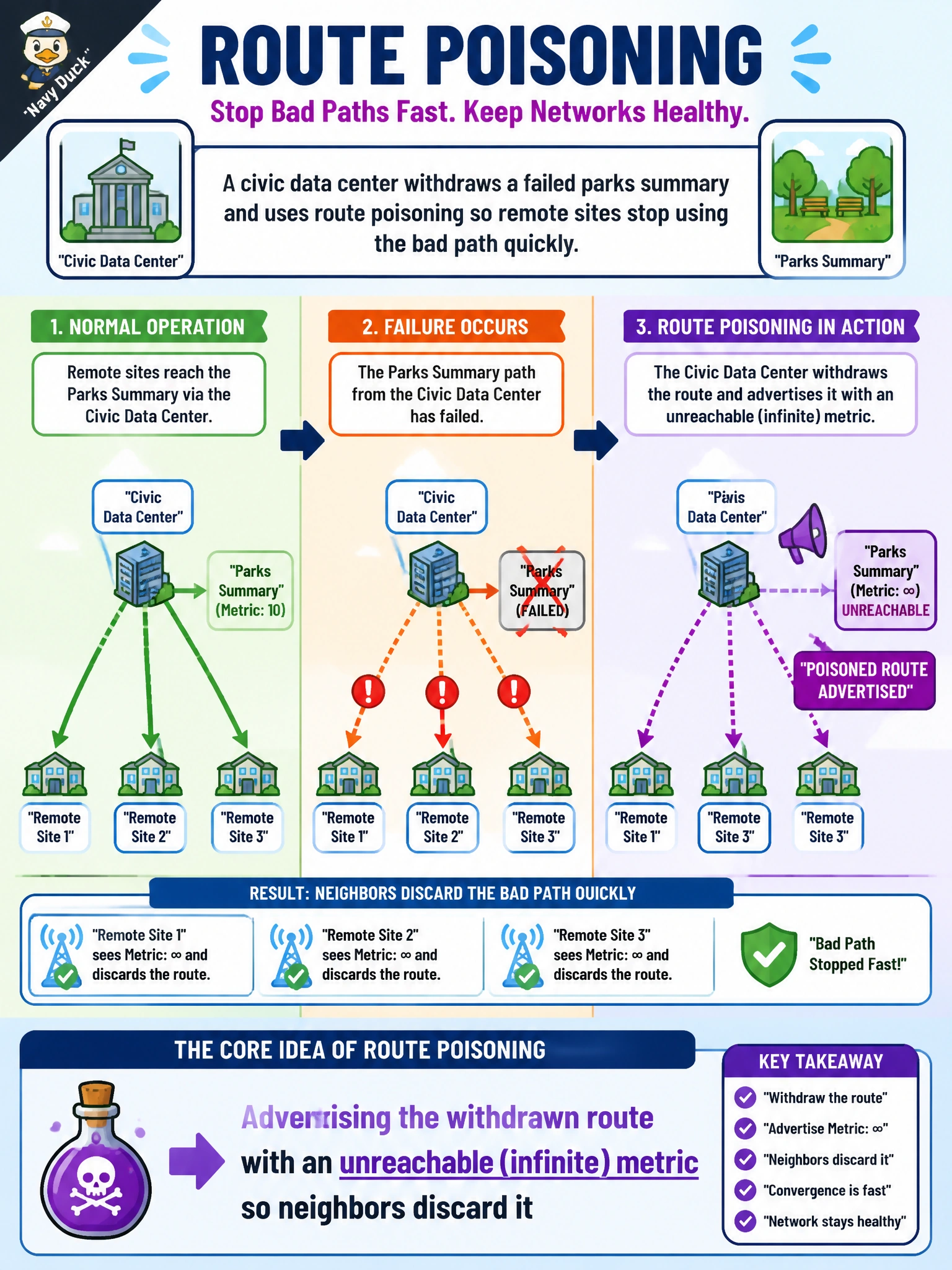
A civic data center withdraws a failed parks summary and uses route poisoning so remote sites stop using the bad path quickly. What is the core idea of route poisoning?
Select an answer to reveal the explanation.
Short Explanation
You use route poisoning to advertise the failed parks path with an infinite metric, prompting neighbors to discard it quickly instead of keeping a zombie route until timers expire. That way, remote sites can converge on an alternate path if one exists.
Full Explanation
Route poisoning accelerates convergence by advertising a failed or withdrawn route with an unreachable (infinite) metric, so neighbors treat the path as invalid and remove it rather than waiting for hold timers or silent disappearance to expire. When the civic data center withdraws the failed parks summary and poisons it, remote sites hear the summary with an infinite metric and discard the bad path quickly; they can converge on an alternate if one exists. Removing the failed prefix only from the local routing table, without telling neighbors, leaves remote sites using a black hole until timers expire—the opposite of poisoning. Raising administrative distance to 1 makes a route more preferred, not poisoned. Converting the summary into a default route for all civic VRFs is a default-routing design choice, not route poisoning. Exam caveat: poison reverse is related but distinct; it advertises a poisoned route back out the interface from which it was learned, often with infinity, as an extra loop-prevention tactic. Infinity encodings differ by protocol, such as RIP’s metric of 16. Link-state protocols flood link-state advertisement changes rather than using classic distance-vector poisoning, though exam questions may use poisoning language in distance-vector contexts. Ensure alternates exist or remote counties may lose coverage after discarding the summary. Practical check: withdraw the summary in a lab, observe updates with an infinite metric using protocol-appropriate show or debug commands, and confirm the remote routing table promptly loses the poisoned entry and installs an alternate if designed. Compare convergence time with and without poisoning behavior enabled by the protocol’s update mechanisms.