
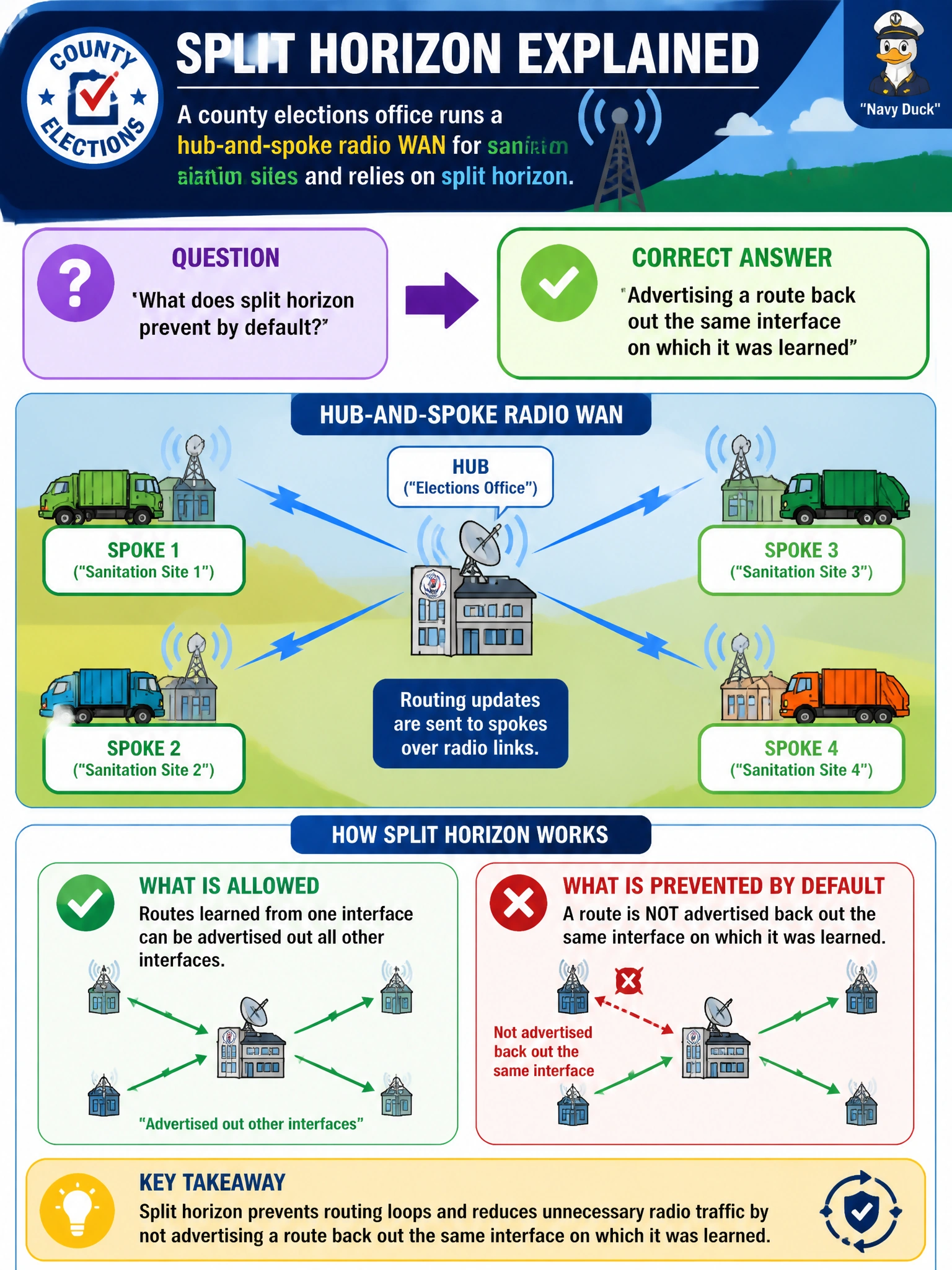
A county elections office runs a hub-and-spoke radio WAN for sanitation sites and relies on split horizon. What does split horizon prevent by default?
Select an answer to reveal the explanation.
Short Explanation
Split horizon is the “don’t echo the rumor back to the person who told you” rule. By default, you won’t advertise a route right back out the interface that taught it to you, which stops simple loops on that link.
Full Explanation
Split horizon is a distance-vector loop-prevention rule: a router does not advertise a route back out the same interface on which it learned that route. On a county elections office hub-and-spoke radio WAN for sanitation sites, the hub learns spoke prefixes via the multipoint or per-spoke radio interface and, with split horizon enabled (the default on most interfaces for RIP/EIGRP as applicable), will not send those routes back out that same interface. That prevents simple two-router loops on the radio segment. (Design note: classic hub-and-spoke often requires split-horizon disable on the hub multipoint interface so spoke-to-spoke routes can be advertised—policy depends on topology.)
The claim about forming any neighbor relationship across NBMA radio links is false: split horizon does not block neighbor formation on NBMA radio links; neighborship is separate from advertisement rules. The claim about using unequal-cost load balancing for spoke-to-spoke paths confuses split horizon with variance/unequal-cost load balancing, which is an EIGRP metric feature unrelated to the default meaning of split horizon. The claim about redistributing connected interfaces into the IGP at the hub misstates the feature: split horizon does not exist to block redistribution of connected interfaces at the hub.
Exam caveat: the stem asks what split horizon prevents by default—the correct conceptual answer is advertising a route back out its learning interface. In Frame Relay/DMVPN-style hub-and-spoke, engineers often disable split horizon on the hub to allow spoke reachability, accepting alternative loop controls. Do not assume “split horizon always on” equals “best municipal radio design.”
Operational check: on the hub, show ip interface <radio> or protocol-specific interface details for split horizon state. With split horizon enabled on a multipoint hub, spokes may miss other spoke routes; with it disabled, verify spoke-to-spoke sanitation reachability and watch for loops if other safeguards are absent. Debug or show ip eigrp/rip updates can confirm whether a prefix is readvertised out the learning interface.