
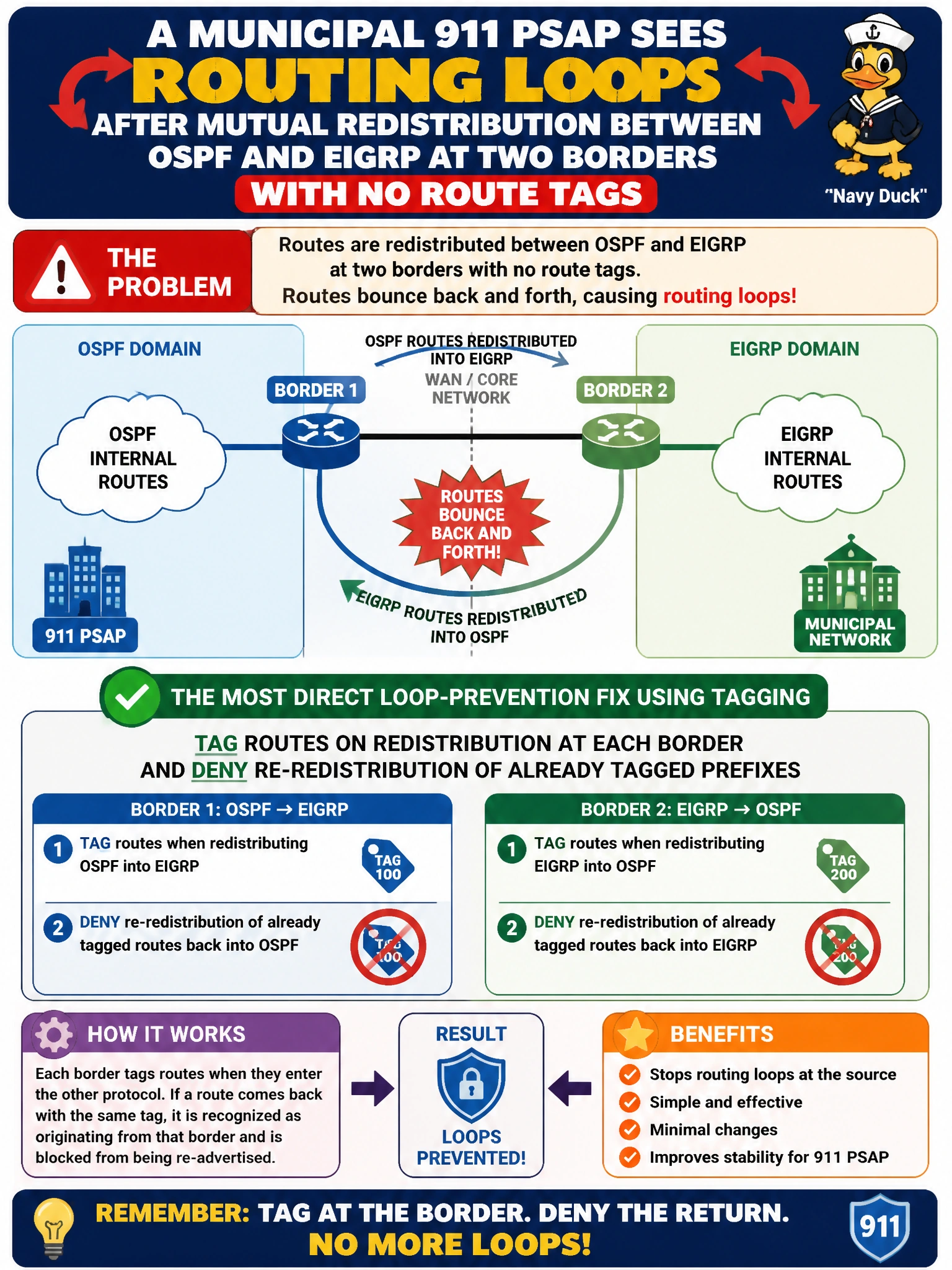
A municipal 911 PSAP sees routing loops after mutual redistribution between OSPF and EIGRP at two borders with no route tags. What is the most direct loop-prevention fix using tagging?
Select an answer to reveal the explanation.
Short Explanation
Mutual redistribution without tags is a hall of mirrors for 911 routes. You stamp routes on the way in, refuse anything already stamped on the way back out, and the loop breaks.
Full Explanation
Mutual redistribution between OSPF and EIGRP at two 911 PSAP borders without tagging allows a prefix learned from OSPF at one border to be redistributed into EIGRP, learned at the other border, and redistributed back into OSPF, and the reverse, forming a routing feedback loop. The most direct tag-based fix is to set a tag when redistributing at each border and to deny redistribution of prefixes that already carry that tag, or protocol-specific tags identifying that the route came from the other side. Once tagged externals are refused re-entry, the hall-of-mirrors feedback stops while legitimate native routes continue. The option that lowers both protocols’ administrative distance to 1 increases ambiguity and does not prevent feedback; equal preference can worsen loops. The option that enables OSPF stub on every area does not stop EIGRP-to-OSPF re-injection at borders and can alter link-state advertisement filtering in ways unrelated to mutual redistribution loop prevention. The option that disables split horizon only on the PSAP LAN interfaces addresses a different class of distance-vector loop behavior and is not the primary mutual-redistribution cure. Exam caveat: use distinct tags per redistribution direction or a single ‘already external’ tag with deny-on-match at both borders. Combine with careful seed metrics. Alternative or complementary controls include prefix-lists that block known feedback prefixes and route-maps that match source-protocol. On ENARSI, tagging plus deny re-redistribution is the classic textbook answer for dual-boundary mutual redistribution loops. Operational check: before tags, look for OSPF externals that bounce and for rapidly changing next hops on 911 prefixes by repeatedly checking the route for the prefix. After setting tags and denying match-tagged routes on both borders, confirm each 911 prefix has a single stable source and that redistributed externals carry tags visible in topology or link-state advertisement outputs. Intentionally remove the deny briefly in a lab window only to prove tags were the control.