
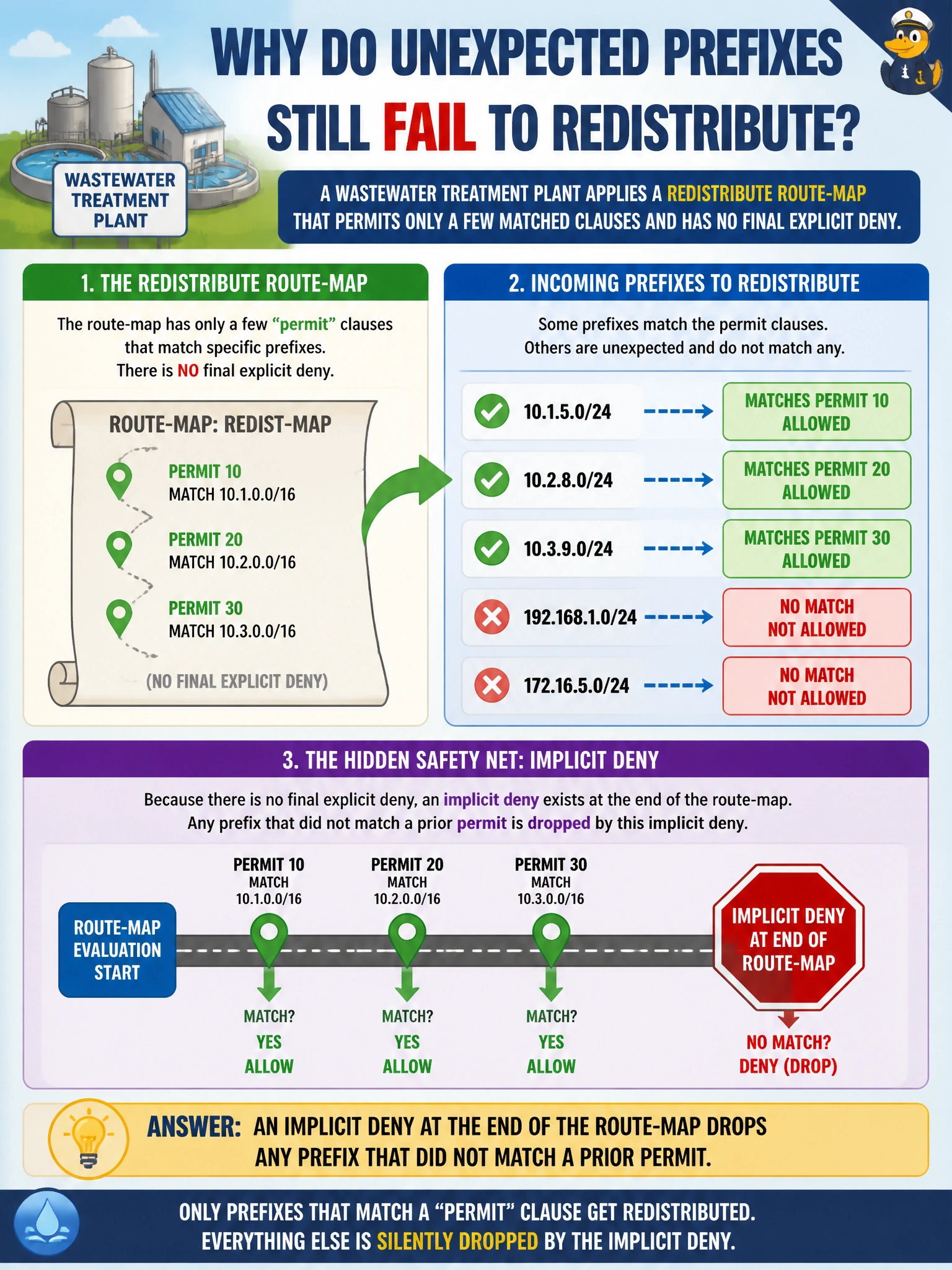
A wastewater treatment plant applies a redistribute route-map that permits only a few matched clauses and has no final explicit deny. Why do unexpected prefixes still fail to redistribute?
Select an answer to reveal the explanation.
Short Explanation
You don’t need a final deny line; the route-map still ends with a silent deny. Any prefix that never matches a permit clause gets dropped, so those unexpected wastewater prefixes don’t make it across.
Full Explanation
Route-maps used for redistribution end with an implicit deny all. If the wastewater treatment plant’s redistribute route-map contains only a few permit clauses for specific matches, any prefix that fails to match those clauses is dropped, even when no explicit deny line is configured. The unexpected prefixes fail to redistribute because they never match a permit, so the implicit deny rejects them; this is intentional and supports selective redistribution. The claim that IOS treats an omitted final deny as an implicit permit reverses the behavior: missing denies do not permit unmatched prefixes. The claim that only BGP route-maps have an implicit deny is also incorrect; IGP redistribution route-maps honor it too. Split horizon, meanwhile, controls advertising a route back out the interface on which it was learned; it does not remove unmatched prefixes at the route-map evaluation stage. Exam caveat: to permit everything except a named prefix, include explicit denies followed by a final permit any. To permit only named prefixes, omit that final permit and rely on the implicit deny. Check sequence types to ensure intended permit clauses are configured. Operational check: use show route-map <name> to inspect matching permit sequences and confirm a failing prefix matches none. You can temporarily add a permit for that prefix, or permit any, and check whether it appears in the target protocol; remove the test if policy should remain selective. Use show run | section redistribute to verify the map is attached to the intended redistribution statement.