
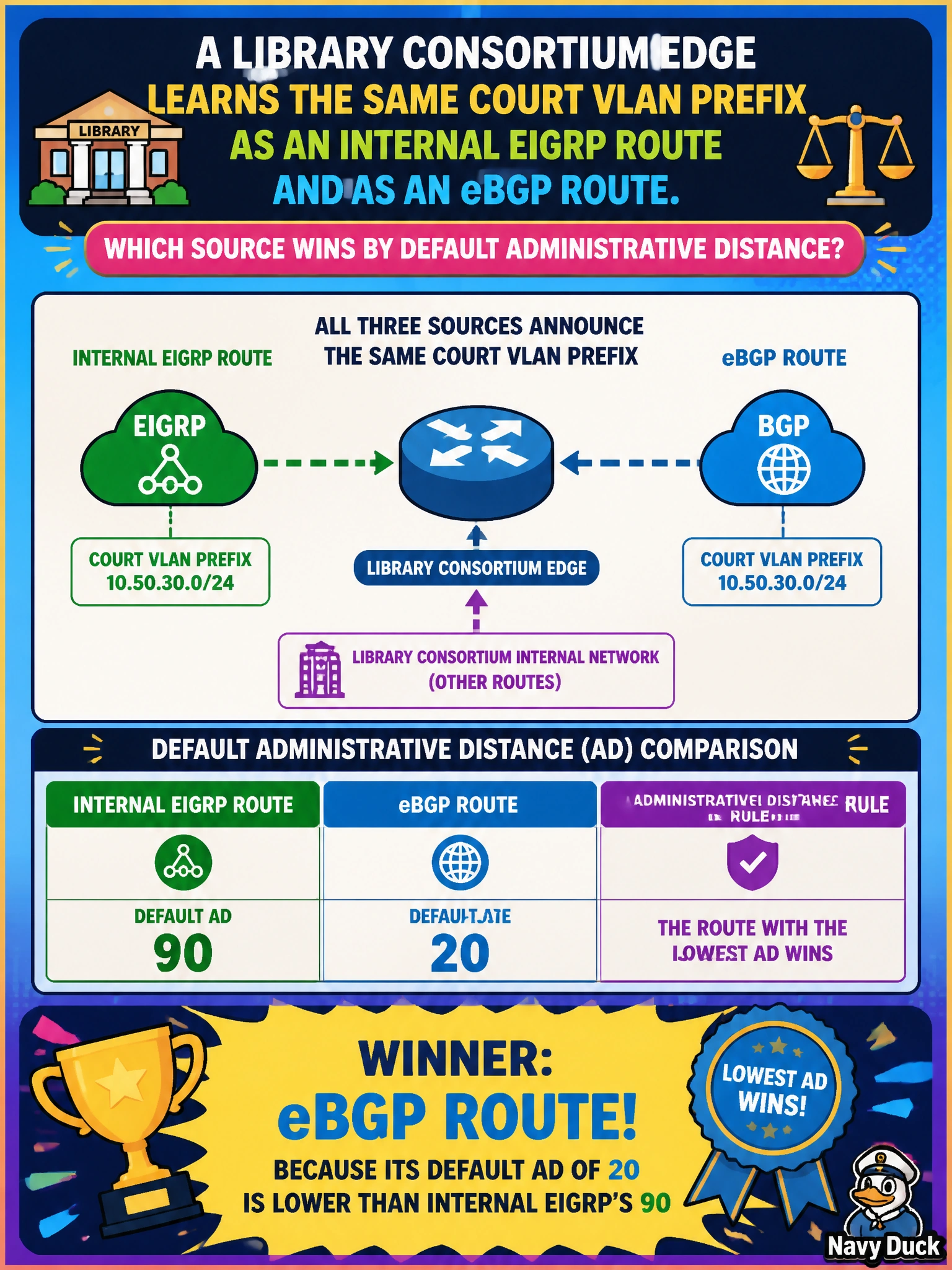
A library consortium edge learns the same court VLAN prefix as an internal EIGRP route and as an eBGP route. Which source wins by default administrative distance?
Select an answer to reveal the explanation.
Short Explanation
Picture two vendors bidding for the court VLAN circuit—the lower bid (AD) wins. The eBGP route shows up with a 20, and internal EIGRP brings a 90, so you get the eBGP route installed unless policy changes those numbers.
Full Explanation
Administrative distance decides which source of a duplicate court VLAN prefix is installed when a library consortium edge learns the same network from internal EIGRP and from eBGP. Default Cisco AD values place eBGP at 20 and internal EIGRP at 90. Because 20 is lower than 90, the eBGP-learned path is preferred and enters the RIB by default. This preference exists even though EIGRP is an IGP used inside the consortium: AD is a local trust ranking of route sources, not a statement that 'IGPs always beat BGP.'
The answer claiming internal EIGRP wins because AD 90 beats every BGP path reverses the numbers. Internal EIGRP’s AD 90 does not beat every BGP path; it beats iBGP (AD 200) and many other sources, but eBGP’s AD 20 is better (lower). Memorizing 'EIGRP always wins' is a common trap. The answer claiming only iBGP is eligible because external BGP is not eligible for the RIB confuses eligibility with preference. External BGP routes are fully eligible for the RIB; there is no rule that only iBGP may install. iBGP defaults to AD 200, which is worse than both eBGP and internal EIGRP. The answer claiming neither source wins because redistribution is required before AD comparison invents a redistribution prerequisite. AD comparison happens whenever two sources offer the same prefix to the routing table selection process; redistribution is a separate control-plane injection mechanism and is not required before AD can choose a winner.
Exam caveat: default ADs can be overridden with the distance command (and BGP distance/bgp distance ebgp/ibgp forms). On a municipal edge that peers eBGP to a court-system provider while running EIGRP internally, an engineer who raises eBGP distance above 90 will suddenly prefer the internal EIGRP copy and may blackhole or trombone traffic intended for the provider path. Also distinguish eBGP (20) from iBGP (200) carefully on ENARSI-style items.
Operational check: show ip route <court-vlan-prefix> and verify the entry is installed as a BGP route with AD 20 (or the configured eBGP distance), not as an EIGRP route. show ip bgp <prefix> and show ip eigrp topology <prefix> confirm both sources still know the route while only one is RIB-installed. Document any non-default distance values under show run | include distance.