
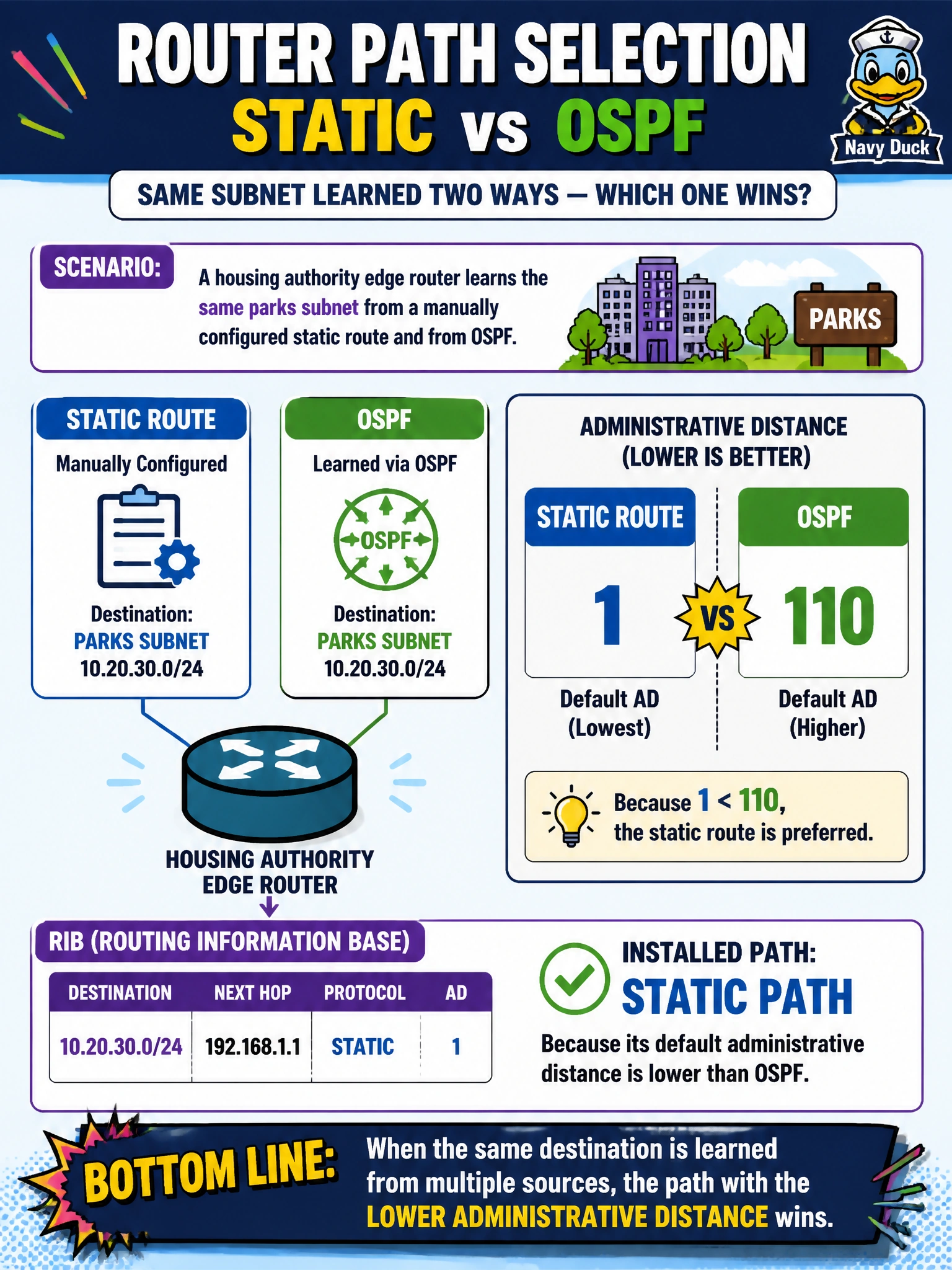
A housing authority edge router learns the same parks subnet from a manually configured static route and from OSPF. By default, which path does the router install in the RIB?
Select an answer to reveal the explanation.
Short Explanation
Think of administrative distance like a trust score—lower number wins the beauty contest. A plain static route defaults to 1, while OSPF defaults to 110. So when both claim the parks subnet, you get the static route installed unless someone deliberately raised its administrative distance.
Full Explanation
When a housing authority edge router learns the same parks subnet from both a manually configured static route and OSPF, IOS installs the path with the lowest administrative distance into the RIB. A connected interface is administrative distance 0; a plain static route defaults to administrative distance 1; OSPF defaults to administrative distance 110. Because 1 is lower than 110, the static path wins by default and becomes the forwarding entry for that parks prefix. OSPF may still hold the prefix in its LSDB, but the RIB preference is decided by administrative distance first, not by OSPF cost or the fact that OSPF is a link-state protocol.
The claim that link-state protocols always beat static routes fails on concept: link-state design does not grant OSPF an automatic win over static routes. Protocol type is irrelevant once both candidates reach the RIB decision; administrative distance comparison is the gate. The equal-cost multipath claim misunderstands equal-cost multipath. ECMP applies only when multiple paths share the same prefix, same administrative distance, and, for most IGPs, equal metric within that protocol. Different sources with different administrative distances never load-share solely because both exist. The floating-static administrative distance 255 claim invents a requirement for administrative distance 255. Floating statics use a deliberately worse, higher administrative distance so they stay inactive until the primary withdraws; a normal static at administrative distance 1 installs immediately and does not need administrative distance 255 to participate.
Exam caveat: operators often confuse “default static administrative distance = 1” with floating-static design. If the static were meant as backup only, its administrative distance must be set higher than the primary protocol, and for OSPF that typically means greater than 110. Also remember that changing distance on one side of a dual-homed housing edge can silently flip parks traffic without an OSPF failure.
Operational check: on the edge router, run show ip route <parks-prefix> and confirm the route is marked as static with administrative distance and metric 1/0, or the configured static administrative distance, not OSPF. Compare with show ip route ospf to see the OSPF candidate is present or withdrawn but not preferred. Optionally run show ip protocols to verify no distance overrides were applied under the OSPF or static configuration.