
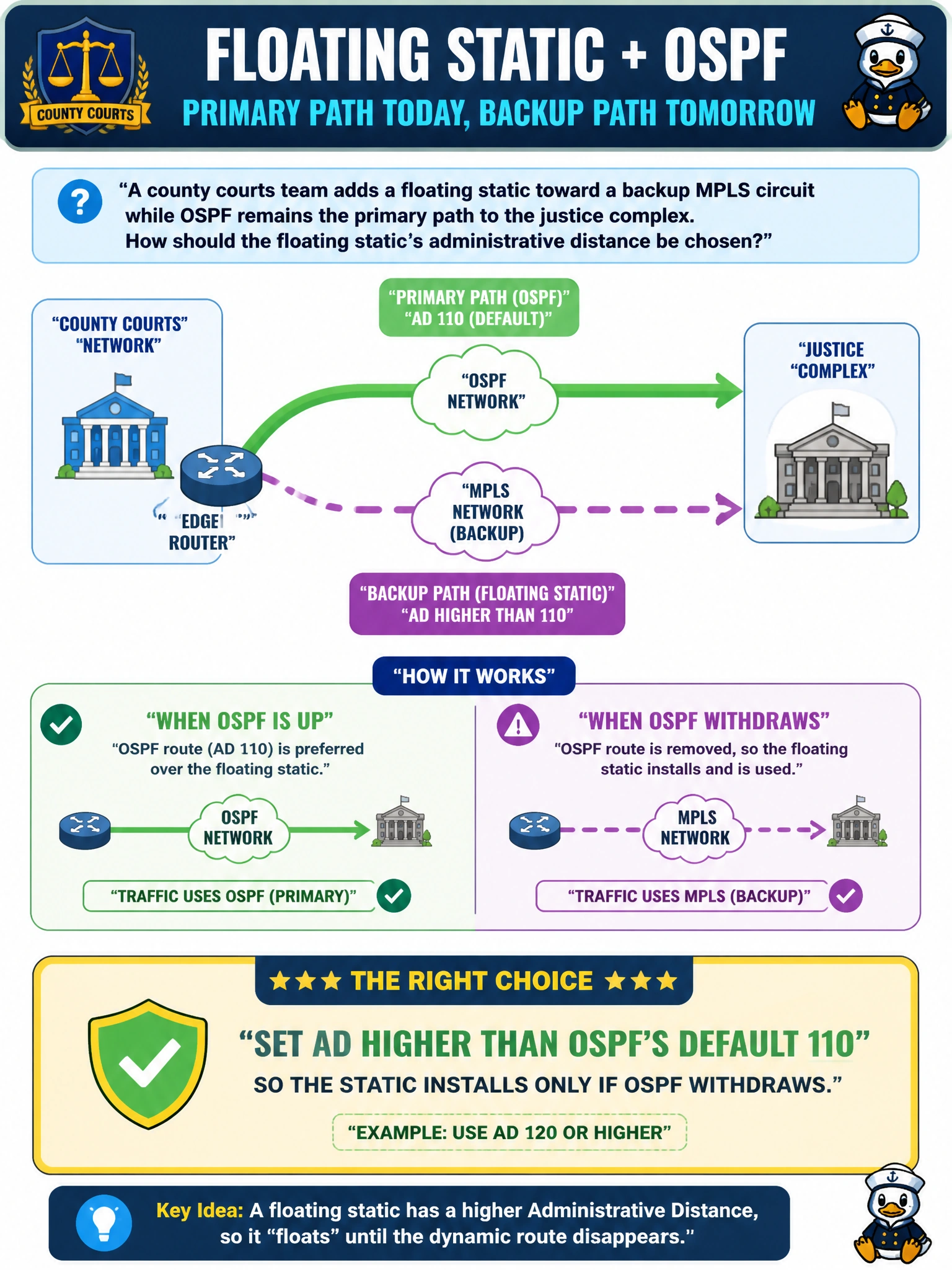
A county courts team adds a floating static toward a backup MPLS circuit while OSPF remains the primary path to the justice complex. How should the floating static’s administrative distance be chosen?
Select an answer to reveal the explanation.
Short Explanation
A floating static is the spare tire—you don't want it bolted on while the good tire still works. Give it an AD worse than OSPF (higher than 110) so it only jumps in when the primary route disappears.
Full Explanation
A floating static is a backup route that remains out of the RIB until the primary path disappears. For a county courts team keeping OSPF as the primary path to the justice complex while adding a static toward a backup MPLS circuit, the static’s administrative distance must be set higher (worse) than OSPF’s default AD of 110. Typical choices are 130, 150, or another value clearly above 110 and below 255. While OSPF advertises a usable justice-complex route, the floating static stays dormant. When OSPF withdraws that prefix, the static’s higher AD becomes the best remaining candidate and installs, steering traffic onto the backup MPLS path. Setting AD to 1 is wrong because 1 is the default for a normal static and causes the backup to preempt OSPF immediately, defeating the floating design. Setting AD equal to OSPF’s 110 is wrong because equal AD does not create IGP-style ECMP across different protocols; selection becomes nondeterministic or still prefers one source depending on code path, and it is not a supported way to load-share a static with OSPF. Omitting AD entirely is wrong because floating statics do not ignore distance; the elevated AD is the entire mechanism that keeps the static floating. Exam caveat: AD 255 means the route is not installed in the RIB at all, so it cannot serve as a backup. Choose an AD greater than the primary but less than 255. Also ensure the floating static’s next hop is reachable independently, for example via a more specific or connected path to the MPLS CE; otherwise the backup appears in config but never forwards when OSPF fails. Track objects or BFD can improve detection beyond waiting for OSPF SPF/LSA expiry. Operational check: with OSPF healthy, show ip route <justice-prefix> should show O with [110/cost], and show ip route static should either omit the floating route or show it as a candidate not used for forwarding. Shut an OSPF neighbor or filter the prefix, then re-check that the same prefix installs as S with the configured higher AD and that traceroute toward the justice complex exits the backup MPLS circuit.