
A security engineer wants to scan application source code in CI/CD pipelines for insecure cryptographic API calls, even when developers rename variables or split statements across multiple lines. Why is Semgrep more effective for this task than plain-text regular expressions?
Select an answer to reveal the explanation.
Short Explanation
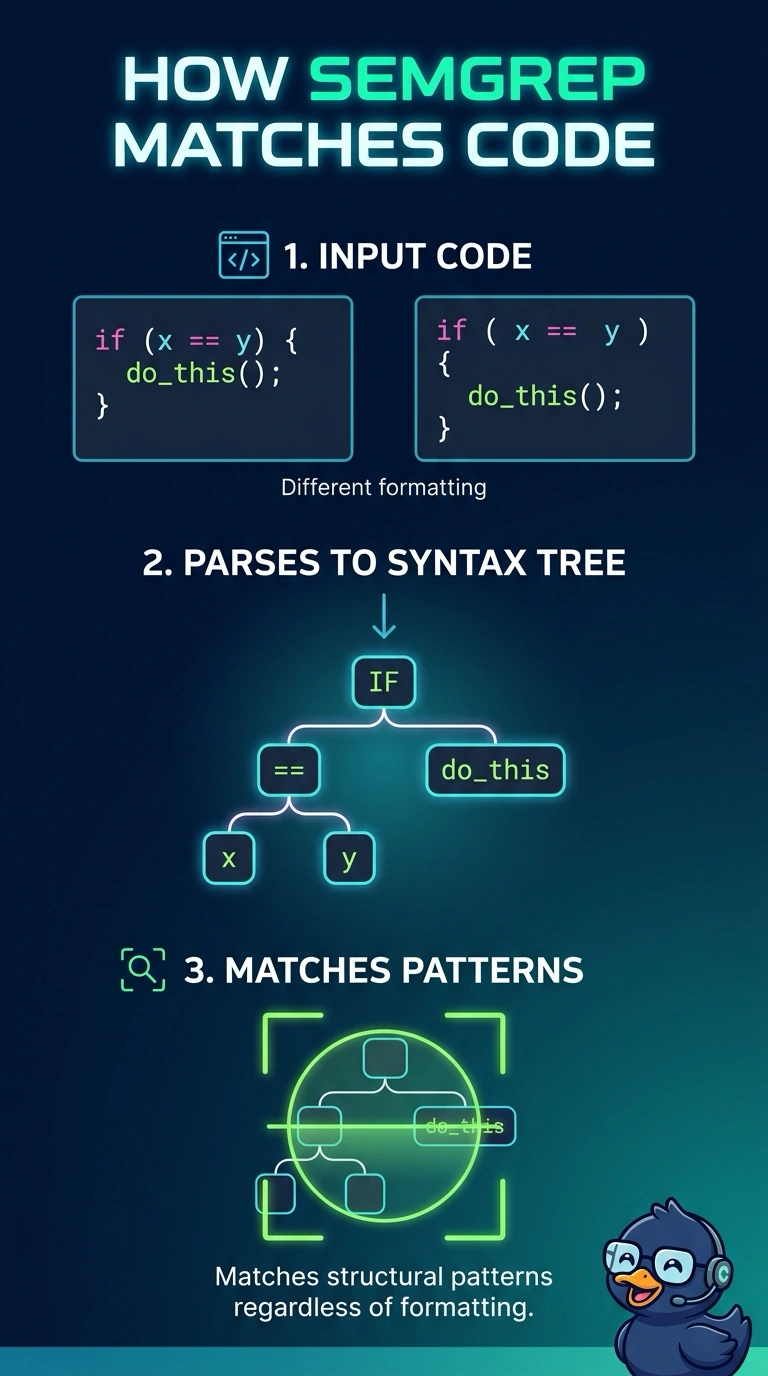
Plain-text searches read code like a photocopy, breaking the moment someone adds a line break or renames a variable. You need a tool that understands code grammar, not just character strings. The trap is confusing static structural analysis with dynamic runtime testing or automated patching.
Full Explanation
Static code hunters rely on structural matching because Semgrep parses code into syntax trees to match structural patterns regardless of formatting. By understanding language syntax rather than raw text layout, it reliably flags insecure API calls even when developers reformat whitespace, add comments, or rename local variables. Resistance to variable renaming depends on rule design, including metavariables and supported language semantics; syntax-tree matching alone does not make every literal variable-name pattern rename-invariant. Claiming that Semgrep executes the compiled binary in a sandbox to observe runtime memory allocations confuses static source analysis with dynamic behavioral detonation. Likewise, Semgrep automatically rewrites and patches vulnerable third-party libraries without requiring developer review overstates the tool's role, as it identifies risky patterns and suggests fixes rather than silently altering dependencies. Saying that Semgrep inspects live encrypted HTTPS traffic between the browser and the backend API describes an intercepting web proxy rather than a source-code scanner. As a caveat, syntax-tree rules still require tuning to avoid false positives on safe wrapper functions. As an operational check, run custom Semgrep rules against a representative repository baseline and review matched lines in context before enforcing pipeline blocks.