
A threat hunter queries Windows endpoint process-creation logs to uncover privilege escalation via unquoted service paths. Which execution pattern most strongly indicates an adversary is abusing this misconfiguration?
Select an answer to reveal the explanation.
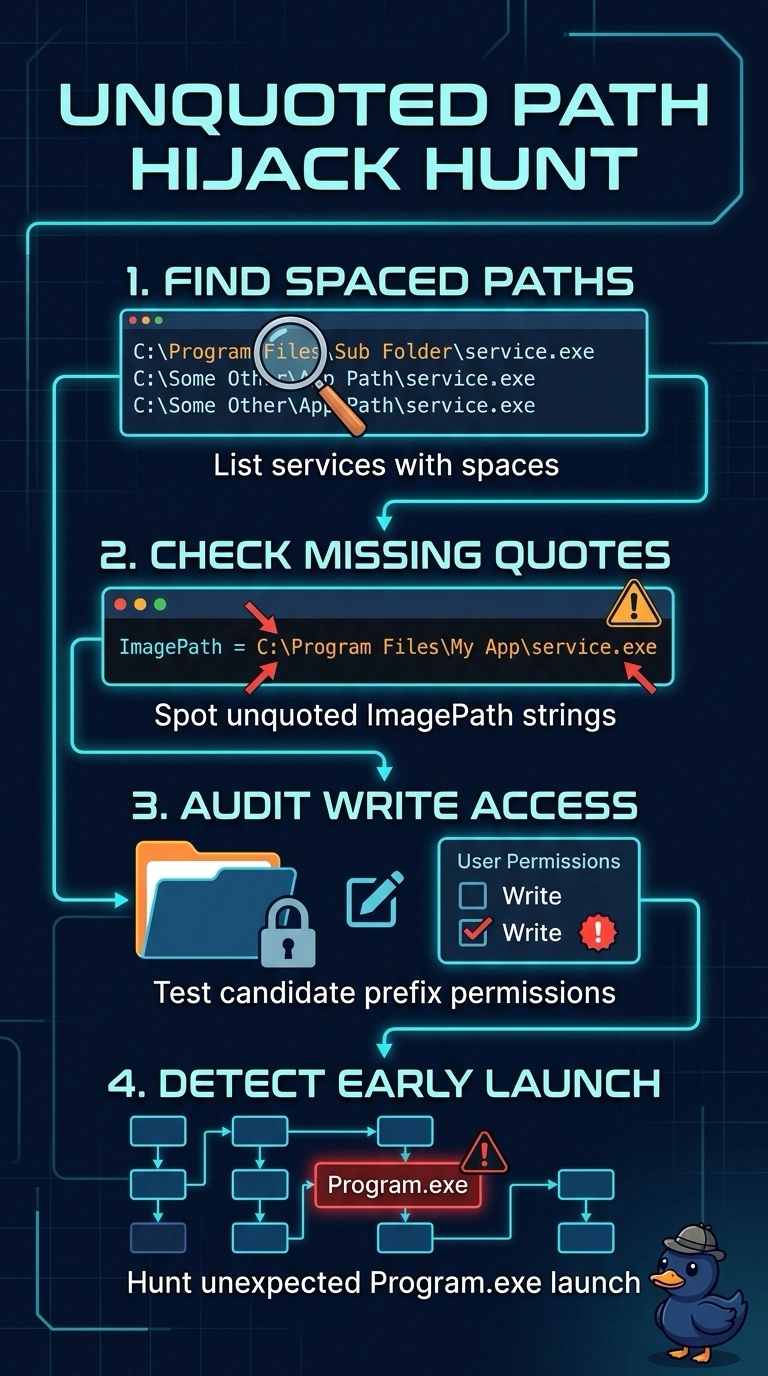
Short Explanation
You can spot abuse when you see a service firing an earlier writable candidate from an unquoted path with spaces rather than chasing normal System32 launches. Windows may interpret successive prefixes such as C:\Program.exe before the intended spaced executable path; exploitation requires write access to a candidate and a way to start the service.
Full Explanation
A service launches an attacker-writable earlier executable candidate from an unquoted path containing spaces is the strongest indicator because Windows may interpret successive prefixes such as C:\Program.exe before the intended spaced executable path; exploitation requires write access to a candidate and a way to start the service. When ImagePath lacks enclosing quotes and contains spaces, Windows resolves the string left to right and will attempt each truncated prefix, so a planted binary at an earlier location executes with the service SYSTEM-level context once the Service Control Manager starts it. A signed Microsoft service binary launching normally from System32 does not fit because protected system directories use properly resolved paths without ambiguous prefixes and do not permit attacker writes. A user opening a standard web browser from the Windows Start menu describes interactive user execution rather than privileged service startup and involves no unquoted ImagePath resolution. An administrator running a signed patch installer from a read-only share fails because read-only locations block staging of rogue candidates and manual installer launches lack service startup behavior. For validation, inventory services whose ImagePath contains spaces without enclosing quotes and audit write permissions on each candidate prefix.