
A threat hunter needs to write a custom network intrusion detection signature to catch a malware family's command-and-control check-in traffic across changing external servers. Which rule construction practice yields the most durable detection?
Select an answer to reveal the explanation.
Short Explanation
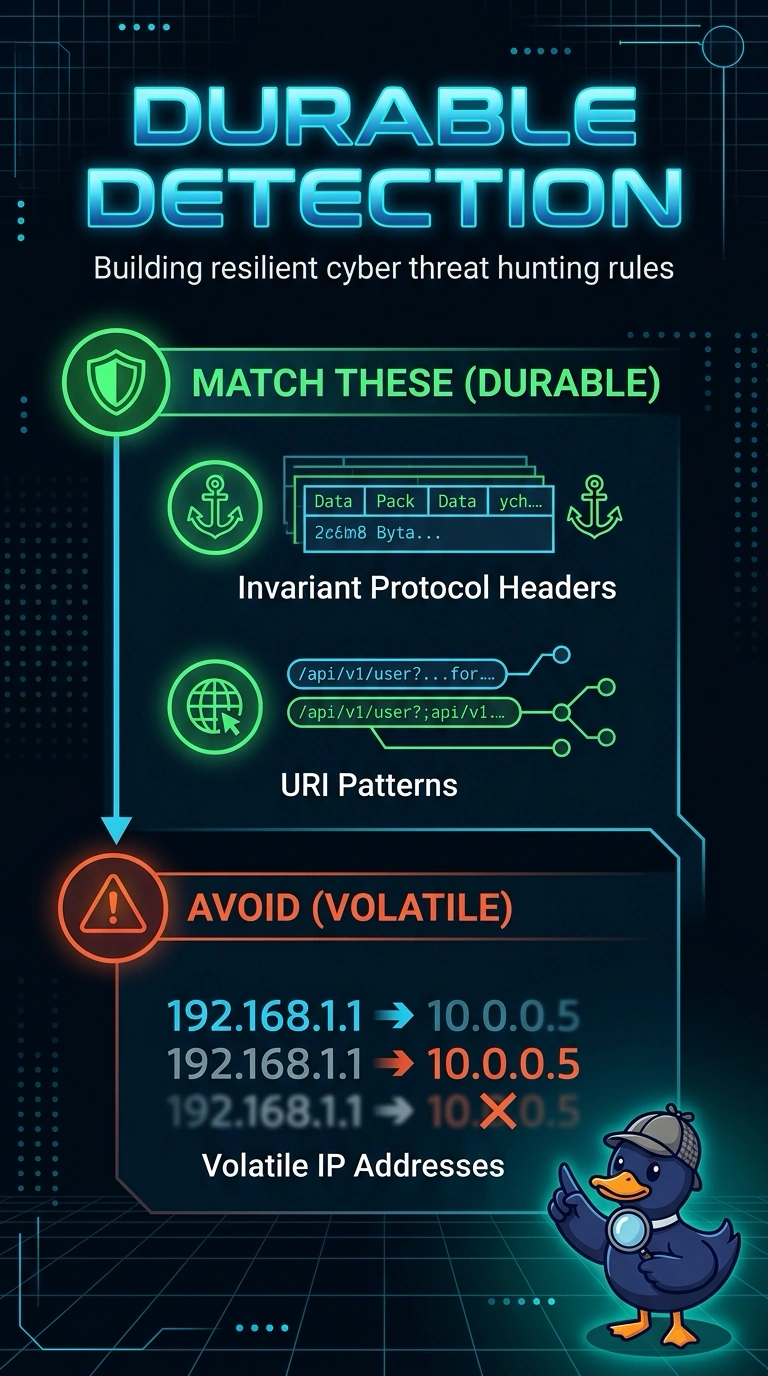
Chasing an attacker's IP address in a network signature is like memorizing the license plate of a rental car they ditch tomorrow. Anchor your rules on invariant protocol headers and URI patterns so the detection holds up even when servers rotate.
Full Explanation
Durable network intrusion signatures rely on matching invariant protocol headers and URI patterns rather than volatile IP addresses. Malware families typically reuse consistent HTTP header ordering, custom user-agent structures, or fixed URI parameter formats even when operators rotate hosting infrastructure frequently. Hardcoding the adversary's current external source IP address as the sole detection condition breaks immediately as soon as the attacker switches servers or cloud providers. Alerting on every outbound encrypted TLS handshake across the corporate perimeter floods analysts with benign traffic because normal web browsing relies on TLS. Requiring an exact match on the entire packet payload including dynamic timestamps is overly brittle and fails whenever session identifiers, nonces, or timestamps change between check-ins. As a caveat, overly broad header matches can trigger false positives on legitimate custom applications. For an operational check, replay captured benign corporate traffic alongside sample malicious packet records against the signature before enabling alerts.