
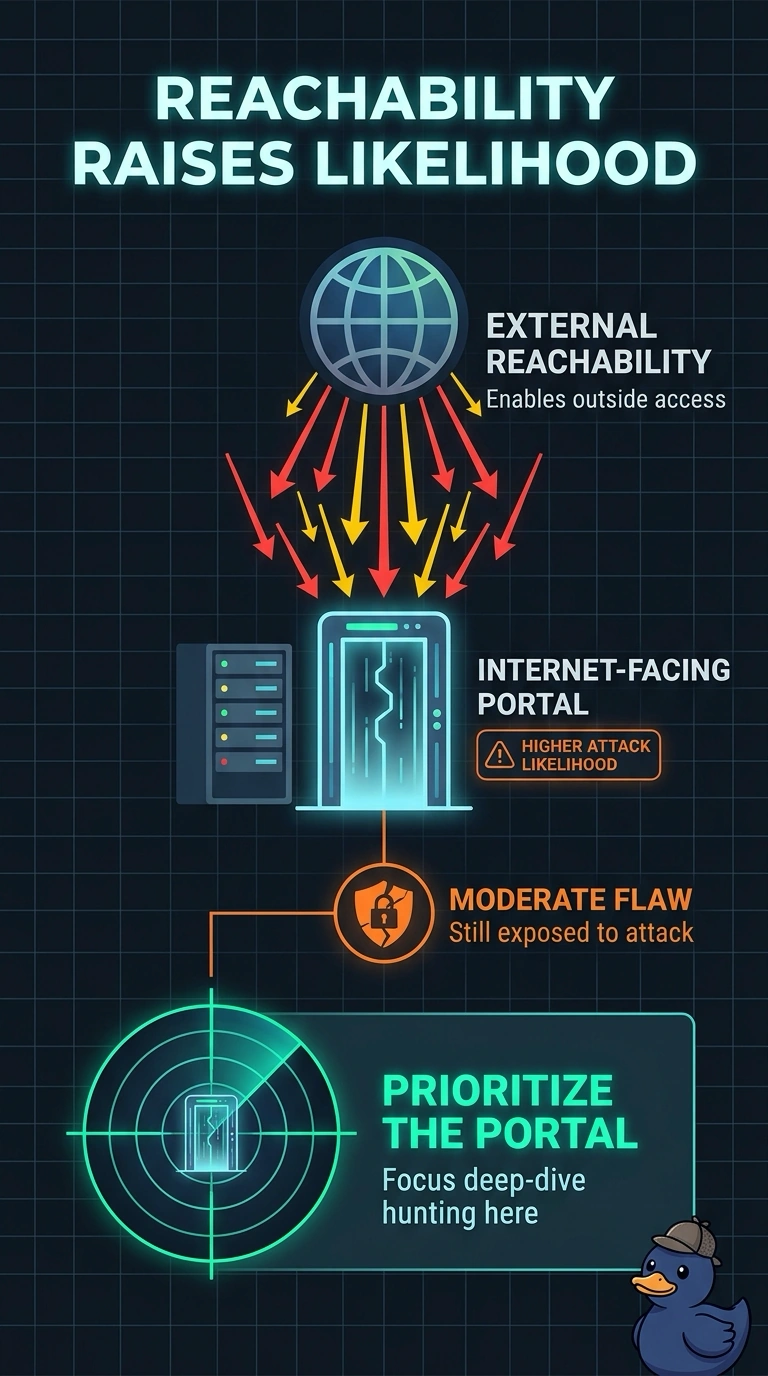
A threat hunter at a logistics company must prioritize where to focus limited deep-dive hunting resources across two unpatched servers: an internet-facing web portal with a moderate flaw and an air-gapped lab server with a critical flaw. Which assessment best reflects attack likelihood?
Select an answer to reveal the explanation.
Short Explanation
A unlocked shed in the middle of a desert faces far fewer visitors than a cracked window on a busy street, and your threat hunts should follow that same logic. The trap is letting a high severity score override real-world network exposure.
Full Explanation
Concluding that The internet-facing portal carries higher attack likelihood due to external reachability properly balances vulnerability severity against adversary access paths. Attack likelihood reflects the probability that a threat actor can reach and exploit a weakness, meaning an externally exposed service faces continuous opportunistic scanning and targeted probing. Assuming that The air-gapped server is more likely to be compromised first because its flaw is critical mistakes technical impact severity for exploitation probability, ignoring that an isolated host requires physical access or an unlikely bridge to reach. Claiming that Both servers carry identical attack likelihood because neither has received vendor patches overlooks network segmentation as a primary mitigating factor that reduces adversary reachability. Stating that Attack likelihood depends solely on the server hardware age rather than network exposure introduces an irrelevant metric that has no bearing on whether an attacker can connect to a vulnerable service. As a caveat, air-gapped systems can still face insider threats or removable-media risks, so isolation is not absolute immunity. Perform an operational check by reviewing perimeter firewall rules and web access logs on the exposed portal for early exploitation attempts.