
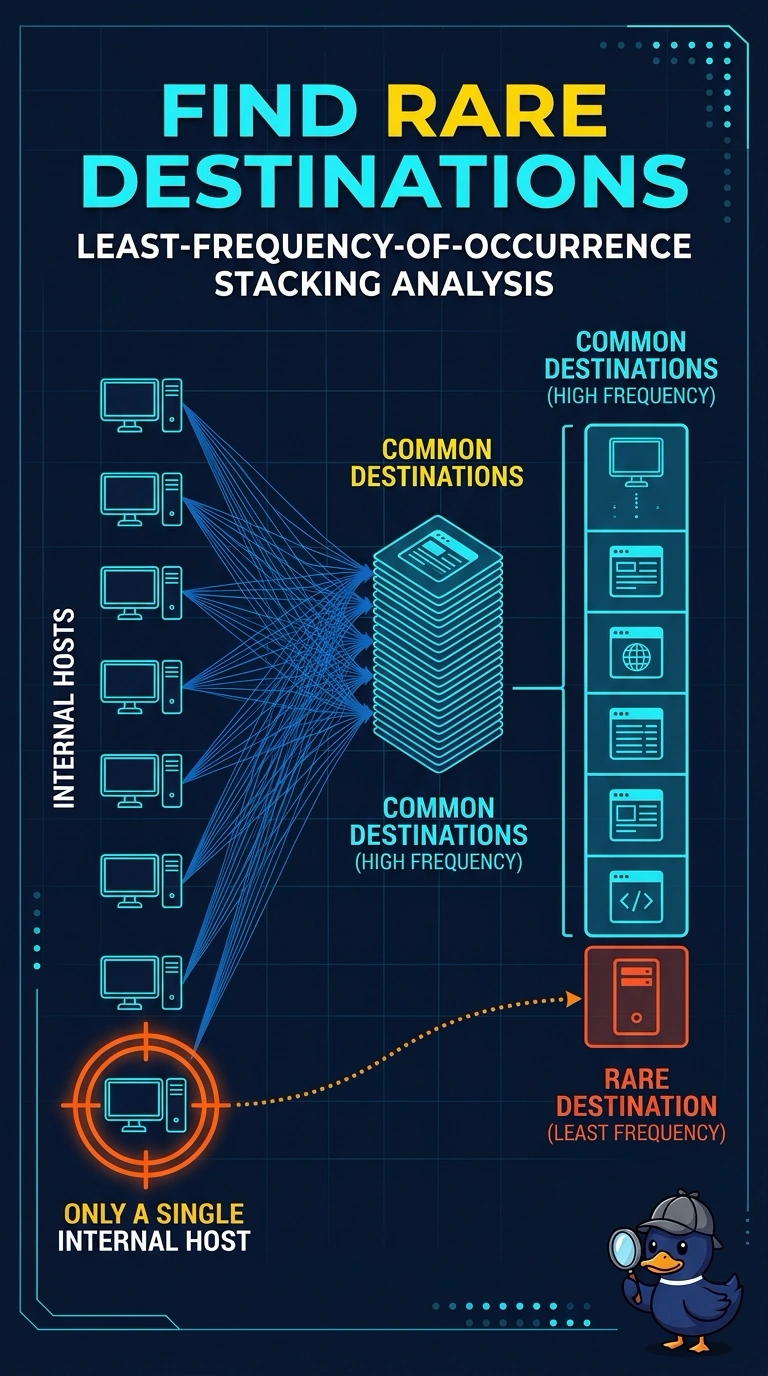
A threat hunter exports a week of corporate web proxy logs containing millions of requests and wants to quickly surface rare, one-off external destinations contacted by only a single internal host without relying on known threat feeds. Which analytical technique is best suited for this hunt?
Select an answer to reveal the explanation.
Short Explanation
When you sort millions of proxy records from rarest to most common, stealthy command-and-control beacons that only one workstation talks to pop right to the top. The trap is looking at the busiest destinations or relying on static hashes when you have no prior indicators.
Full Explanation
Least-frequency-of-occurrence stacking analysis is ideal because aggregating destinations by unique internal source count and sorting from lowest to highest quickly isolates rare, single-host external connections that may represent custom C2 infrastructure. Static file-hash matching against known malware repositories depends on pre-existing indicators and cannot identify unknown web destinations in proxy logs. Filtering exclusively for top-ranked high-volume destinations surfaces popular business services and content delivery networks while burying low-volume anomalies. Blocking all outbound TLS traffic across every workstation is a disruptive containment action rather than an analytical hunting technique. As a caveat, stacking proxy destinations also surfaces legitimate niche vendor sites and software update endpoints, so analysts must filter known-good domains and inspect user-agent and timing context. As an operational check, run a frequency aggregation on destination domains grouped by distinct source IP and investigate single-host outliers exhibiting regular interval patterns.