
A threat hunter writes a new YARA signature to detect a malicious script family discovered during an incident and wants to deploy it across thousands of enterprise endpoints. What step should the hunter take first to avoid overwhelming the SOC with false positives?
Select an answer to reveal the explanation.
Short Explanation
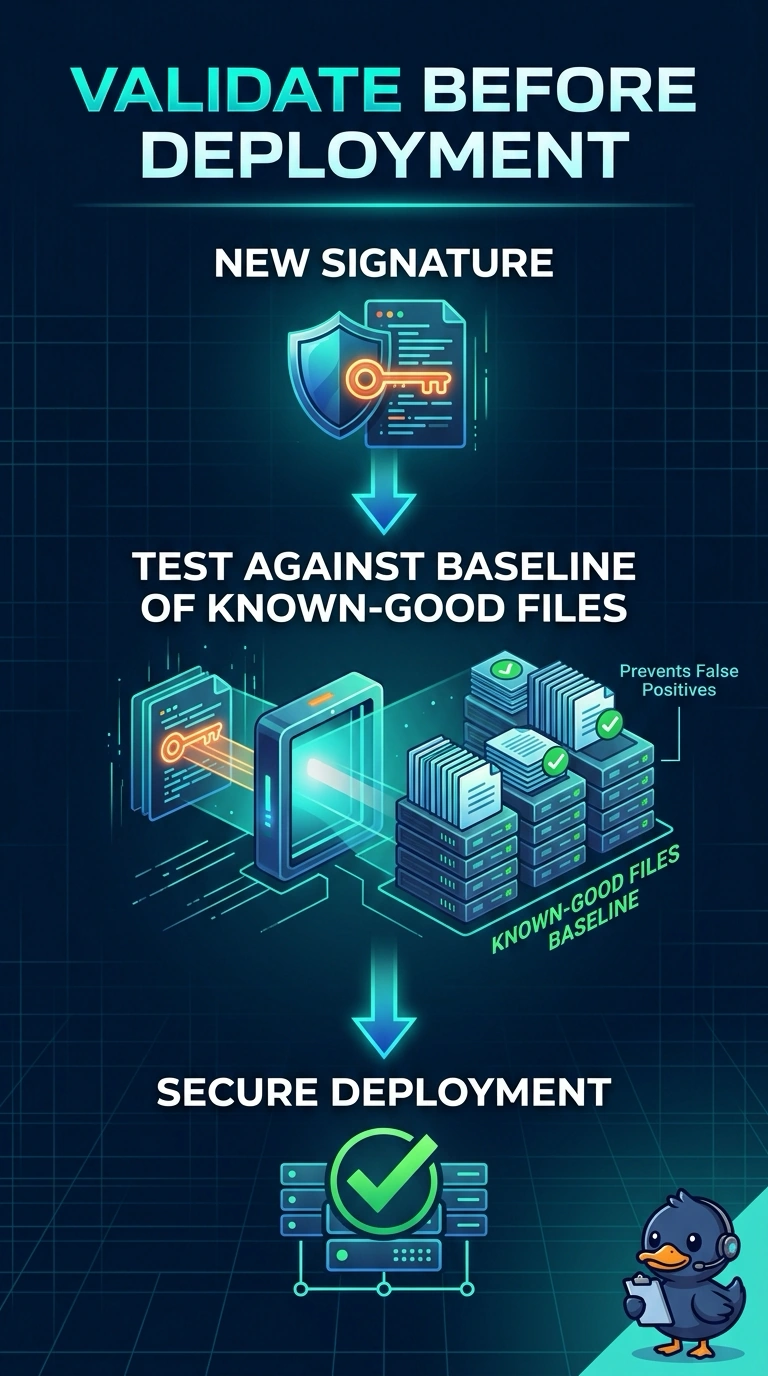
Before you sound a fire alarm across a packed building, test the sensor so it does not trip on steam from the kitchen. Before deploying a new signature, check it against known-good files rather than pushing an untested rule straight to production.
Full Explanation
To prevent alert fatigue and operational disruption, test the signature against a baseline of known-good files before deploying it across production endpoints. Running the rule against legitimate administrative scripts, vendor binaries, and system files can reveal overly broad string or byte patterns early. Assigning the highest possible severity score to every alert amplifies noise in analyst queues without improving detection accuracy. Removing all conditional logic from the signature definition weakens precision and increases false-positive matches on benign files. Configuring the endpoint agent to auto-wipe matching systems creates catastrophic availability risk if an untested rule matches critical operating system files. One caveat is that a signature that passes against a historical clean corpus can still trigger on newly released legitimate software updates, so ongoing tuning may be needed. As a practical check, run the rule in audit-only mode across a representative pilot group of endpoints and review any matches before enabling automated alerting.