
A threat hunter queries endpoint process-access telemetry in a SIEM to uncover credential theft attempts against Windows domain workstations. Which event pattern most strongly indicates unauthorized memory-based credential harvesting?
Select an answer to reveal the explanation.
Short Explanation
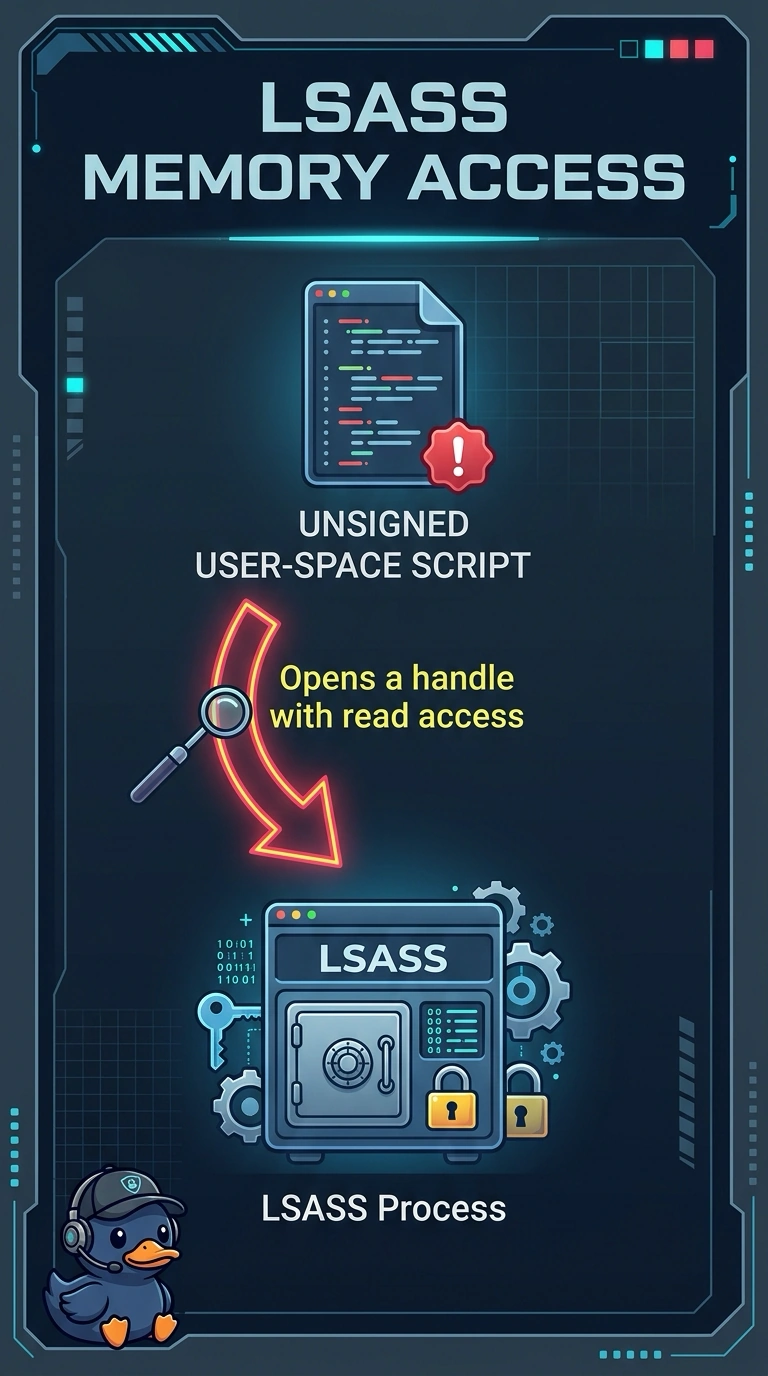
You’re right to treat an unsigned user-space script reading LSASS memory as a high-signal warning, since LSASS holds sensitive authentication material. Registry reads by a signed updater, Kerberos ticket-granting tickets issued at logon, and browser cookies saved in a user profile are routine behaviors, not evidence of LSASS memory harvesting.
Full Explanation
The Local Security Authority Subsystem Service (LSASS) stores sensitive authentication material in memory on Windows hosts. An unsigned user-space script opening a handle with read access to LSASS is therefore a high-signal indicator of unauthorized credential harvesting: ordinary user scripts have no operational reason to inspect LSASS memory. By contrast, a signed system updater reading registry keys under local machine hives reflects routine OS maintenance, not memory-based credential access. A domain controller issuing Kerberos ticket-granting tickets at logon is standard Active Directory authentication behavior. A web browser writing cached session cookies to a user profile folder is normal browser state management and does not involve reading LSASS process memory. As an exam caveat, legitimate endpoint security agents and diagnostic tools may occasionally open handles to LSASS, so analysts should baseline activity and exclude signed, authorized security binaries to reduce false positives. As a practical check, query endpoint process-access logs for non-system, unsigned executables requesting read permissions against LSASS, then validate each match against approved software inventories.