
A threat hunter is reviewing NetFlow and proxy session records to determine whether a compromised internal server has progressed from initial access to active data exfiltration. Which session pattern most strongly indicates exfiltration?
Select an answer to reveal the explanation.
Short Explanation
When a server suddenly sends out a mountain of data and only gets tiny acknowledgments back, something is leaving the building. Watch those byte ratios closely so you catch exfiltration before the trail goes cold.
Full Explanation
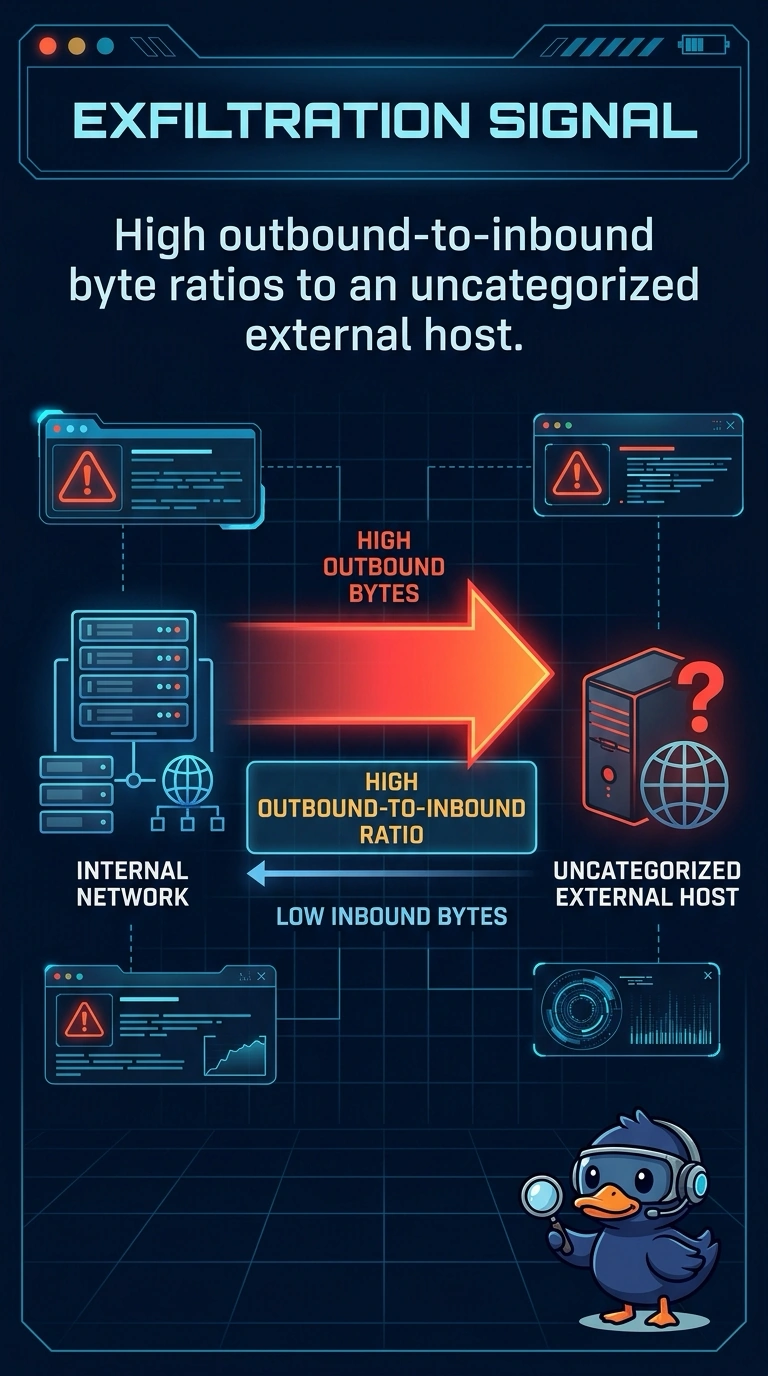
High outbound-to-inbound byte ratios to an uncategorized external host strongly indicate exfiltration because transferring large archives outward generates heavy outbound byte counts paired with minimal inbound acknowledgment traffic. Seeing this asymmetry directed toward an unfamiliar or uncategorized destination separates active data theft from routine server administration. Balanced bidirectional traffic to a known update server fails because normal patching and synchronization workflows exchange predictable volumes with trusted vendor infrastructure. Brief inbound health-check packets from a load balancer fails because periodic availability probes involve tiny, expected internal packets rather than sustained outbound transfers. Repeated failed DNS lookups for internal hostnames fails because unresolved internal queries point to misconfiguration or internal discovery rather than bulk external data transfer. As a caveat, legitimate cloud backups or partner file transfers can also produce high outbound ratios, so baseline authorized server destinations first. As an operational check, run scheduled queries ranking internal servers by outbound-to-inbound byte ratios to external destinations and investigate outliers lacking business justification.