
A threat hunter at a SaaS company is reviewing cloud identity audit logs to uncover stealthy privilege escalation across AWS accounts. Which pattern most strongly indicates unauthorized cross-account access?
Select an answer to reveal the explanation.
Short Explanation
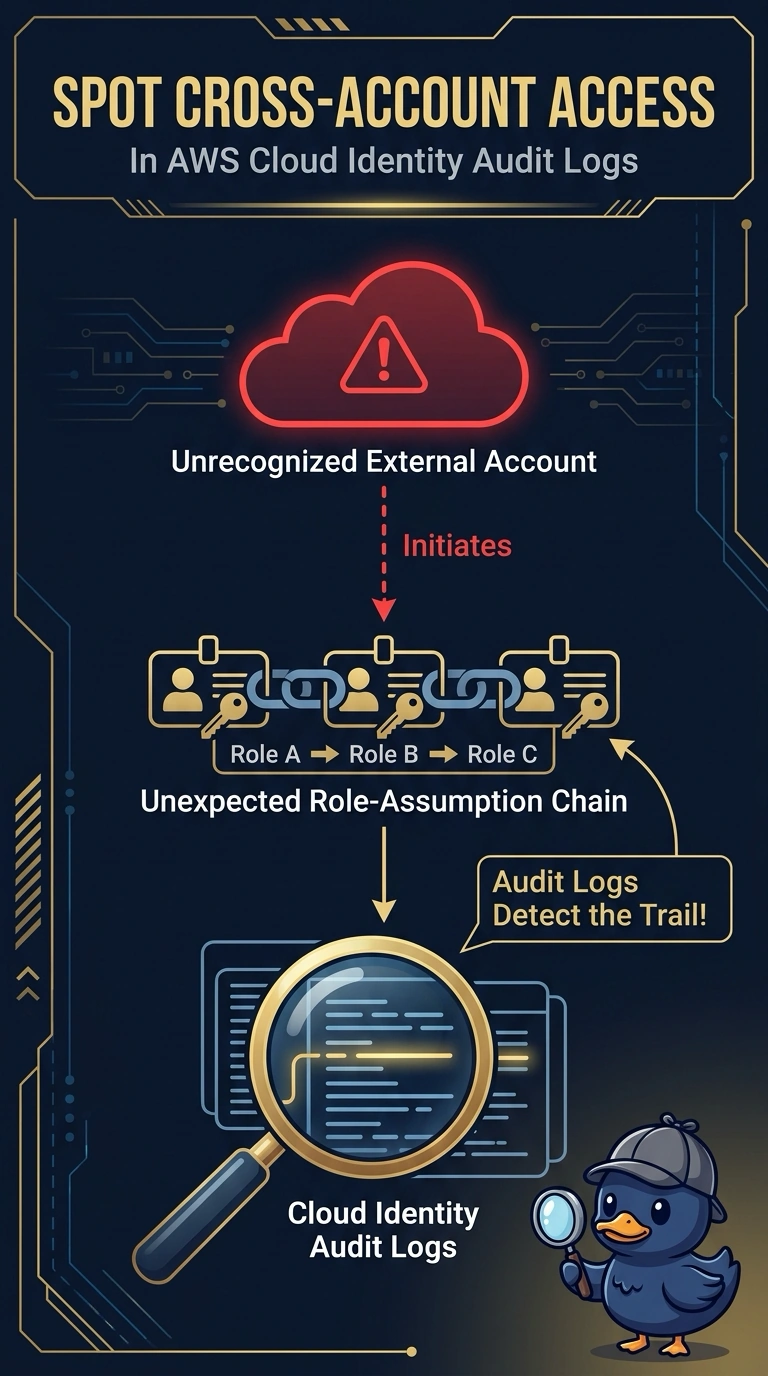
You’re right to focus on identity logs: temporary roles can hide a stealthy trust jump across AWS accounts. An unexpected role-assumption chain from an unrecognized external account is the strongest clue; the listed health checks, backups, and password changes describe routine activity instead.
Full Explanation
Cloud-native threat hunting relies on control-plane audit logs to spot unauthorized identity pivots across trust boundaries. Unexpected role-assumption chains initiated from an unrecognized external account indicate that an external principal is invoking temporary credentials to escalate privileges or move laterally between accounts, making this pattern the strongest evidence of unauthorized cross-account access. Routine read-only health checks executed by an internal monitoring service instead represent normal operational telemetry with predictable source identities. Scheduled automated backups writing encrypted snapshots to a local bucket reflect expected maintenance activity within authorized storage boundaries, rather than a cross-account identity pivot. Standard user password changes completed through the corporate identity portal are routine account hygiene, not evidence of cross-account privilege escalation. One caveat is that legitimate third-party vendors or disaster-recovery tools may sometimes assume cross-account roles, so an external source is not automatically malicious; verify that its account is approved. As a practical check, correlate cross-account role-assumption events in cloud audit logs against your approved partner account inventory, then inspect subsequent API calls made by the temporary session.