
A threat hunter at a SaaS provider is reviewing network protocol metadata to find encrypted command-and-control channels where full packet decryption is unavailable. Certificate attributes are available from captured TLS 1.2 handshakes or trusted endpoint/proxy enrichment. Which protocol indicator best warrants deeper host investigation?
Select an answer to reveal the explanation.
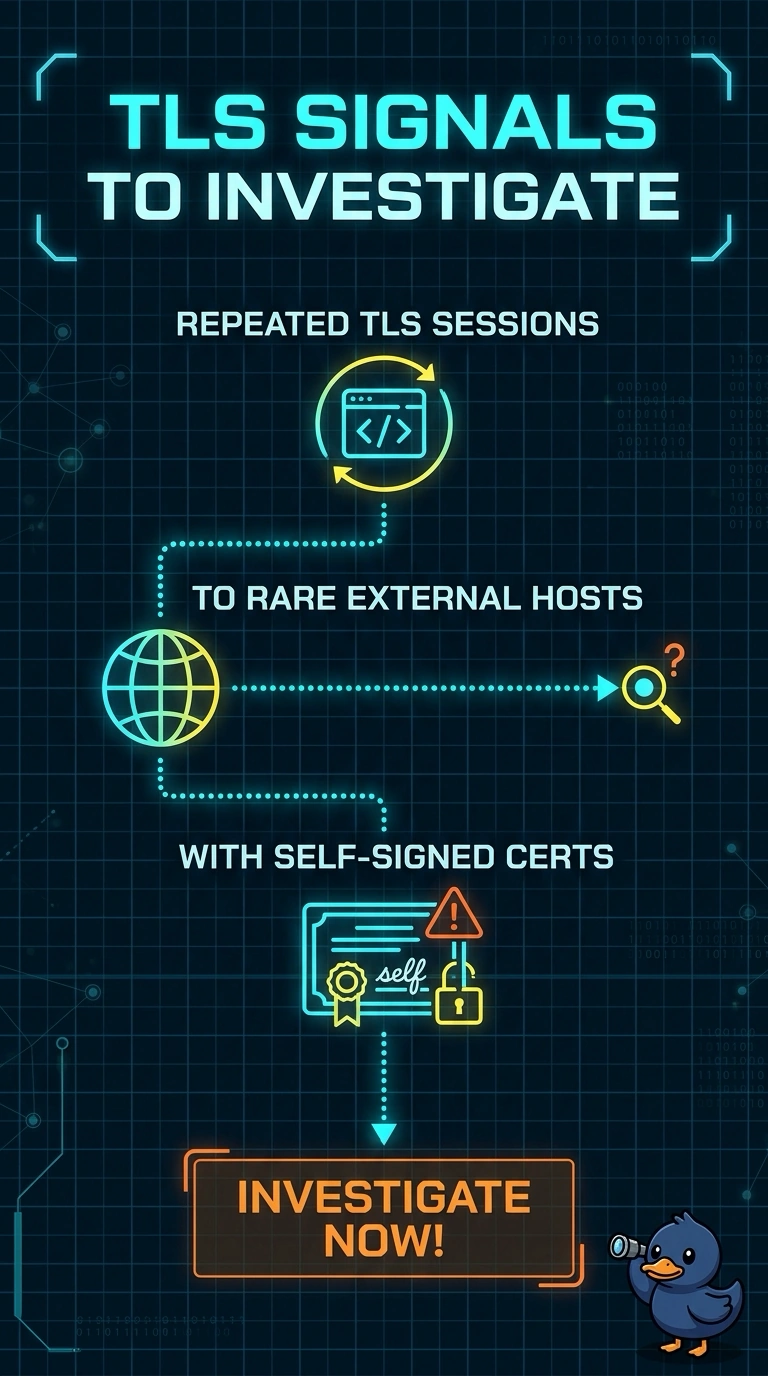
Short Explanation
Even when encryption hides the conversation inside a sealed envelope, you can still spot suspicious behavior by watching who receives repeated late-night letters. The trap is assuming encrypted traffic leaves zero clues without full packet decryption.
Full Explanation
When payload inspection is unavailable, TLS handshake metadata and session frequency expose anomalous command-and-control patterns. TLS 1.3 encrypts Certificate messages, so a passive sensor without session keys cannot generally inspect the server certificate from that handshake. Selecting Repeated TLS sessions to rare external hosts with self-signed certs highlights classic adversary infrastructure traits, as threat actors often spin up short-lived servers with unverified certificates and maintain periodic callbacks. In contrast, Standard TLS handshakes using trusted enterprise root certificates reflect normal internal or managed services that align with organizational trust stores. Routine DNS lookups resolving well-known content delivery providers represent expected baseline traffic for modern cloud applications and rarely signal covert channels on their own. Similarly, High-volume outbound video streaming during scheduled town halls matches predictable business events rather than stealthy beaconing. As a caveat, some legitimate developer tools or legacy appliances also use self-signed certificates internally, so destination rarity and session regularity matter. As an operational check, pivot from the rare destination IP and certificate fingerprint to endpoint process logs to verify which binary initiated the TLS connections.