
A threat hunter reviews perimeter network flow and packet metadata and suspects an internal host is using ICMP to covertly exfiltrate data past a misconfigured firewall. Which protocol anomaly best supports this hypothesis?
Select an answer to reveal the explanation.
Short Explanation
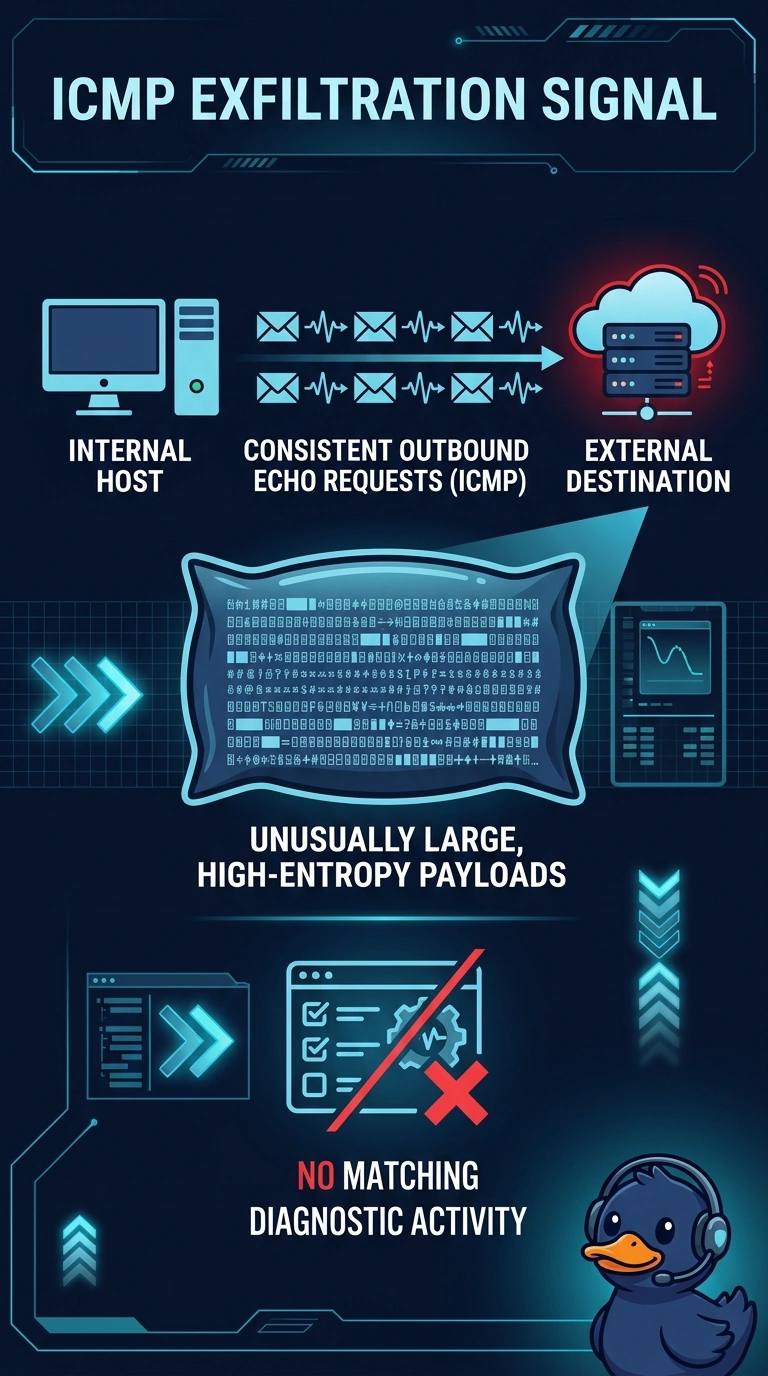
You’re right to focus on whether the echo requests carry more than routine reachability checks need. Unusually large or high-entropy payloads without matching diagnostic activity can point to covert data transfer, unlike the small probes used for ordinary monitoring.
Full Explanation
Consistent outbound echo requests carrying unusually large or high-entropy payloads without matching diagnostic activity strongly support ICMP tunneling: attackers can embed encoded command-and-control traffic or exfiltrated files in the data section of echo packets. Occasional small echo requests sent by a network monitoring server during uptime checks are expected administrative health polling, with small, predictable payloads. Brief bursts of destination unreachable messages from a misconfigured internal router are network error signaling, not evidence of an outbound covert channel. Standard path MTU discovery probes triggered by normal encrypted web browsing are legitimate transport-optimization packets and do not indicate sustained outbound data transfer. As an exam caveat, some custom troubleshooting tools or VPN keepalives can occasionally use non-standard ICMP sizes, so an unusual packet size alone does not establish an incident; pair protocol anomalies with host process context. For a practical check, inspect packet captures or flow byte counts for the source host and correlate ICMP timestamps with endpoint process-creation logs to identify which binary initiated the traffic.