
A threat hunter queries endpoint process creation telemetry in a SIEM to uncover initial execution of malicious macros and script-based payloads. Which parent-child process relationship most strongly warrants immediate investigation?
Select an answer to reveal the explanation.
Short Explanation
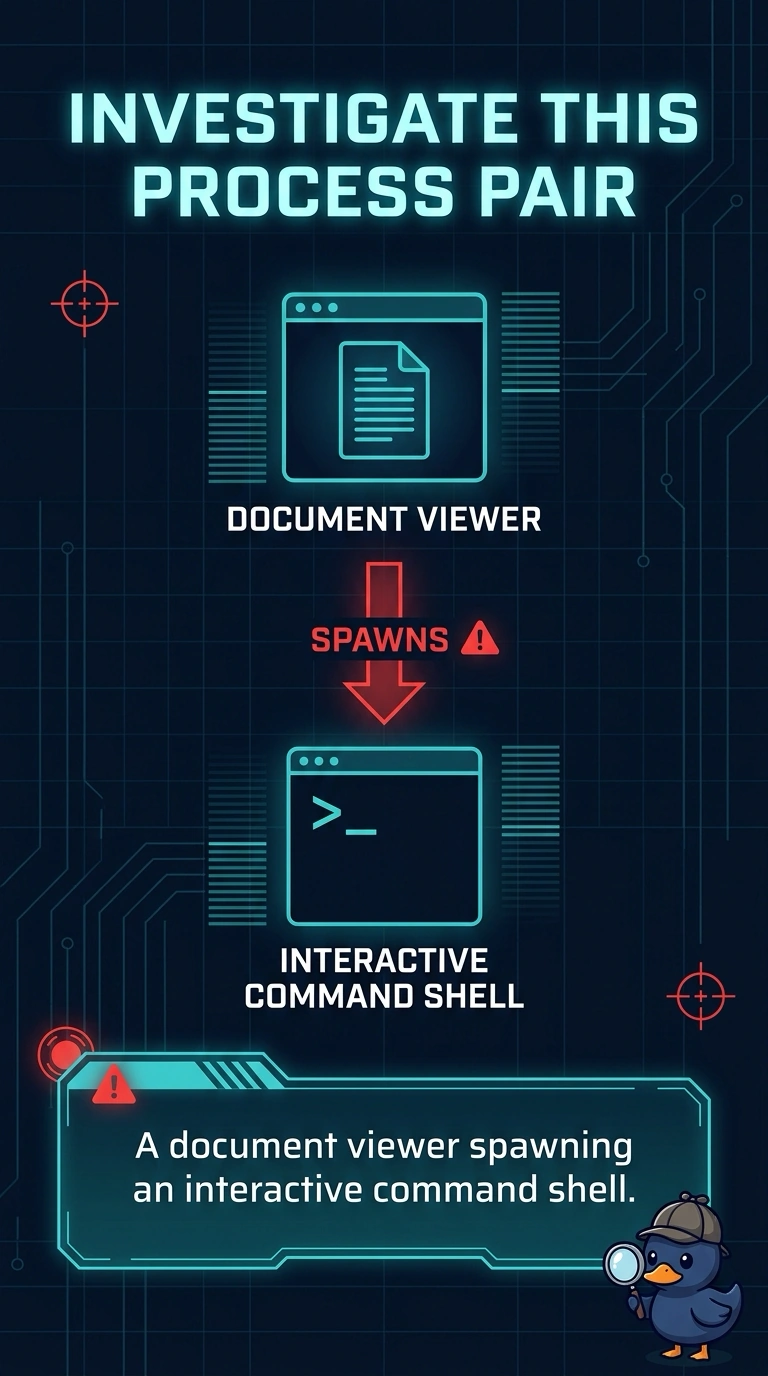
A document viewer's job is to show text and images, not to open a command prompt and start running scripts behind your back. The trap is chasing noisy but normal operating system or browser subprocesses instead of spotting true execution anomalies. When you see a productivity app launching a shell, treat it as a high-priority hunting lead.
Full Explanation
Tracking anomalous parent-child process relationships is a core endpoint hunting technique, and A document viewer spawning an interactive command shell strongly indicates malicious macro, script, or exploit execution because document readers have no routine need to launch command interpreters. By contrast, A system service manager launching a scheduled operating system update reflects normal maintenance behavior managed by core operating system services. Similarly, A web browser spawning a dedicated tab rendering subprocess is standard multi-process browser architecture designed for isolation and stability. Likewise, An interactive user shell running a standard directory listing represents ordinary command-line navigation rather than an unexpected execution chain. Caveat: certain enterprise plugins or custom document automation workflows can occasionally invoke helper scripts, so always inspect the full command line and user context. As an operational check, query endpoint process-creation logs for command-line arguments, script paths, and any immediate outbound network connections from the spawned shell.