
A threat hunter is authoring a custom YARA signature to detect a family of malicious scripts across enterprise endpoints. Which construction practice produces the most durable and accurate signature?
Select an answer to reveal the explanation.
Short Explanation
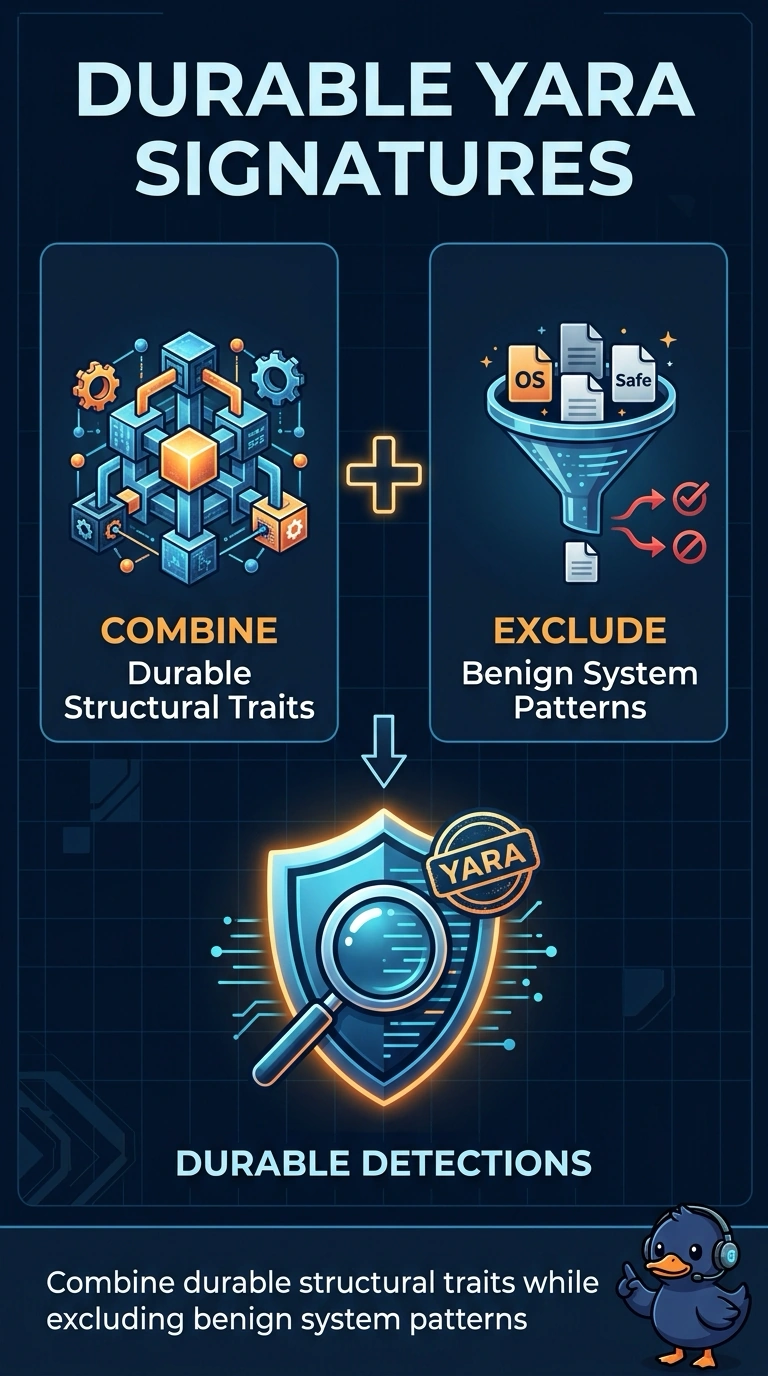
A good detection rule is like a tailored key: too loose and every door opens, too rigid and one tiny scratch breaks it. You want to combine durable structural traits while excluding benign system patterns. The trap is relying on brittle single hashes or noisy wildcards.
Full Explanation
The most effective approach is to combine durable structural traits while excluding benign system patterns. Pairing invariant code structures, unique API call sequences, or consistent configuration markers with explicit exclusion conditions catches variants of a malware family without flooding analysts with false positives. Choosing to match only the exact file hash of a single observed sample breaks the moment an attacker changes a single byte or recompiles the script. Choosing to write broad wildcard patterns that match common system strings triggers excessive false alarms on legitimate administrative files and degrades endpoint performance. Choosing to hardcode temporary attacker IP addresses into file-scanning rules creates brittle signatures that fail as soon as infrastructure rotates. One caveat is that overly complex regular expressions inside file-scanning rules can slow scanning throughput on large endpoints. As an operational check, test every new rule against a corpus of known-good enterprise files and historical malware samples before deploying it into production alerting.