
A cybersecurity director asks a threat hunting lead to demonstrate whether the team's quarterly hunting sprints are actually improving organizational defense rather than just keeping analysts busy. Which metric pair best evaluates threat hunting effectiveness?
Select an answer to reveal the explanation.
Short Explanation
Counting busywork hours or noisy alerts makes a hunting team look active on paper without proving you are actually safer. Measure how much faster you spot real threats and how often your hypotheses pay off with high-signal detections.
Full Explanation
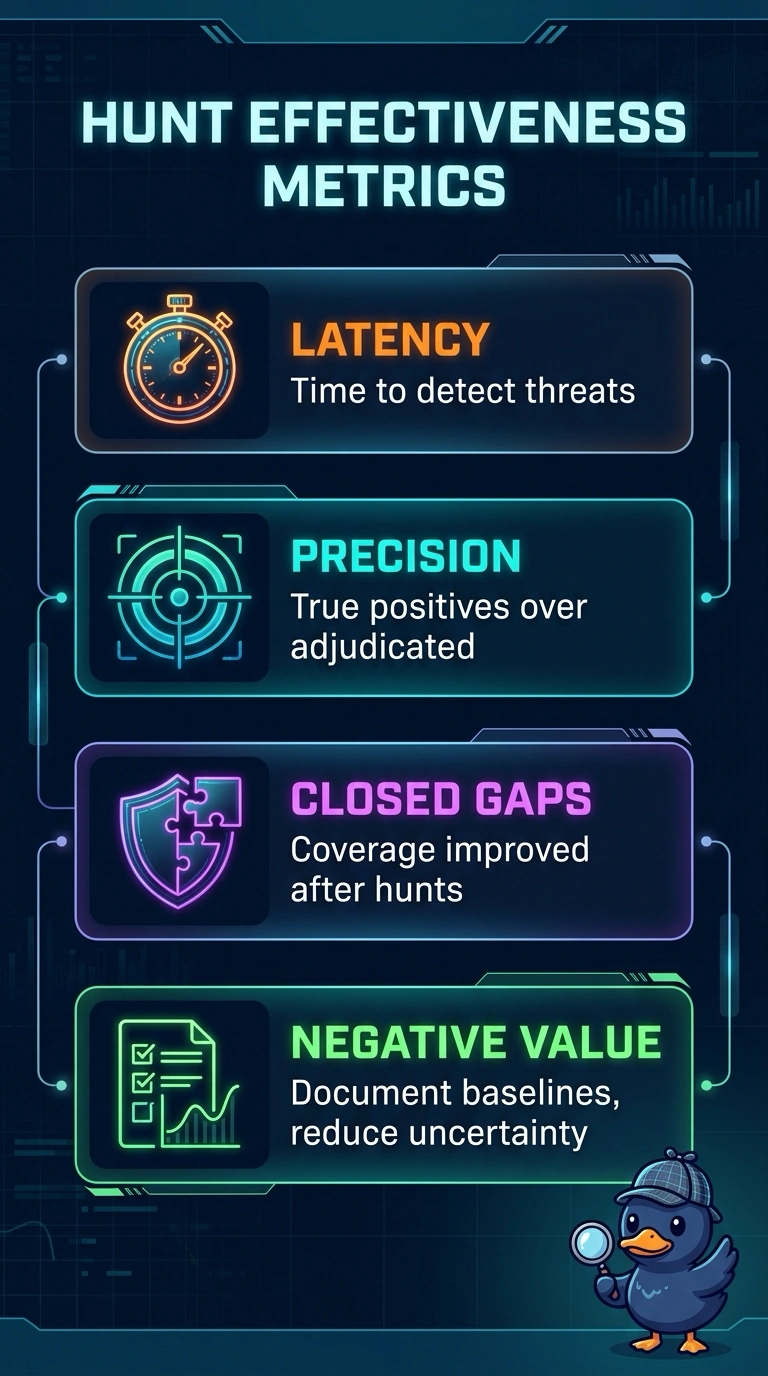
Effective threat hunting should measurably shorten the time adversaries can operate undetected and convert investigative discoveries into reliable, low-noise detections. Tracking Measured detection latency and precision of validated hunt-derived detections demonstrates whether hunts are uncovering real blind spots and producing durable operational value. Precision is confirmed true-positive alerts divided by adjudicated alerts; also track closed gaps and useful negative outcomes. Choosing to measure Total hours analysts spent reading threat advisories without running queries tracks passive activity rather than empirical testing against enterprise telemetry. Choosing to count the Raw count of unverified SIEM alerts generated regardless of false positives rewards noisy rule creation that overwhelms SOC triage analysts. Choosing to count the Number of security dashboards displayed on the main operations center wall measures visual reporting rather than defensive improvement. As a caveat, a hunt that disproves a hypothesis is still valuable when it documents normal baselines and closes an uncertainty gap, so effectiveness metrics should not penalize rigorous negative findings. Operationally, compare pre-hunt and post-hunt detection coverage in your tracking log and verify that newly promoted rules maintain an acceptable false-positive rate over a 30-day review.