
A threat hunting team plans to deploy decoy credentials and canary files across an enterprise environment to detect internal reconnaissance. What design principle is most critical to keep these deception countermeasures reliable?
Select an answer to reveal the explanation.
Short Explanation
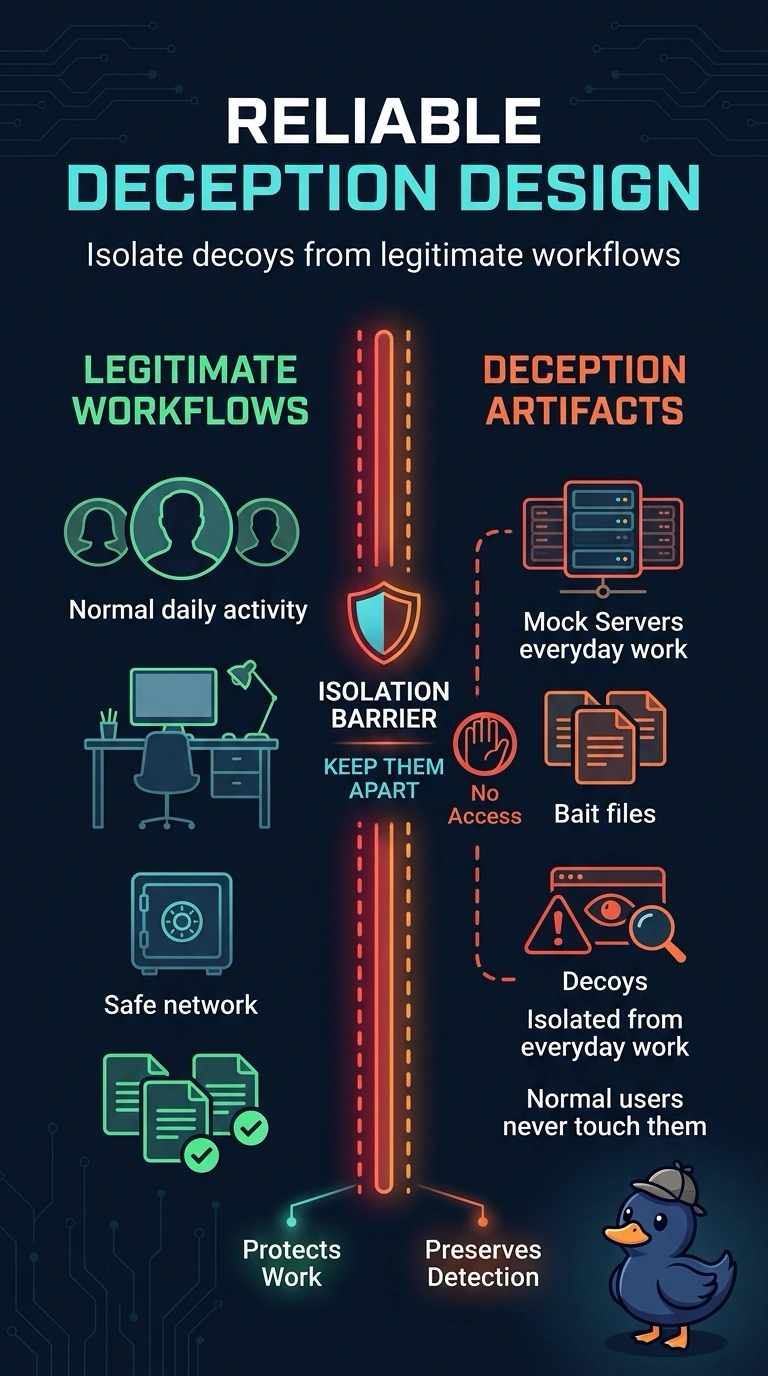
Deception works like a tripwire in a locked storage room: it only stays useful if employees never walk through it by accident. Keeping decoys isolated ensures every alert you see points to suspicious probing. The trap is placing lures in busy folders or granting them real privileges that widen your risk.
Full Explanation
The core value of deception countermeasures is near-zero false-positive alerting, which is why Isolate deception artifacts from legitimate workflows so normal users never touch them is the critical design principle. When decoy credentials or canary files sit outside normal business paths and automated scanners, any interaction strongly signals unauthorized enumeration or lateral movement. Deploy decoy accounts with domain administrator privileges on all hosts is dangerous because granting real administrative rights creates unnecessary attack surface if an adversary compromises the decoy. Publish canary file locations in the company-wide IT onboarding guide defeats the purpose of deception by informing users and cluttering alerts with curious clicks or automated indexing. Configure deception alerts to automatically wipe the triggering endpoint is reckless because automated destructive actions can disrupt production systems if a vulnerability scanner or backup job touches a lure. As a caveat, enterprise vulnerability scanners and endpoint backup agents must be explicitly excluded or monitored separately. As an operational check, test each decoy in a staging group for one week to verify zero legitimate service or user hits before enabling high-priority SOC alerting.