
A healthcare security team wants a low-noise countermeasure that detects intruders conducting internal lateral-movement reconnaissance across production workstations without disrupting legitimate clinical workflows. Which approach best meets this goal?
Select an answer to reveal the explanation.
Short Explanation
Imagine placing a silent tripwire inside a room no employee ever needs to enter—only an intruder will step on it. If you instead shut down everyday tools or flood your SIEM with failed-login noise, your clinical staff and analysts pay the price.
Full Explanation
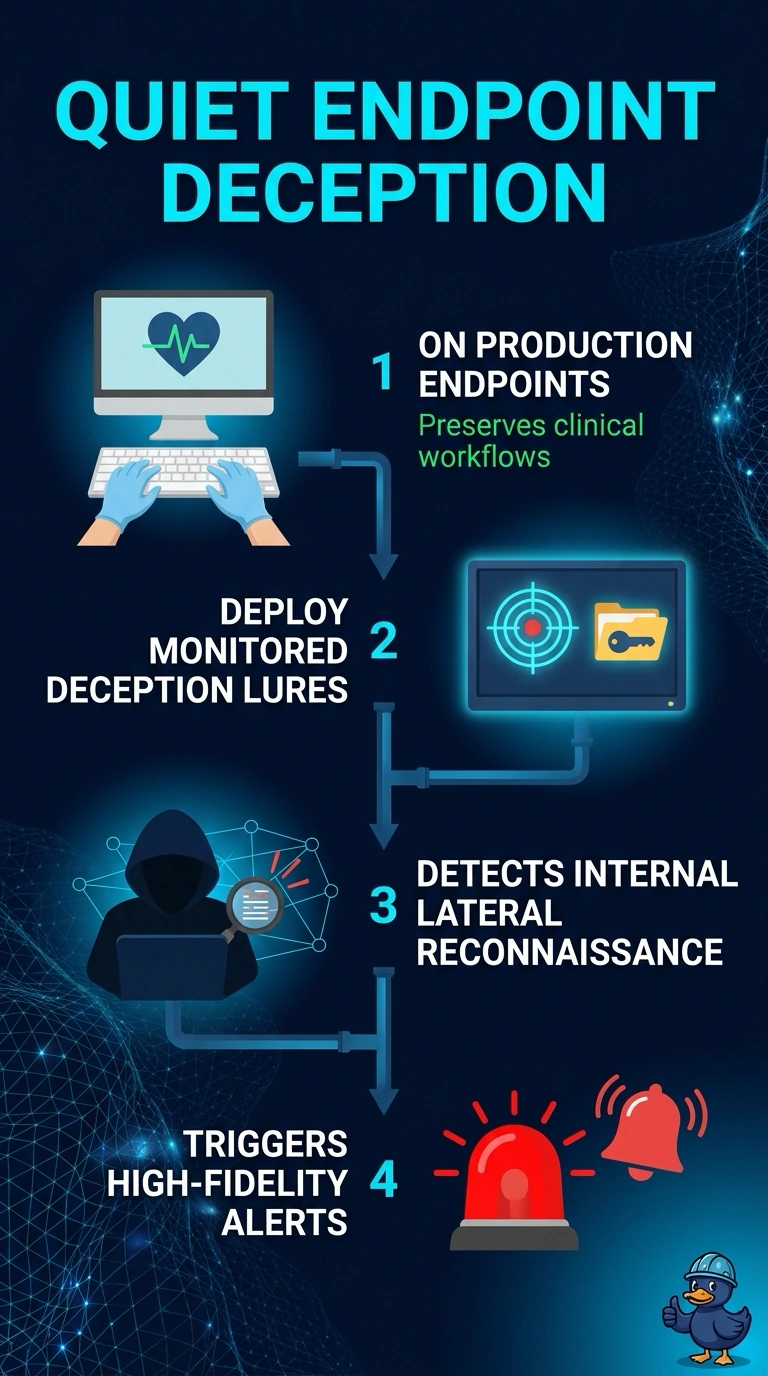
Deception countermeasures provide high-signal detection because legitimate users and automated workflows have no reason to interact with fabricated assets. When defenders Deploy monitored deception lures on endpoints that trigger high-fidelity alerts, any reconnaissance query or access attempt against those lures immediately signals suspicious exploration with minimal false positives. Choosing to Block all administrative scripting utilities across every workstation immediately risks breaking legitimate IT management and clinical support scripts. Choosing to Disable internal name resolution protocols on all hospital subnets during business hours would disrupt normal application connectivity across the environment. Choosing to Lower SIEM anomaly thresholds to alert on every single failed authentication attempt floods analysts with benign typo and expired-password noise, masking real threats. As a caveat, deception lures must look realistic enough to attract an adversary while remaining completely isolated from automated backup or indexing jobs that could trigger false alerts. Operationally, test each deployed lure by verifying that routine vulnerability scanners and help-desk tools do not touch it during a full weekly cycle.