
During a threat hunt, analysts confirm an adversary compromised a domain administrator account and used it to grant a standard user account directory replication permissions for ongoing credential access. Why is resetting the administrator's password alone insufficient remediation?
Select an answer to reveal the explanation.
Short Explanation
Changing your front door lock does little good if the intruder already unlocked the side gate for a second account. The trap is assuming a password reset erases every permission change the attacker made while holding your domain admin rights.
Full Explanation
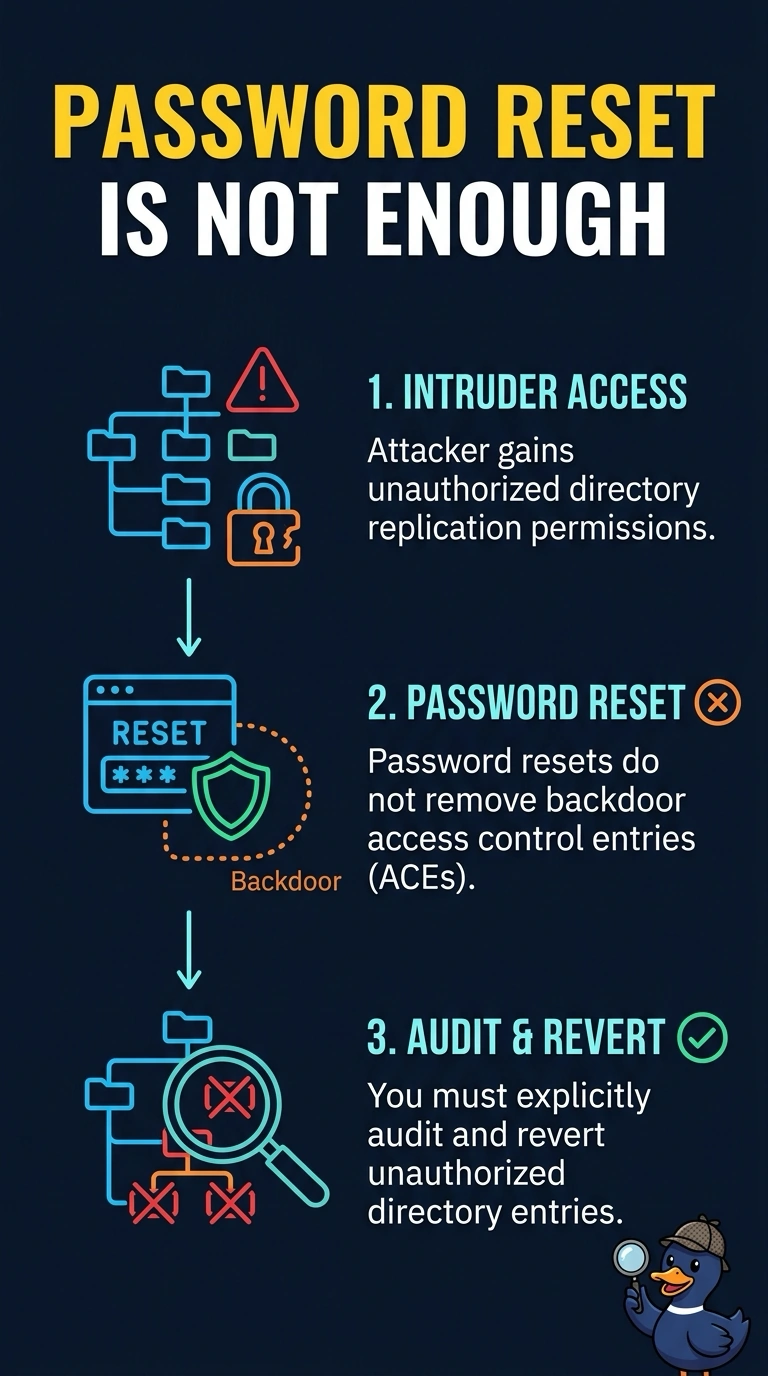
When an attacker holds administrative privileges, they can modify directory Access Control Lists—such as granting directory replication rights or altering sensitive security groups—so Unauthorized directory access control entries persist as a backdoor until explicitly audited and reverted. Even after the original administrator password is changed, the secondary account retains its newly granted replication rights and can continue harvesting credentials. Claiming that Password resets automatically revoke every delegated directory permission across the domain is false because authentication secrets and object authorization permissions are stored separately. Believing that Directory replication permissions expire immediately whenever any administrator logs off confuses transient login sessions with persistent directory ACLs. Assuming that Changing the password forces all domain controllers to rebuild their permission tables misunderstands replication, which actually preserves and propagates the attacker's ACL changes. Also audit AdminSDHolder permissions for protected-account backdoors; its protection task can reapply ACLs to protected users/groups. Domain-root replication ACEs must be audited separately—AdminSDHolder does not generally restore arbitrary DCSync grants on the domain root. For an operational check, audit directory ACLs on the domain root and privileged admin containers against a known-good baseline before closing the incident.