
A threat hunting team wants a low-noise deception countermeasure that immediately alerts the SOC if an intruder performs internal port scanning or probes unused network segments for lateral movement targets. Which deployment best achieves this goal?
Select an answer to reveal the explanation.
Short Explanation
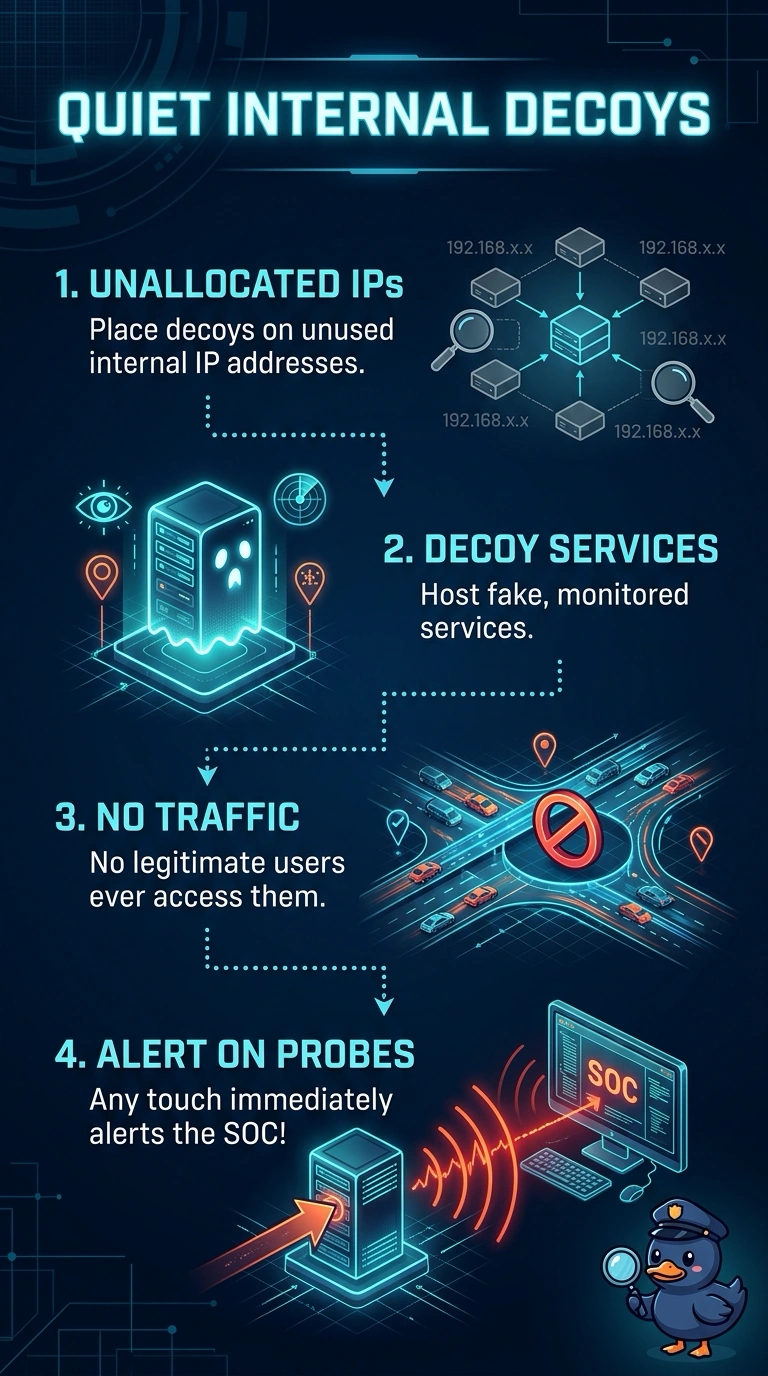
Think of a decoy service like a silent alarm on an empty warehouse door that nobody in the company should ever open. Because legitimate users have no reason to knock there, any connection you see is immediately suspicious. The trap is confusing high-noise logging or blunt perimeter blocks with targeted internal deception.
Full Explanation
Deception works best when legitimate traffic never touches the trap, which is why Deploying monitored decoy services on unallocated internal IP addresses with no legitimate traffic produces high-fidelity alerts. When an intruder sweeps internal subnets for open administrative ports or shares, interacting with those dark addresses immediately exposes reconnaissance without flooding analysts with false positives. By contrast, Configuring perimeter firewalls to block all outbound DNS queries from every internal user workstation is a disruptive egress restriction that breaks normal name resolution rather than detecting internal lateral probing. Similarly, Increasing SIEM retention for routine DHCP lease renewals across all corporate branch offices adds storage overhead without creating an active tripwire for unauthorized scanning. Meanwhile, Enabling verbose debug logging on every production web server's public-facing load balancer generates massive external noise instead of catching internal east-west discovery. As a caveat, vulnerability scanners must be excluded or accounted for so authorized sweeps do not trigger false alarms. As an operational check, verify that no production DNS records or automated inventory tools reference the decoy IP addresses.