
During a threat hunt, a malware analyst recovers a suspicious executable that stores its command-and-control URLs inside an XOR-encoded data section. How can the analyst safely extract those parameters without running the malware?
Select an answer to reveal the explanation.
Short Explanation
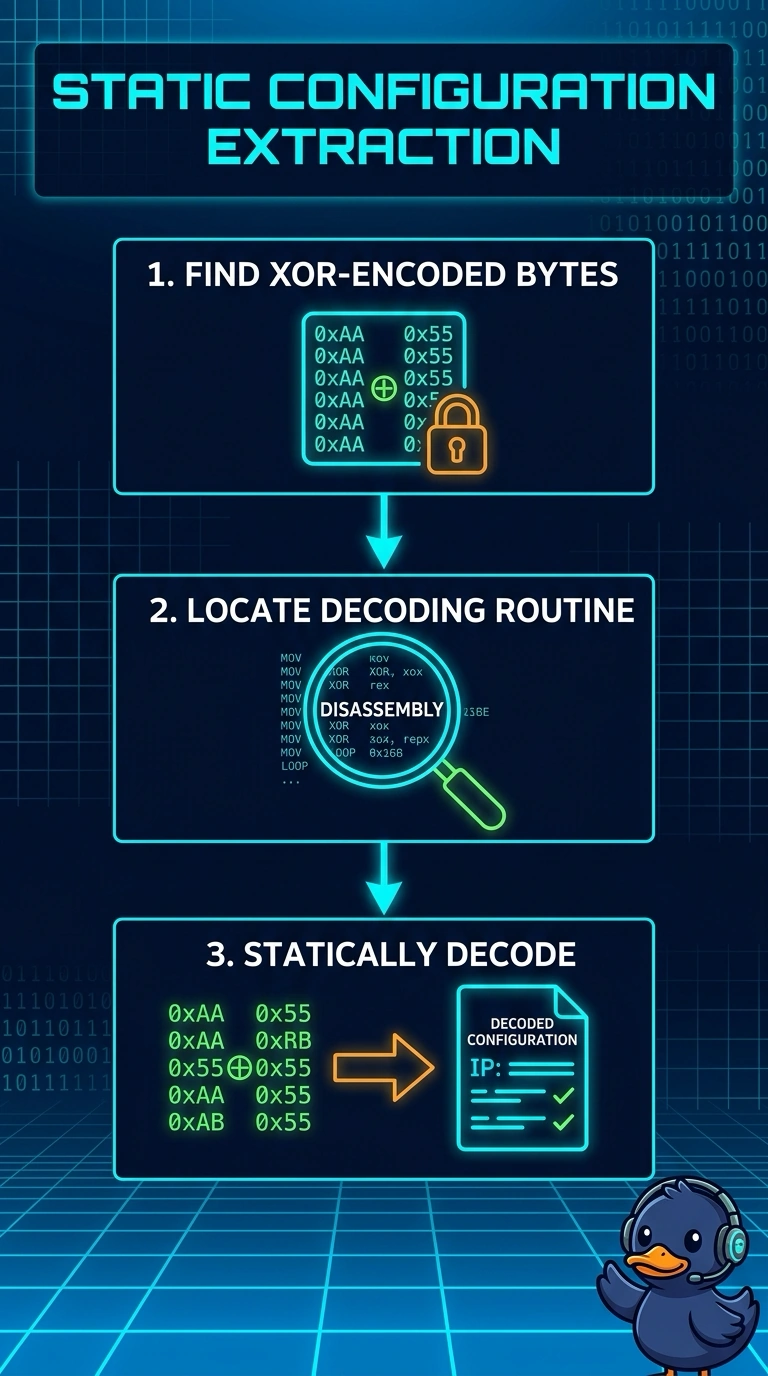
You don’t have to light a firecracker just to see what powder is inside; you can inspect the recipe without setting it off. By tracing the decoding routine and key statically, you can safely recover the configuration without running an unknown sample on a live system.
Full Explanation
Locate the decoding routine in disassembly and statically decode the encoded configuration bytes because reverse-engineering tools let you inspect the XOR key and loop logic without executing the payload. Once you identify the key or algorithm, an offline script can decrypt the configuration block and reveal C2 domains, ports, and campaign tags safely. Executing the binary directly on a production domain controller to observe live DNS queries is unsafe because running untrusted malware on a live production server risks immediate domain compromise. Uploading the raw binary to a public search engine and asking users to share internal incident logs violates handling practices and does not extract the binary’s local configuration. Renaming the executable file extension to plain text and opening it in a standard web browser does not reverse XOR encoding, so the configuration remains encoded. As an exam caveat, some samples use multi-stage encryption and derive keys at runtime, which can make static extraction insufficient and require controlled sandbox emulation. For a practical check, cross-check statically decoded C2 domains against passive DNS and proxy logs.