
A threat hunting team wants a low-noise deception countermeasure to detect adversaries performing internal Kerberoasting and service-account discovery across an Active Directory domain. Which deployment best achieves this goal?
Select an answer to reveal the explanation.
Short Explanation
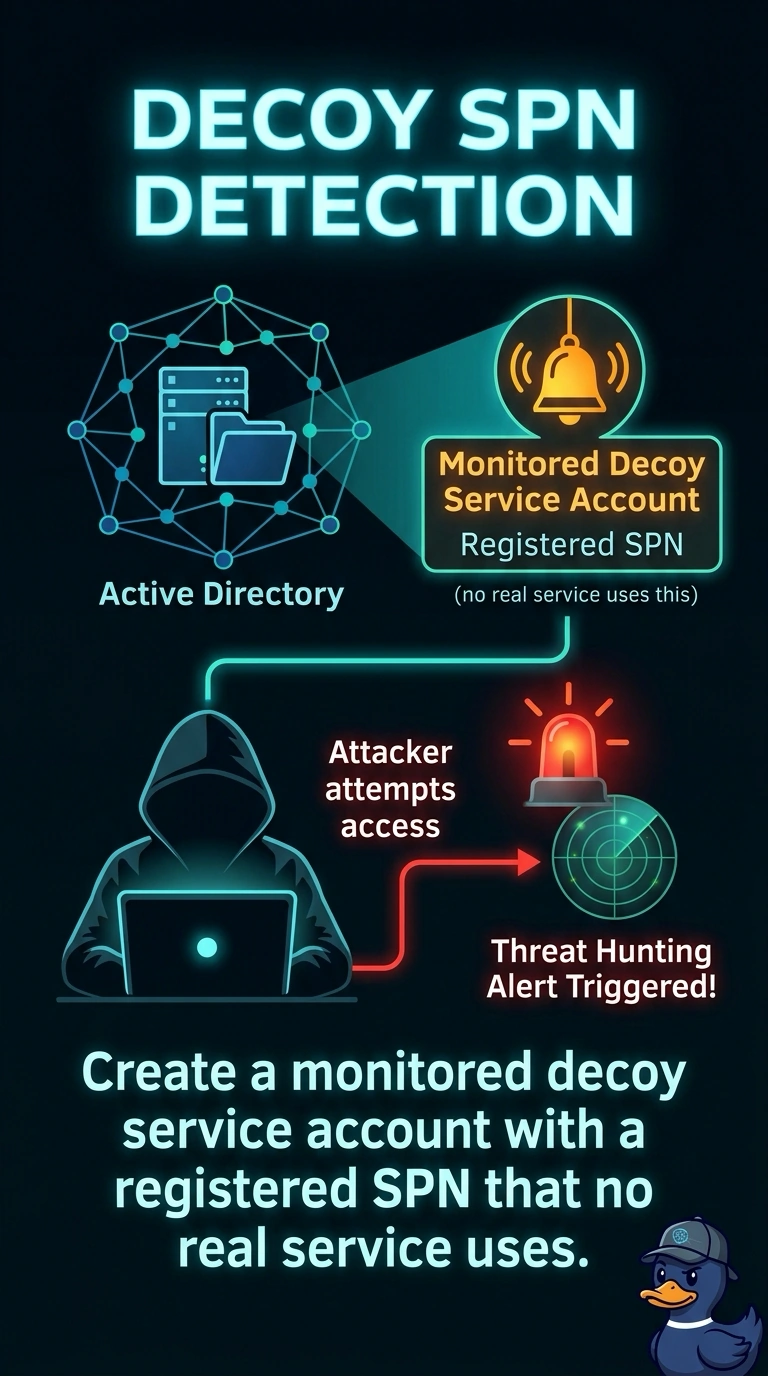
Setting a tripwire on an unused door means anyone who opens it immediately gives themselves away. A decoy service account lets you catch internal Kerberoasting with near-zero noise, whereas the trap is relying on perimeter blocks that never see inside your domain.
Full Explanation
Create a monitored decoy service account with a registered SPN that no real service uses provides a high-fidelity deception signal because legitimate users and applications have no reason to request a Kerberos service ticket for it. Any ticket request targeting that decoy SPN immediately alerts hunters to active internal enumeration or Kerberoasting. Choosing to Increase the domain password complexity requirement to twenty-four characters for all standard users hardens user passwords but does not generate an active detection signal when attackers enumerate service accounts. Meanwhile, Configure perimeter firewalls to block all inbound Kerberos traffic from external internet addresses fails to detect adversaries who have already compromised an internal workstation. Finally, Disable all legitimate application service principal names across production servers indefinitely would break normal enterprise authentication. As a deployment caveat, decoy accounts should be excluded from automated ticketing or password-audit scripts that might trigger false alerts. As an operational check, configure a dedicated SIEM alert on Kerberos service ticket requests for the decoy SPN and test it periodically during controlled validation.