
During a memory-resident attack investigation, an analyst finds a malicious dynamic-link library executing inside a legitimate process even though no corresponding DLL file exists on disk and standard OS loader records never logged it. Which technique explains this behavior?
Select an answer to reveal the explanation.
Short Explanation
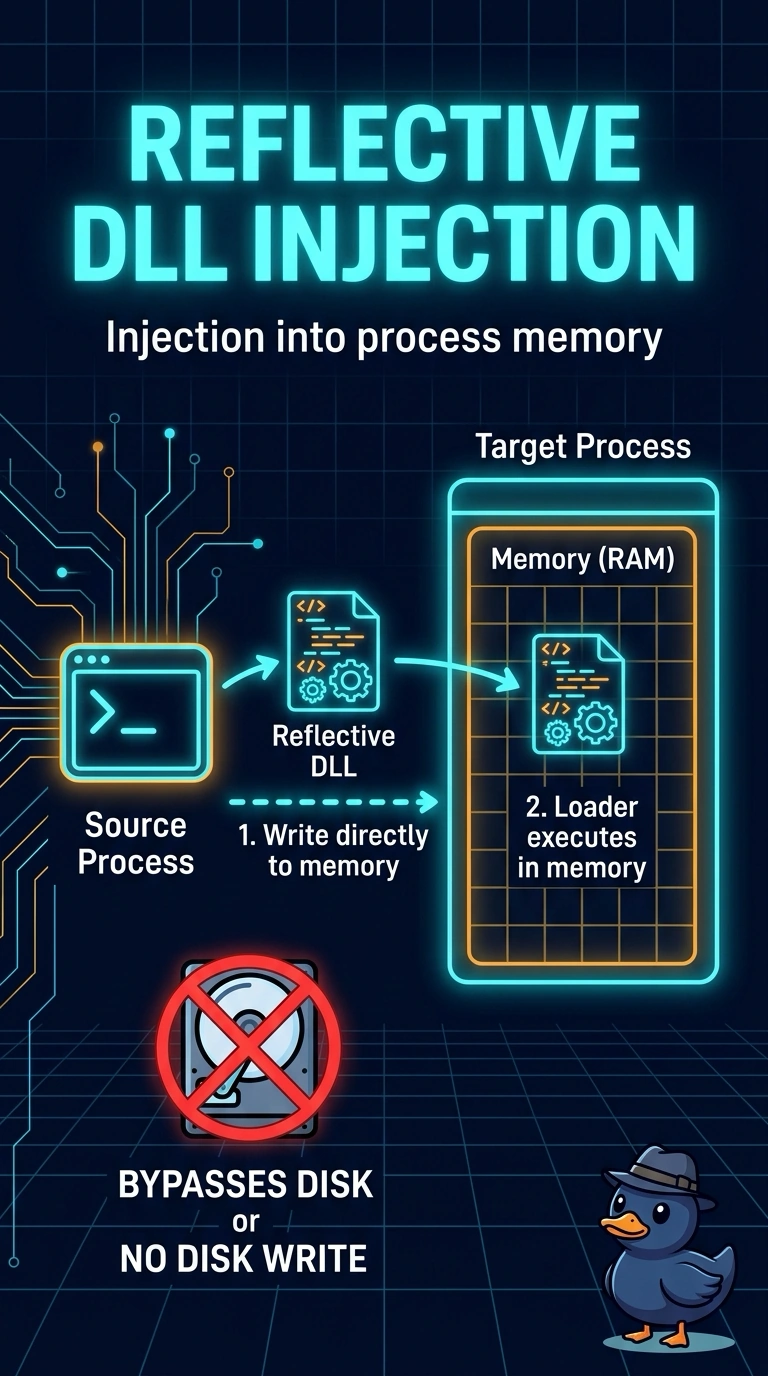
Reflective injection is like sneaking a guest into your building without signing the lobby logbook, because the payload maps itself straight into memory. The trap is attributing the hidden library to standard OS loader registration or disk replacement when no file ever touched storage.
Full Explanation
Reflective DLL injection into process memory explains this finding because the payload includes its own custom loader stub that maps sections, resolves imports, and executes directly inside an existing process without using the normal OS loader to map the payload DLL or requiring a payload DLL file on disk; the reflective loader may still call OS APIs to resolve dependencies. Traditional disk-based executable replacement on startup requires writing a modified binary to storage, which contradicts the absence of any file on disk. Standard OS loader registration via system registry keys relies on the operating system loader and leaves visible module entries in process structures. Static compile-time linking of libraries before deployment embeds code into a binary when it is built rather than injecting an unrecorded DLL into a running host process. As a caveat, some legitimate security tools and just-in-time runtimes also allocate executable private memory regions, so analysts must inspect memory content and thread start addresses. As an operational check, acquire volatile memory and scan for unbacked executable memory regions containing PE headers that do not map to disk-backed modules.