
During a post-incident review, a threat hunting team finds that an attacker injected code into a legitimate Windows service process in memory and cleared standard event logs before exiting. Which telemetry enhancement best closes this detection gap for future hunts?
Select an answer to reveal the explanation.
Short Explanation
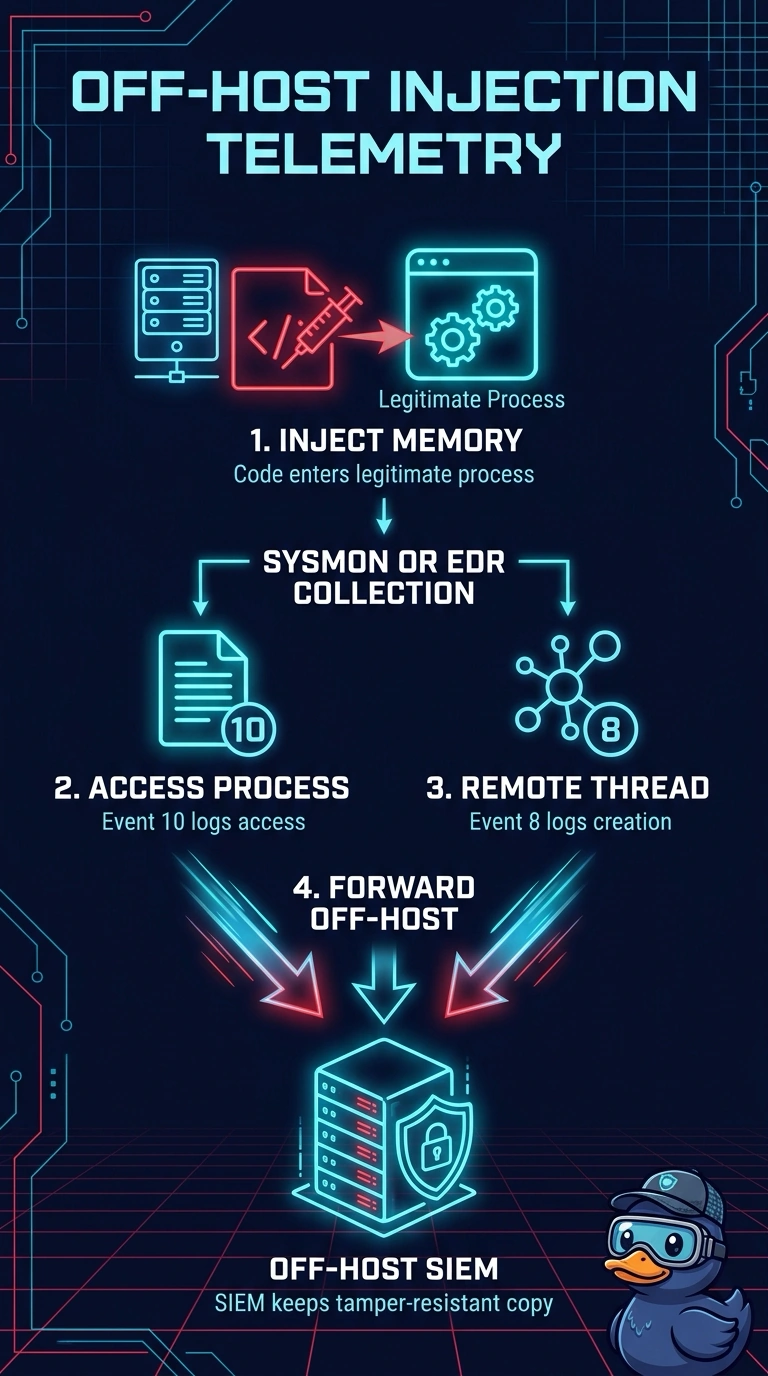
If an attacker erases the local security camera tape before leaving, buying a bigger local hard drive will not save your footage. You need process-injection visibility and off-host streaming so evidence survives tampering.
Full Explanation
Memory-resident process injection leaves minimal disk artifacts, and attackers with elevated privileges routinely clear local logs to hide their tracks. To close both blind spots, collect configured process-access and remote-thread telemetry with Sysmon or EDR and forward it off-host promptly, capturing cross-process access attempts and remote thread creation while streaming records to a central SIEM before local erasure can occur. For Sysmon, Event 10 records ProcessAccess and Event 8 records CreateRemoteThread; coverage is configuration- and technique-dependent and does not capture every injection variant. Forwarding protects records already received off-host, not events never generated or transmitted. Increase the local retention size of standard application event logs fails because larger local files do not add injection visibility and are still wiped when an attacker clears logs. Block all outbound ICMP traffic at the perimeter firewall is irrelevant to host memory injection and local log tampering because it addresses network traffic, not in-memory execution. Schedule weekly antivirus disk scans on critical server volumes misses memory-resident code entirely and operates far too slowly to catch active intrusions. Verbose access telemetry can generate high volume if noisy tools are not filtered, so tune configuration to balance coverage and load.