
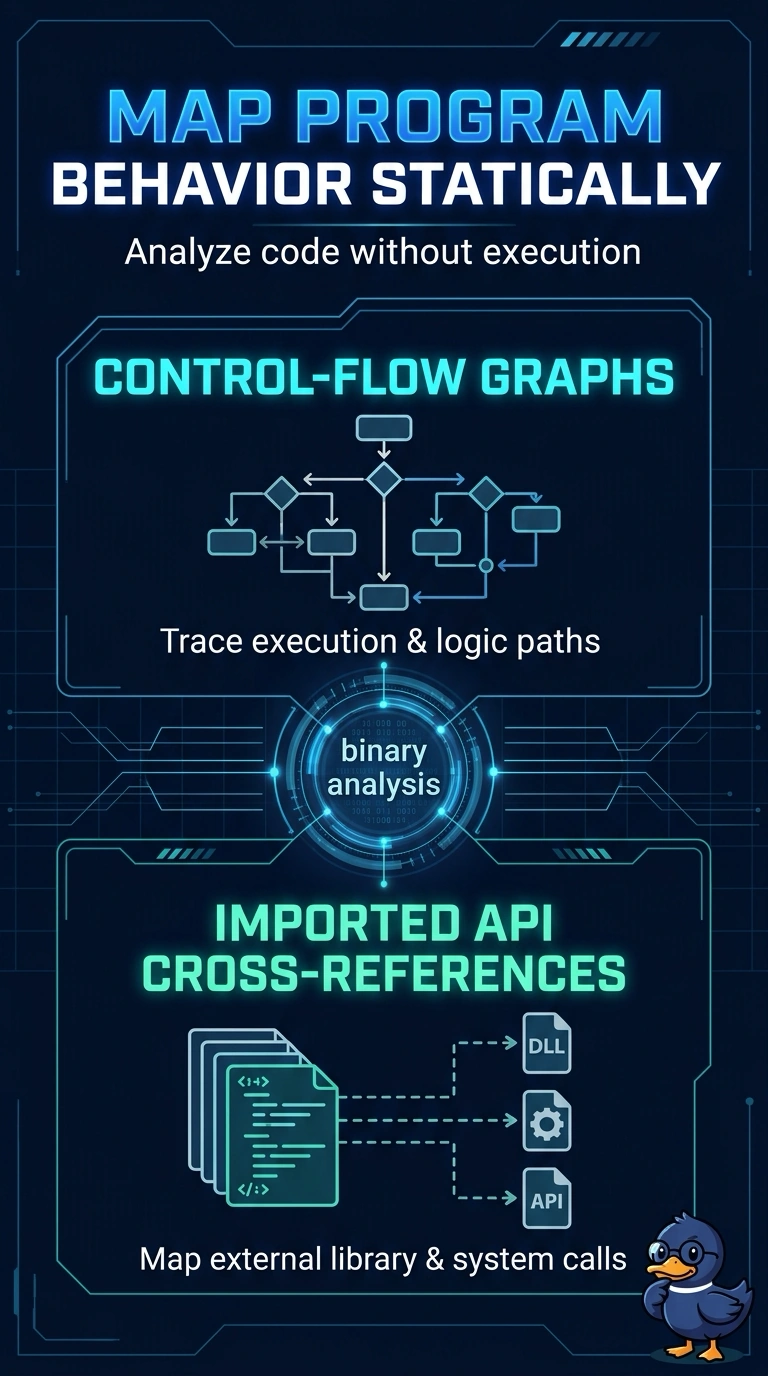
During a threat hunt, a malware analyst recovers a suspicious executable whose readable strings are heavily encrypted, making basic string searches useless. Which static reverse engineering approach best helps the analyst understand the program's structure and likely behavior without running it?
Select an answer to reveal the explanation.
Short Explanation
Even if a book's pages are written in code, you can still trace the chapter map and see which tools the author reaches for. When strings are encrypted, the trap is giving up on static analysis instead of reading the binary's control flow and API references.
Full Explanation
Even when text strings are obscured, Examining control-flow graphs and imported API cross-references reveals how functions branch, loop, and call operating system capabilities such as file access, registry edits, or network sockets. Mapping these structural relationships in a disassembler allows safe analysis before any dynamic execution. Conversely, Executing the binary directly on a production domain controller violates containment principles and risks immediate enterprise compromise. Similarly, Deleting the executable's header bytes to expose plaintext commands corrupts the binary format and does nothing to decrypt obfuscated data sections. Likewise, Monitoring live user keyboard input on the analyst's workstation does not inspect the recovered sample's internal logic. As a caveat, heavily packed binaries may hide both control flow and imports behind a small stub until unpacked in an isolated sandbox. For an operational check, load the sample into a static disassembler, inspect the entry point and import table, and trace cross-references to sensitive system APIs.