
While reverse engineering a suspicious Windows binary, an analyst notices the malware attempts to create a uniquely named mutex object immediately upon startup and exits if that object already exists. What is the primary purpose of this behavior?
Select an answer to reveal the explanation.
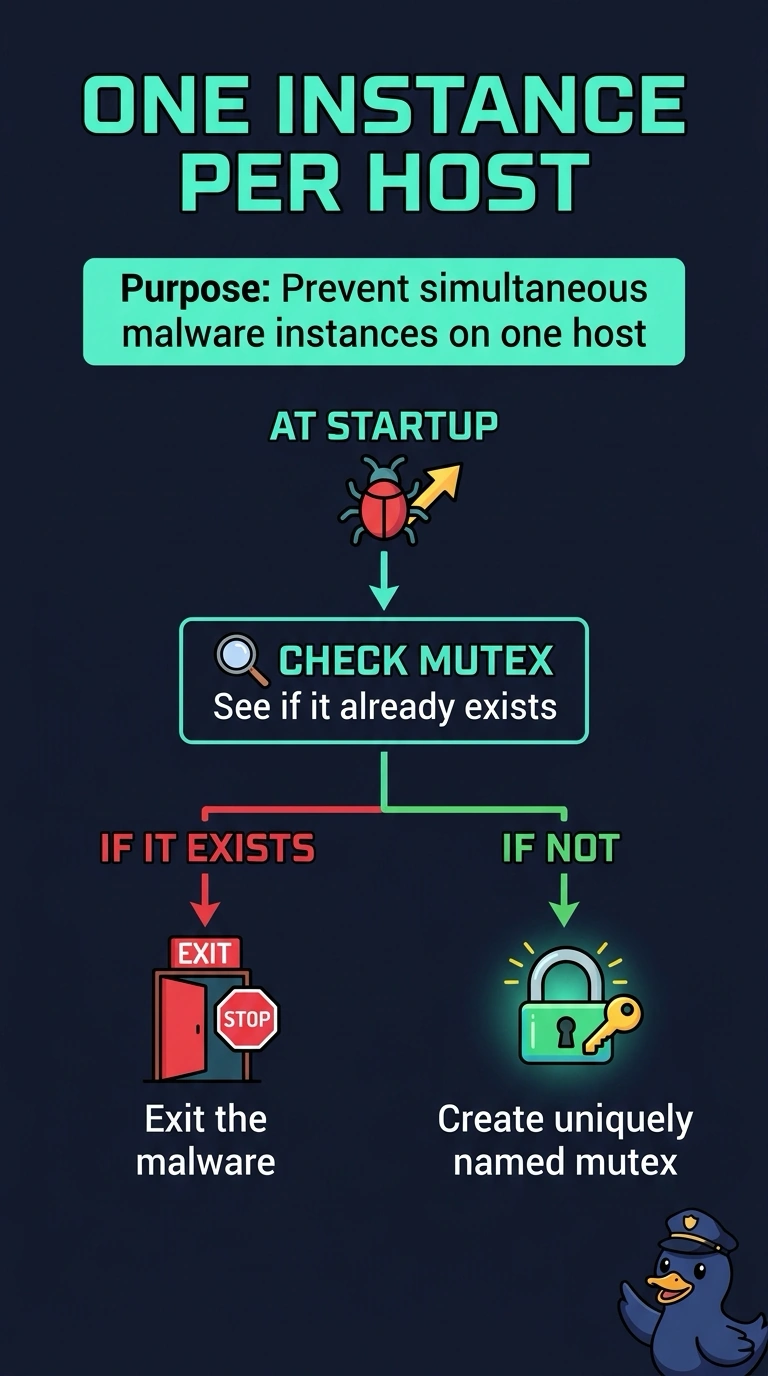
Short Explanation
Malware authors hate stepping on their own toes, so they leave a named mutex on the doorknob to tell duplicate copies the room is already taken! The trap is mistaking a simple synchronization marker for encryption or privilege escalation, when it is actually a golden hunting indicator for your team.
Full Explanation
A mutual exclusion (mutex) object is a standard operating system synchronization primitive that malware frequently repurposes as a host-level infection marker. Checking for and creating a unique mutex serves To prevent the malware from running multiple simultaneous instances on the same host, avoiding resource conflicts, duplicate C2 beacons, or file-locking crashes if a user clicks a lure twice. It is not designed To encrypt outbound command-and-control traffic using hardware-backed session keys, as mutexes hold no cryptographic key material or cipher logic. It does not function To automatically elevate the process privileges to kernel mode without user interaction, since creating a named synchronization object runs within the caller's existing security context. Nor is a mutex used To erase all historical Windows event logs before establishing network persistence, which requires interacting with event log services rather than synchronization handles. Caveat: defenders sometimes pre-create known malware mutex names as a temporary host-level vaccine, though adversaries can randomize mutex strings across builds. Operational check: search endpoint telemetry or memory handle listings across other hosts for the same unique mutex string to scope the intrusion.