
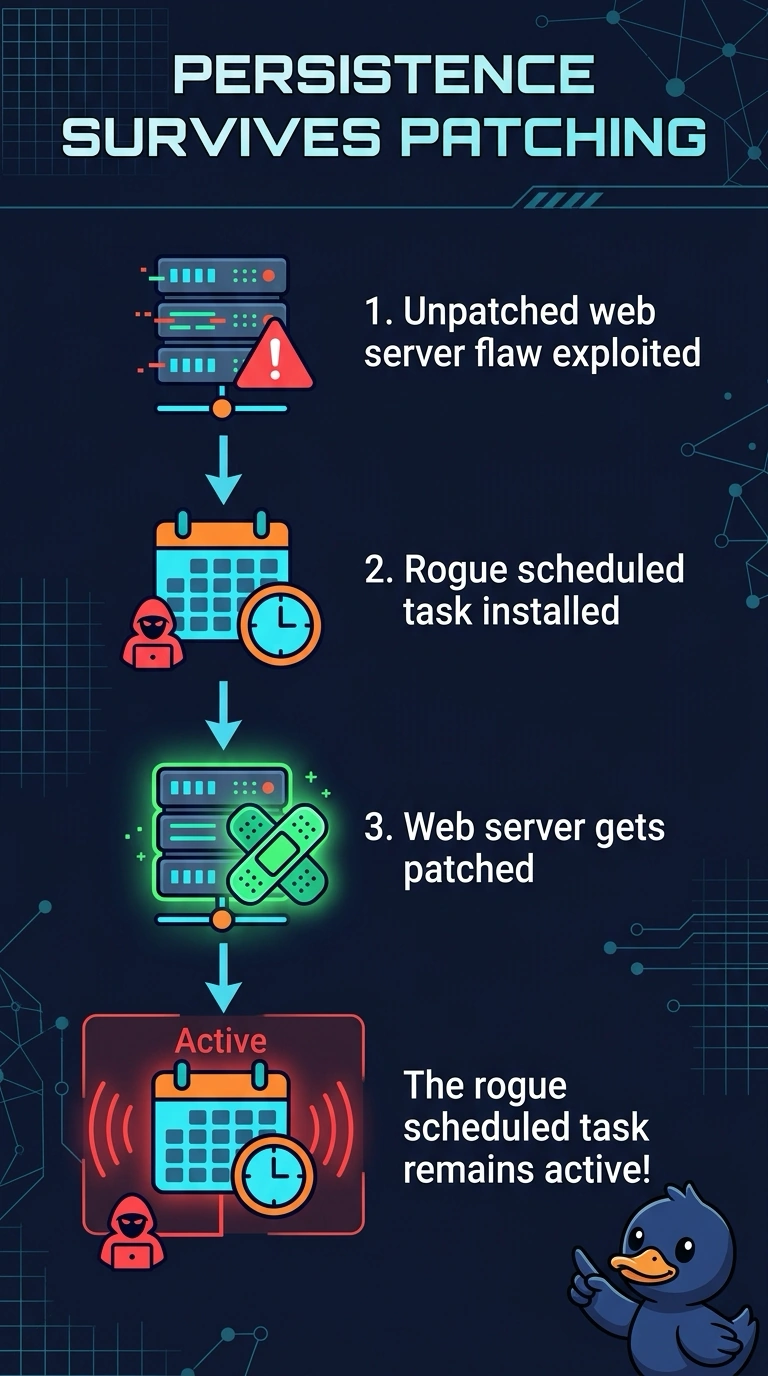
During a threat hunt, an analyst confirms that an attacker exploited an unpatched web server flaw to gain initial access and then created a rogue scheduled task to maintain access. Why is patching the web vulnerability alone insufficient to remediate this compromise?
Select an answer to reveal the explanation.
Short Explanation
Locking the front window after an intruder is already sitting in your living room will not get them out of the house. When you remediate a compromise, the trap is assuming a software patch removes the persistence mechanisms the attacker already planted.
Full Explanation
Vulnerability patching closes the original entry point against future exploitation, but The existing scheduled task persistence remains active on the host unless defenders explicitly hunt for and remove post-exploitation artifacts. Adversaries routinely establish independent persistence mechanisms so they can retain access even after initial flaws are fixed. Conversely, Applying vendor security patches automatically deletes all user accounts is incorrect because software updates do not purge system accounts or rogue tasks. Similarly, Scheduled tasks only execute when the web server software is unpatched is false because the operating system scheduler runs independently of web application patch levels. Likewise, Patching an application permanently disables all outbound network access misrepresents software maintenance, which restores security without severing normal host connectivity. As a caveat, if the attacker also harvested valid credentials before patching, persistence can be re-established even after removing the scheduled task. For an operational check, audit scheduled tasks, services, and startup entries on the host, rotate exposed credentials, and re-run hunt queries after patching.