
During a threat hunt, an analyst confirms that an attacker compromised an employee's cloud identity, reset their password, and established persistence using an authorized OAuth application. Which remediation step is essential to fully evict the attacker?
Select an answer to reveal the explanation.
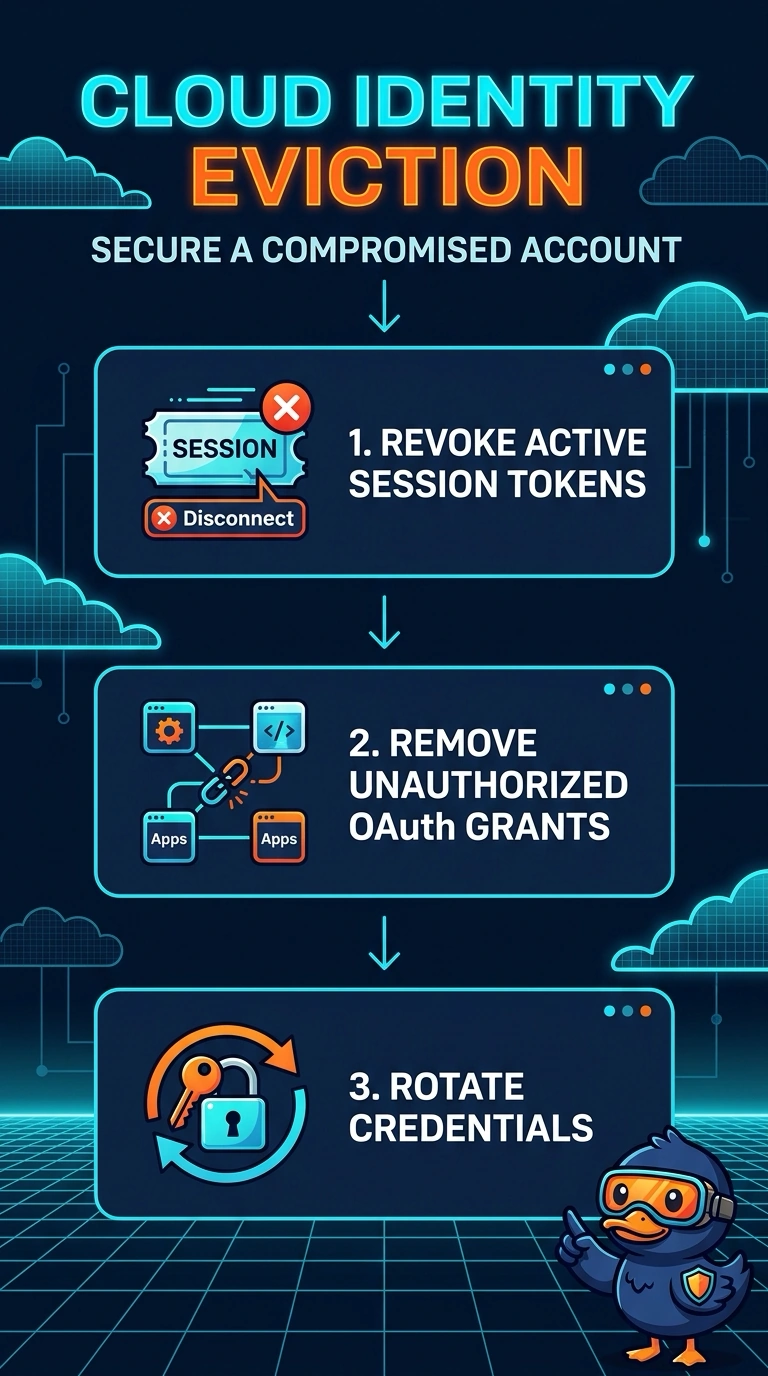
Short Explanation
Changing a password without revoking active tokens is like changing your house locks while leaving the back door propped open for someone already inside. The trap is assuming a password reset automatically kicks out an attacker holding valid OAuth or session tokens.
Full Explanation
Complete remediation of a cloud identity compromise requires you to revoke active session tokens, remove unauthorized OAuth grants, and rotate credentials. Password changes revoke some token/session types in some identity providers, but must not be assumed to terminate every access token, application session, or OAuth grant. Revoke sessions and grants explicitly, remove malicious app credentials, and verify provider-specific expiry or continuous-access enforcement. Choosing to reimage the employee's local laptop while leaving existing cloud identity sessions active addresses only the local device and leaves the cloud persistence mechanism intact. Similarly, deciding to block the attacker's initial login IP address at the perimeter firewall without touching cloud tokens fails because cloud APIs are reachable from any external network or proxy. Choosing to monitor the employee's account passively for another week before altering any permissions allows ongoing data exposure after the compromise is already confirmed. As a caveat, revoking sessions can temporarily disrupt legitimate workflows, so coordinate user communication during containment. As an operational check, audit the user's cloud sign-in logs and registered applications after revocation to confirm no new tokens or multifactor devices were added during the intrusion.