
After isolating a compromised file server, removing a rogue scheduled task, and rotating service credentials, a threat hunting team prepares to close the incident. Which final verification step best confirms that the adversary has been completely eradicated?
Select an answer to reveal the explanation.
Short Explanation
Pulling one weed out of the garden does not guarantee you did not miss a root two rows over. The trap is closing an incident right after cleaning one host without sweeping the rest of your environment to prove the attacker is truly gone.
Full Explanation
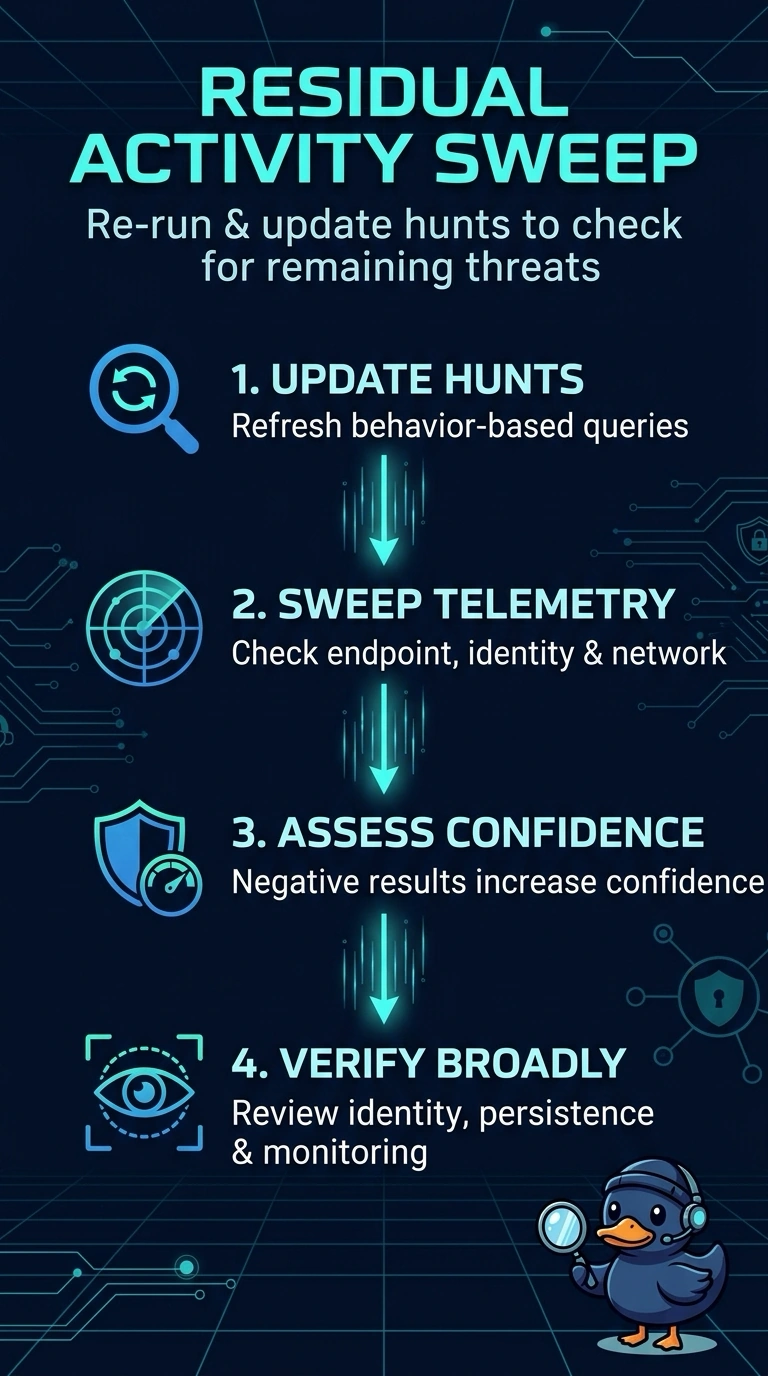
Before closing an intrusion case, you should re-run and update hunts across relevant telemetry to check for residual activity. Negative queries increase confidence within their coverage; combine them with root-cause, identity, persistence, and continued-monitoring checks. Adversaries frequently establish secondary persistence on adjacent hosts or re-authenticate using previously harvested tokens, so post-remediation sweeping is needed to look for hidden footholds that survived cleanup. Choosing to close the ticket immediately once the initial scheduled task file is deleted from disk risks leaving undiscovered backdoors or lateral implants active elsewhere on the network. Deciding to disable all endpoint telemetry agents temporarily to confirm no alerts fire overnight destroys visibility rather than verifying eradication. Likewise, choosing to rely solely on the original perimeter firewall rule without checking internal hosts misses internal east-west persistence and alternative egress paths. As a caveat, if the adversary altered their tooling or command syntax during the incident, update the hunt queries to cover behavioral patterns rather than only the first-seen artifact. As an operational check, execute the updated hunt queries across endpoint, identity, and network telemetry after containment and document the clean sweep results in the incident closure record.