
During a post-incident investigation, a threat hunter examines a recovered Linux binary whose symbol table has been stripped, leaving no internal function names. Which reverse engineering approach best helps the hunter reconstruct the binary's behavior?
Select an answer to reveal the explanation.
Short Explanation
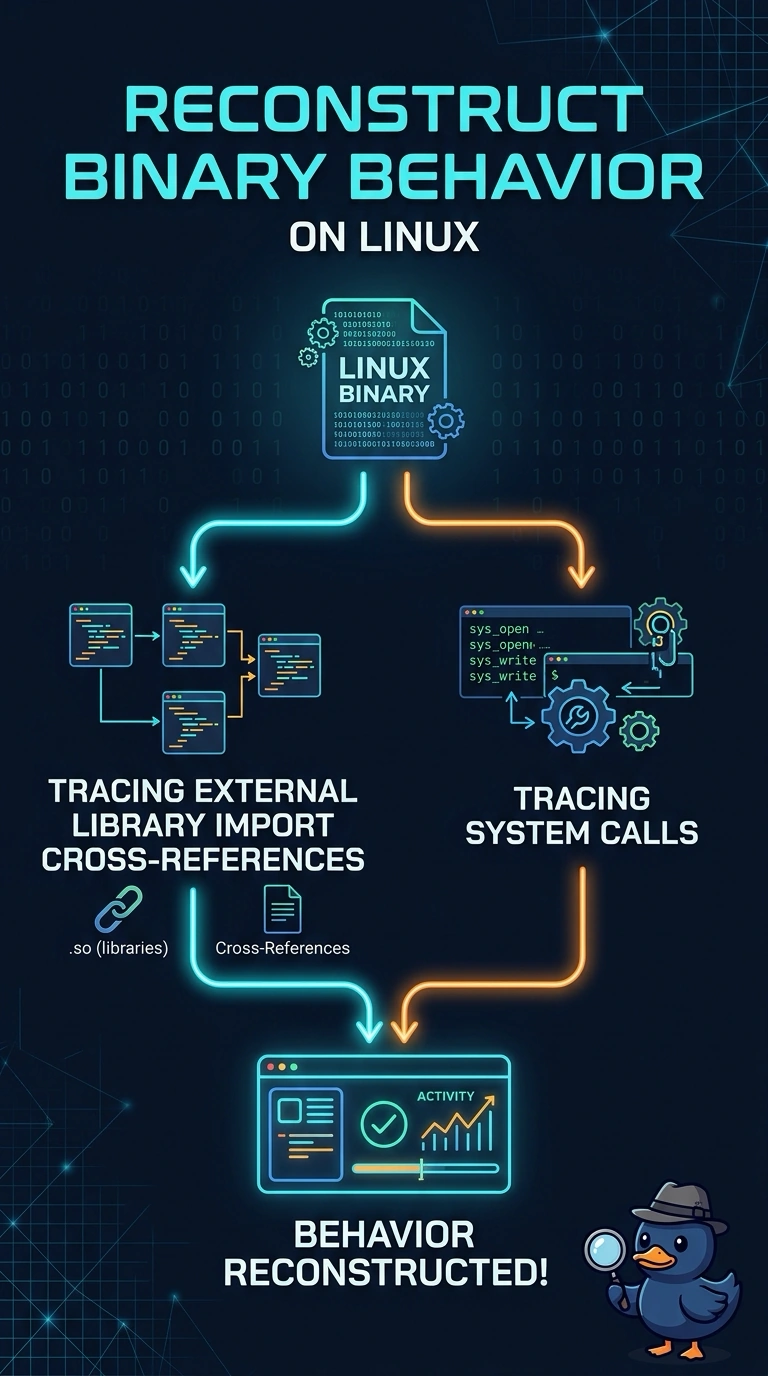
Think of a stripped binary like a city map with the street names erased: you can still follow the highways between major landmarks. By tracing external library imports and system calls, you can see how the program interacts with the operating system and reconstruct its behavior.
Full Explanation
Stripping removes local symbol tables and debugging metadata to shrink a binary and hinder analysis, but the program still needs the operating system to perform useful work. Tracing external library import cross-references and system calls reveals actions such as allocating memory, opening files, or initiating network connections, giving you visible anchor points for reconstructing functional flow. Restoring original source variable names from the ELF section header fails because compilation and stripping discard local variable identifiers that are unnecessary for execution. Converting compiled machine instructions back into uncompiled comments is not possible: developer comments are removed during preprocessing and never enter the compiled binary. Querying the host package manager to verify missing debug symbols does not itself reveal behavior, and you must establish the binary’s provenance first; separate debug files or debuginfod may restore symbols for known builds, but a custom sample may have none available. One caveat is that attackers may obfuscate or dynamically resolve imports, so static cross-referencing may need controlled dynamic tracing. As a practical check, inspect the binary’s dynamic linking section and run a controlled system-call trace in an isolated sandbox to confirm its observed capabilities.