
During a threat hunt at a logistics firm, an analyst inspects a volatile memory image from a workstation suspected of running a hollowed system process. Which memory artifact most reliably indicates that a legitimate process has been hollowed?
Select an answer to reveal the explanation.
Short Explanation
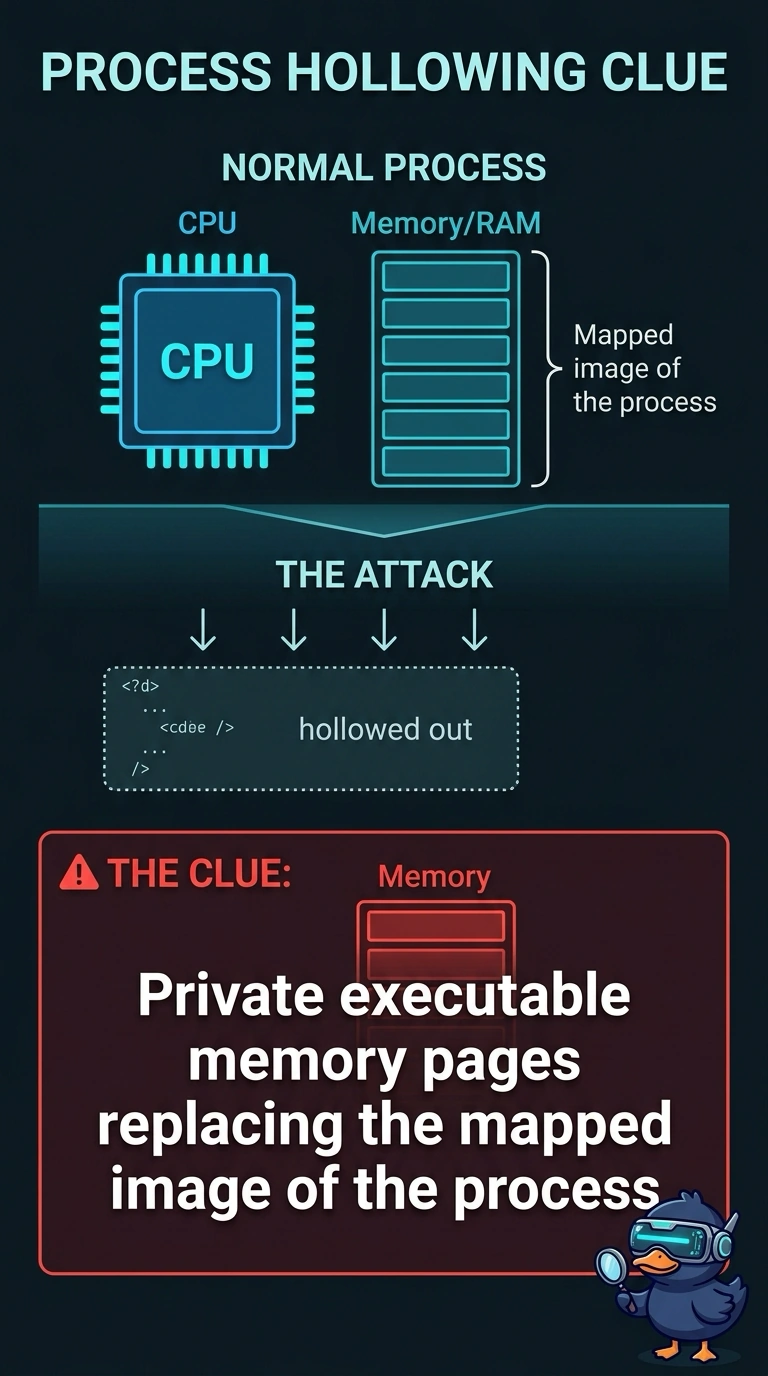
Think of process hollowing like swapping the engine inside a parked delivery truck while keeping the outer logo intact. When you hunt in volatile memory, you look for private executable memory pages replacing the mapped image of the process rather than trusting its clean on-disk reputation. The trap is assuming a signed binary on disk guarantees the code running in RAM is still legitimate.
Full Explanation
Process hollowing starts a legitimate process in a suspended state, unmaps its original executable image from memory, and writes malicious code into its address space before resuming execution. An unexpected private executable region replacing the original image is a hollowing lead; the final protection can be RX rather than RWX. Compare VADs, image mappings, headers, and thread context because private executable pages alone are not proof. By contrast, A standard system executable running with a verified digital signature on disk is expected during hollowing and actually helps the adversary blend in while the malicious payload lives only in RAM. Similarly, A high count of open file handles pointing to temporary user directories may indicate staging or noisy application I/O, but it does not prove that a process's in-memory code image was replaced. Multiple child shells spawned directly from a scheduled task service point toward persistence or suspicious execution chains rather than in-memory image replacement. As a caveat, some legitimate just-in-time compilers and runtime engines allocate private executable memory, so analysts must correlate allocation flags with missing file-backed mappings. For an operational check, inspect the process's virtual address descriptors and compare in-memory headers against the corresponding executable on disk.