
During a threat hunt, analysts confirm that an attacker installed a persistent kernel-level rootkit on an internal Linux file server. Which remediation step is most appropriate to ensure the server is trustworthy before returning it to production?
Select an answer to reveal the explanation.
Short Explanation
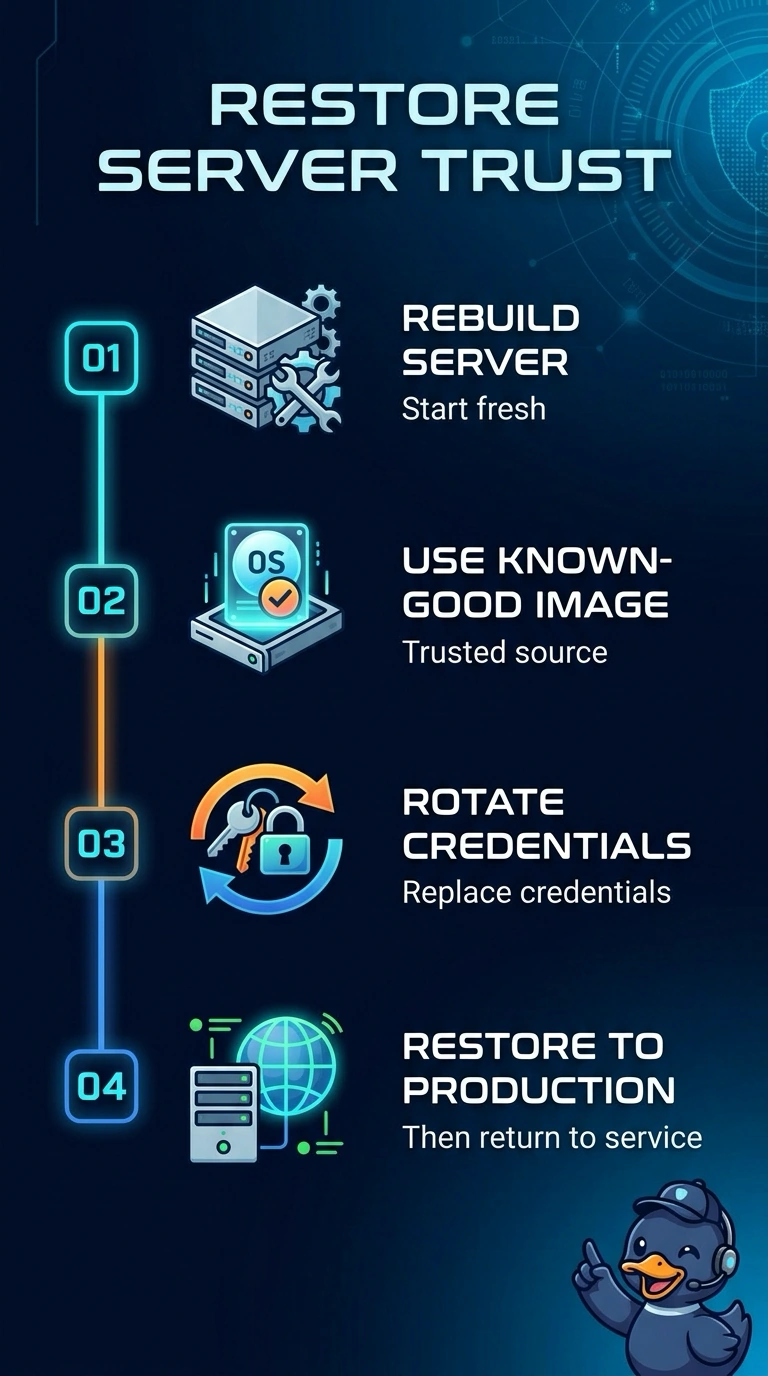
When an attacker compromises the kernel, you can’t restore trust by patching just one visible crack. Deleting the suspicious module may leave hidden backdoors behind, so you need a clean rebuild and rotated credentials before returning the server to production.
Full Explanation
Rebuilding the server from a known-good image and rotating its credentials is the reliable way to restore trust after kernel-level compromise. A kernel rootkit runs with the highest privileges and can tamper with system binaries, bootloaders, and integrity checks, so the compromised system cannot be trusted to reveal or remove all changes. Deleting the suspicious kernel module file and restarting the file-sharing daemon can leave hidden hooks, modified system libraries, and secondary persistence mechanisms in memory or on disk. Blocking the external command-and-control IP address at the perimeter firewall only interrupts contact with one destination; the infected host can still pivot internally or use backup channels. Running an updated user-space antivirus scan and clearing authentication logs is also inadequate: the rootkit can intercept user-space queries to conceal itself, and clearing logs destroys forensic evidence. As a caveat, capture volatile memory and disk images for investigation before wiping the server, and verify that backup data restored to the rebuilt host is clean. As a practical check, confirm that the rebuilt host matches hardened baseline hashes and that all service and local account passwords have been rotated.