
A threat hunting team wants to verify whether newly deployed endpoint detection rules actually trigger on specific credential-access techniques before an adversary exploits a blind spot. Which process step best validates this coverage?
Select an answer to reveal the explanation.
Short Explanation
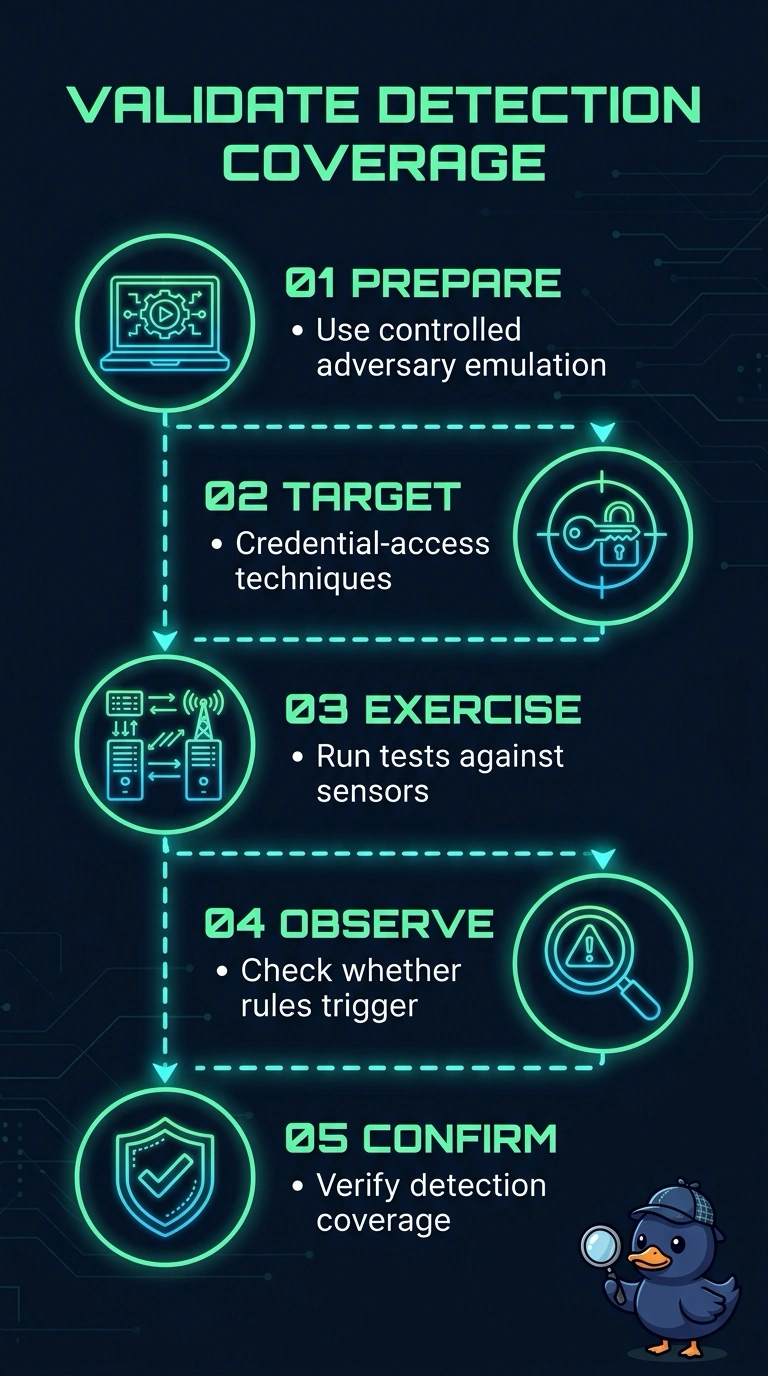
You can confirm coverage by running controlled adversary emulation against your sensors and checking whether the credential-access activity triggers the intended detection. A rule saving cleanly is not enough; testing shows whether it works with real telemetry.
Full Explanation
Validating detection engineering closes the gap between theoretical rule logic and real-world telemetry behavior. Executing controlled adversary emulation tests against sensors safely reproduces targeted credential-access behaviors in a monitored test environment, confirming that logs are generated, parsed, and correlated into actionable alerts. Disabling endpoint telemetry agents to reduce alert fatigue removes critical visibility and worsens blind spots rather than verifying coverage. Waiting for an external breach to test SIEM correlation rules leaves the organization exposed to undetected compromise until damage is already done. Archiving historical firewall logs without running any queries neither exercises endpoint sensors nor tests whether current rules fire on live activity. As a caveat, emulation tests must be scoped to isolated or approved systems with clear safety guardrails so they do not disrupt production services or trigger uncoordinated incident responses. As an operational check, review the resulting SIEM alert timestamps and field mappings after each emulation run to confirm end-to-end rule fidelity.